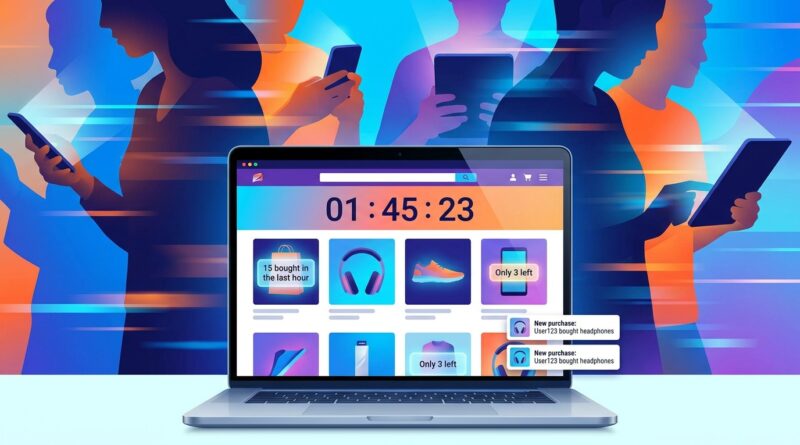
The ‘Social-Proof Flash’ Strategy: Turn One Live Counter Into A Stampede Of Buyers
You cut the price. You turn on the ads. People click, browse, even add to cart. Then they stall. It is frustrating because the offer looks good on paper, but the checkout still feels weirdly empty. That is the real problem with many flash sales now. Shoppers do not just want a deal. They want proof that other people are jumping in too. A quiet sale feels risky, even when the discount is real.
That is where an ecommerce flash sale social proof strategy can change the mood fast. One live counter, a real-time “just purchased” streak, or an inventory band that says “18 left at this price” can make the same sale feel busy, trusted, and worth acting on now. In 2026, urgency by itself is easy to ignore. Urgency plus visible proof is what gets fence-sitters moving, without forcing you into steeper discounts or bigger ad bills.
⚡ In a Hurry? Key Takeaways
- Use urgency and proof together. A flash sale converts better when shoppers can see that other people are buying right now.
- Start with one honest live signal, like a purchase counter, low-stock band, or “recently bought” feed on your best-selling items.
- Keep it real. Fake scarcity and made-up counters might boost clicks for a day, but they damage trust and hurt repeat sales.
Why shoppers freeze during flash sales
Most store owners assume hesitation means the discount is not big enough. Sometimes that is true. Often, it is not.
People use other people as a shortcut. If they see buyers moving, they feel safer. If they see a dead-looking product page, they start asking silent questions. Is this a good pick? Is this brand legit? Am I about to make a dumb impulse buy?
That is why a busy restaurant gets a line and the empty one next door struggles, even if the food is just as good. Online shopping works the same way.
What the social-proof flash strategy actually is
The idea is simple. You take the natural urgency of a flash sale and pair it with visible signs that the sale is active, trusted, and already in motion.
Instead of saying only “Sale ends in 2 hours,” you also show signals like:
- “24 bought in the last hour”
- “7 orders in the last 10 minutes”
- “Only 12 left at this price”
- “Flash sale pick” badges on fast movers
- Customer share badges like “I grabbed mine” during the sale window
The goal is not to shout louder. It is to remove the fear of being the first buyer.
Start with one live counter, not ten widgets
This is where a lot of brands get messy. They throw in pop-ups, countdowns, spinning wheels, chat nags, sticky bars, and fake stock warnings all at once. The page starts to feel like a carnival.
Start smaller.
The best first test
If you can only add one thing, use a live purchase signal on your sale hero product or collection page. Keep it close to the add-to-cart button or price.
Good examples:
- “39 sold since this flash sale started”
- “11 people checked out this item in the last hour”
- “Trending in today’s flash sale”
That one signal can do a lot of heavy lifting because it answers the shopper’s quiet question. “Are other people actually buying this?”
The three proof layers that work best in 2026
1. Live purchase streaks
This is your crowd effect. It shows motion.
When a shopper sees that orders are happening now, the sale feels alive. That matters because flash sales are everywhere now. People have learned to tune out generic countdowns. They have not tuned out fresh proof.
Keep the wording plain and believable. “8 purchased in the last 30 minutes” works better than “This item is exploding!!!”
2. “Almost gone” inventory bands
This is your scarcity effect. It shows that delay has a cost.
Inventory messages work best when they are specific and tied to a version of the product the shopper is considering. Size, color, bundle, or sale allocation all make sense.
Examples:
- “Only 9 left in Medium at flash price”
- “Final 14 units in today’s sale batch”
- “Black version nearly gone”
Notice the difference. These feel informative, not dramatic.
3. Social-friendly haul badges
This is your amplification effect. It helps customers spread the sale for you.
After checkout, give buyers an easy way to share what they got. It can be a simple badge, image, or one-tap story card that says something like “Snagged it in the flash sale” or “Got the deal before it sold out.”
This does two things. It creates more proof outside your site, and it makes the sale feel like an event, not just another coupon.
How to place social proof without annoying people
Placement matters as much as the message.
Best spots
- Near the product price
- Directly above the add-to-cart button
- On collection cards for top flash-sale items
- In the cart drawer, especially for low-stock reminders
Places to be careful
- Full-screen pop-ups the second someone lands
- Repeating notifications that cover mobile buttons
- Contradictory messages like “5 left” on one page and “22 sold in the last minute” on another
If your proof feels noisy or suspicious, it stops helping.
What honest social proof looks like
This part is important. Social proof only works long term if people trust it.
Use real data where possible. If you are showing purchases, base it on actual orders. If you are showing inventory, tie it to real stock or a clearly defined sale allocation. If you are showing “popular right now” tags, make sure they reflect real page views or conversion activity.
Customers are much better at spotting fake urgency than many brands think.
Good practice
- Round numbers when needed, but stay truthful
- Refresh counters at a reasonable pace
- Use labels like “sale allocation” if that is what the number means
Bad practice
- Resetting fake low-stock warnings every visit
- Showing impossible order volume for a tiny store
- Inventing customer names and locations in purchase pop-ups
How this helps you avoid deeper discounts
Here is the big win. When your sale feels active and trusted, you do not need to slash prices as hard to get movement.
That matters because many brands accidentally train shoppers to wait. If every weak sale gets rescued with a bigger markdown, customers learn patience pays.
An ecommerce flash sale social proof strategy changes that pattern. It makes each sale feel uniquely time-sensitive and socially validated. The reason to buy now is not just “it is cheaper.” It is also “people are buying now and this version may not last.”
A simple rollout plan for your next flash sale
Step 1. Pick one product group
Do not test this across your whole site first. Choose 3 to 5 products that already get decent traffic during sales.
Step 2. Add one proof signal
Use either a live purchase counter or an inventory band. Not both at first if your team is small.
Step 3. Match the message to the sale window
If your sale is 2 hours, use “bought in the last hour” or “sold since sale started.” If your sale is all weekend, stretch the phrasing to fit.
Step 4. Add a share moment after purchase
A simple thank-you page badge or social share card is enough for a first test.
Step 5. Measure the right numbers
Watch:
- Add-to-cart rate
- Checkout start rate
- Conversion rate on product pages with proof vs without
- Average discount needed to hit your target revenue
When this works especially well
This strategy is extra useful if you already have traffic, but sales still lag. Maybe your ads are doing their job. Maybe email is driving clicks. Maybe you got a surprise burst from social.
In those moments, proof becomes the nudge that turns attention into action. If your problem is sudden traffic spikes, it is also worth reading The ‘Traffic-Surge Flash’ Strategy: Turn One Viral Moment Into A 90‑Minute Sellout Window. It pairs nicely with this approach because traffic surges and social proof are a strong mix. One brings the crowd in. The other shows the crowd that buying has already started.
Common mistakes to avoid
Using proof on everything
If every product is “hot,” nothing is. Save your strongest proof for the items you actually want to move.
Making the page feel desperate
Too many alerts can make shoppers slow down instead of speed up. Keep the experience clean.
Forgetting mobile shoppers
Your proof signals need to be easy to read on a phone. If they push the add-to-cart button off screen, fix that first.
Not updating creative during the sale
If an item starts moving fast, promote that fact. “Best seller of this flash” is a useful mid-sale update.
At a Glance: Comparison
| Feature/Aspect | Details | Verdict |
|---|---|---|
| Urgency alone | Countdown timers and discount end times create pressure, but many shoppers now ignore them because they see them everywhere. | Useful, but weaker on its own in 2026. |
| Urgency plus live proof | Adds real-time buying signals, low-stock bands, and “popular now” cues that make the sale feel active and trusted. | Best option for lifting conversion without deeper discounts. |
| Fake scarcity tactics | Can create short-term clicks, but shoppers often spot the trick and lose trust in the brand. | Avoid. Short gain, long-term damage. |
Conclusion
Flash sales are crowded now, so urgency alone is no longer enough. What is working in 2026 is stacking urgency with proof. Live purchase streaks, “almost gone” inventory bands, and social-friendly badges that help customers share their haul during the sale window can turn a quiet offer into one that feels busy, safe, and worth acting on. The nice part is you do not need deeper discounts or more ad spend to test this. You can start with one honest signal on the traffic you already have. Done well, this helps more shoppers buy now, and it helps you stop teaching your audience to wait for an even bigger sale next time.