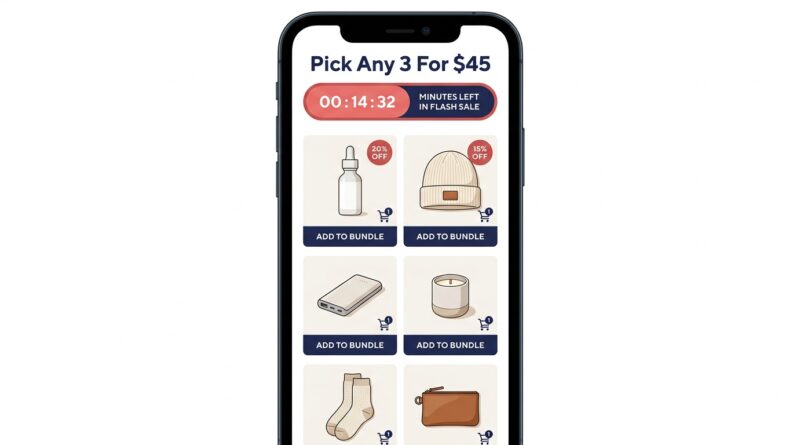
The ‘Mix‑Match Flash’ Strategy: Turn One Simple Bundle Grid Into Sky‑High AOV In Your Next Sale
You know the feeling. You run a flash sale, traffic jumps, orders come in, and then you look at the numbers and realize most people bought exactly one discounted item and left. Sales look busy. Profit does not. That is the trap with a basic percentage-off promo. It gets attention, but it does not give shoppers a reason to build a basket. A better fix is a simple ecommerce mix and match flash sale strategy. Instead of marking down everything and hoping for bigger carts, you group a tight set of products in one clean bundle grid and reward shoppers for picking two or three items together. It feels more premium, more fun, and more controlled on your side. Better yet, it lines up with what platforms like TikTok Shop are pushing right now. Structured offers like Buy More Save More and Mix and Match are getting more support because they increase basket size without turning your store into a bargain bin.
⚡ In a Hurry? Key Takeaways
- A mix and match flash sale works best when shoppers choose 2 or 3 related items from one curated grid, instead of getting a blanket discount on the whole site.
- Start with products that naturally go together, then set clear price breaks like “Any 2 for $X” and “Any 3 for $Y” so the jump to a bigger basket feels obvious.
- Keep the flash short and controlled, usually 6 to 24 hours, so urgency stays high and your margins do not get chipped away for days.
Why ordinary flash sales stall out
Most flash sales are built for clicks, not cart size.
A shopper sees 20 percent off one product they already wanted. Great. They buy that one thing, check out, and move on. You got the sale, but you did not change buying behavior. Your average order value barely budged.
That is why this ecommerce mix and match flash sale strategy matters. It gives people a reason to add one more item, then one more after that. Not because you nagged them with popups, but because the offer itself makes sense.
What the Mix-Match Flash strategy actually is
Think of it as a choose-your-own bundle.
You create one product grid with a small, curated group of items. Then you set simple pricing tiers such as:
- Pick any 2 for $45
- Pick any 3 for $60
The customer gets freedom. You keep control.
This is what makes it better than a messy clearance promo. The offer feels intentional. It says, “Build your own set,” not, “Please help us get rid of random inventory.”
Why this works better for AOV
It changes the shopper’s math
With a normal sale, the customer asks, “Do I want this item?”
With a mix and match sale, they ask, “Which second or third item should I add so I get the better deal?”
That is a much better question for your business.
It feels premium, not cheap
People like choice. They also like feeling smart. A good mix and match setup gives them both. They are not digging through leftovers. They are building a personalized bundle.
It keeps your discount focused
You are not slashing every margin on your store. You are putting the promo around selected products that can handle it.
Which products to put in the grid
This is where most stores either win or ruin the idea.
Do not throw unrelated products into one bundle just because you want to move them. Group items that make sense together in the shopper’s mind.
Good product groups
- Beauty. Lip oils, blush sticks, mini skincare, sheet masks
- Apparel. Tees, tanks, socks, hats
- Food and drink. Snack flavors, coffee bags, sauces, mixers
- Home. Candles, hand soaps, kitchen towels, room sprays
- Supplements. Daily essentials, travel packs, functional add-ons
What these products should have in common
- Similar margin profile
- Easy to understand at a glance
- Light enough to ship together without surprise costs
- Broad enough appeal that shoppers can find 2 or 3 they actually want
A simple rule helps here. If a shopper can explain the bundle in one sentence, you are on the right track.
For example, “Pick any 3 self-care treats.” Clear. Easy. Worth clicking.
How to set the 2-item and 3-item price points
This part matters more than the graphics, the email subject line, or the countdown timer.
If the math feels fuzzy, people stall. If it feels obvious, they add more.
Start with your regular prices
Let’s say most items in your grid sell for $18 each.
- 1 item normally = $18
- 2 items normally = $36
- 3 items normally = $54
Now make the step-up clear enough to matter:
- Any 2 for $32
- Any 3 for $45
That way, the shopper sees a real reward for building the bundle.
Three pricing rules that keep this healthy
- Make the 3-item tier noticeably better than the 2-item tier on a per-item basis.
- Do not make the 2-item tier so weak that nobody bites.
- Check landed margin after discounts, shipping, packaging, and payment fees.
If you cannot profit on the third item, swap the grid products before you launch the sale.
How long the flash should run
Shorter is usually better.
For most brands, 6 to 24 hours is the sweet spot. Long enough for people to see it. Short enough to feel urgent.
If you stretch it across three or four days, the “flash” feeling disappears. People start thinking they can come back later. Later often means never.
If you want to go even tighter, pair this with a compressed paid traffic window like the one discussed in The ‘Super-Burst Flash’ Strategy: Turn 3‑Hour Ad Windows Into A Sellout Without Torching Your List. That approach works especially well if your audience responds fast and your offer is easy to understand in one glance.
How to lay out the bundle grid on your site
Keep it clean. This is not the moment for a complicated landing page.
Your grid should include
- A short headline
- A one-line explanation of the deal
- The selected products only
- Visible price tiers for 2 and 3 items
- A timer, if your platform supports it
- A clear call to action
Good headline example: “Build Your Own Cozy Set”
Good explainer example: “Pick any 2 for $34 or any 3 for $48. Today only.”
The big idea is simple. Remove mental friction. Your shopper should understand the offer in under five seconds.
Where to promote it
Promotion matters, but message match matters more.
Best channels for this kind of flash
- Email. Great for loyal buyers who already trust your products
- SMS. Best for short urgency-driven reminders
- TikTok Shop and short-form video. Ideal for showing how shoppers can mix their own bundle
- Site homepage hero and announcement bar. Important for catching existing traffic
- Retargeting ads. Strong for people who viewed one product but did not convert
What to say in the promo
Do not lead with “huge discounts.” Lead with choice and outcome.
Examples:
- Pick your own 3-piece routine
- Build your snack box tonight only
- Choose any 2 favorites and save
That language feels curated. Not desperate.
Common mistakes that kill the strategy
Too many products in the grid
If shoppers have 40 items to choose from, they freeze. Start with 6 to 12 products.
Products that do not belong together
A bundle should tell one story. Random items make the page feel like a clearance table.
Weak pricing jumps
If buying three only saves an extra dollar or two, many people will stop at two. The third item needs a real nudge.
No inventory planning
If one hero product sells out in the first hour, the whole grid can lose appeal. Pick substitutes in advance or cap quantities if needed.
Running it too often
If every weekend is a flash sale, it stops feeling special. Use this around key shopping moments, product pushes, or inventory windows where basket-building really counts.
A simple template you can use next
If you want a practical starting point, use this framework:
Step 1: Choose one theme
Examples: travel minis, winter layers, workout add-ons, coffee bar favorites.
Step 2: Pick 6 to 10 products
Keep prices fairly close together so the deal feels balanced.
Step 3: Set two deal tiers
Example: Any 2 for $40. Any 3 for $54.
Step 4: Run it for 12 hours
Long enough for email, SMS, and social to do their job. Short enough to keep urgency.
Step 5: Promote it in three waves
- Launch email and homepage update
- Mid-sale SMS reminder
- Last-chance social post and retargeting push
Step 6: Review the right numbers
- Average order value
- Units per order
- Margin by bundle size
- Best-picked product combinations
Those last numbers are gold. They tell you what future bundles should look like.
At a Glance: Comparison
| Feature/Aspect | Details | Verdict |
|---|---|---|
| Product selection | Use 6 to 12 related items with similar margins and a clear shared theme. | Best practice for a cleaner, higher-converting grid. |
| Price structure | Offer an easy 2-item tier and a stronger 3-item tier that makes adding one more item feel worth it. | Essential if your goal is higher AOV, not just more orders. |
| Flash timing | Run the offer for 6 to 24 hours and promote it in timed bursts across email, SMS, and social. | Strong balance between urgency, visibility, and margin control. |
Conclusion
If your holiday plan is drifting toward a lazy sitewide discount, stop before you flatten your margins for no real gain. A smart ecommerce mix and match flash sale strategy gives shoppers a better reason to buy more without making your brand look cheap. That is why this matters right now. Ecommerce brands are racing into Black Friday and holiday promos, and many are about to repeat the same mistake of broad markdowns that move traffic but do not lift AOV. Meanwhile, TikTok Shop is clearly signaling where things are going with better support for Buy More Save More and Mix and Match style offers. Structured, basket-building deals are getting the attention. Use that. Group the right products, make the two-item and three-item pricing dead simple, keep the flash tight, and promote it where urgency feels natural. Done right, shoppers will feel like they built a premium bundle for themselves, not like they wandered into a digital clearance aisle.