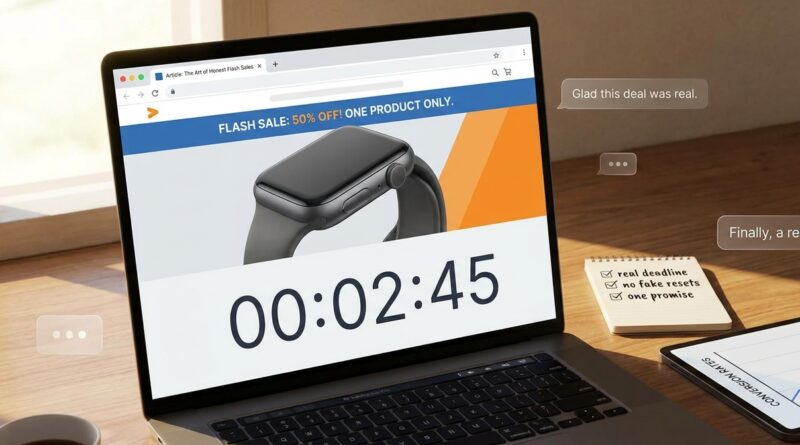
The ‘Truth-Timer Flash’ Strategy: Turn Honest Countdowns Into Trust-Fueled Sellouts
You can feel shoppers rolling their eyes at the timer now. “Ends in 24 hours” has become code for “see you tomorrow with the same deal.” If you run sales, that stings a little, because the point of a countdown is to create urgency, not suspicion. But customers have learned. They have watched clocks reset, “final hours” stretch for days, and “one-time” offers come back every weekend. So they wait. And when they wait, your margins get squeezed and your message loses punch. The fix is simpler than most brands think. Use an honest countdown timer flash sale strategy. One real offer. One clear deadline. No resets. No sneaky extension email ten minutes after it ends. When people believe your clock, they act faster. More importantly, they trust you more the next time too. That is the whole game here. Short-term sales matter, but long-term credibility matters more.
⚡ In a Hurry? Key Takeaways
- A Truth-Timer Flash works best when the countdown is real, visible, and never resets after expiry.
- Use one focused offer and follow it with a cooldown period so customers learn the deal will not instantly return.
- This protects trust and margins, because buyers stop waiting for the same “limited-time” sale to reappear tomorrow.
Why fake urgency stopped working
People are not confused anymore. They are paying attention.
Shoppers now screenshot countdowns. They compare email offers. They notice when your “today only” promotion pops back up the next morning with a fresh clock. That old trick may still create a few impulse buys, but it trains a much larger group of people to stop believing you.
Once that happens, urgency breaks.
Instead of thinking, “I should grab this now,” they think, “I will wait for the next reset.” That is bad for conversion, bad for repeat sales, and bad for your brand voice. It also puts you on a treadmill where every promo has to be louder than the last one.
What a Truth-Timer Flash actually is
A Truth-Timer Flash is a flash sale built around one rule. When the timer ends, the deal ends.
That sounds obvious, but plenty of brands do not follow it.
The basic structure
Keep it tight:
- One product, bundle, or clear category focus
- One start time and one end time
- One visible countdown timer
- No extension after expiry
- No repeat of the exact same offer for a short cooldown period
That last part matters more than most people realize. If the same discount comes back two days later, your timer was technically true, but emotionally false. Buyers still learn that the opportunity was not really rare.
Why this honest countdown timer flash sale strategy works
It works because it swaps fake pressure for believable urgency.
Believable urgency is powerful. People do not need drama. They need clarity. If they know the offer is real, the timer is real, and the brand will not cave after the deadline, they make decisions faster.
You also get cleaner customer behavior:
- Less waiting for “the next version” of the same sale
- Fewer support messages asking for extensions
- Stronger open rates on future promos because people trust your deadlines
- Better margin control because you are not training everyone to buy only on discount
If your sales have started feeling noisy and less effective, this is often the missing piece.
How to set one up without overcomplicating it
1. Pick one offer, not five
The more choices you pile in, the weaker the flash feels. A flash sale should be easy to understand in seconds.
Good examples:
- 25% off one hero product
- Buy one bundle, get a free add-on
- Free expedited shipping on one collection
Not-so-good examples:
- Different discounts across twenty categories
- A coupon that stacks in weird ways
- A sale page that needs a map and flashlight
2. Use a clean, specific timer
Show the exact end time. Include the time zone if your audience is broad. Keep the clock visible on the product page, cart, and sale landing page.
Do not make people guess whether “tonight” means 8 PM, midnight, or whenever your team remembers to switch it off.
3. Say what happens when it ends
Spell it out in plain English: “This price ends at 9 PM Eastern and will not be extended.”
That line does two jobs. First, it removes confusion. Second, it quietly signals confidence. You are telling people your promotion has rules, and you intend to follow them.
4. Actually let it end
This is where the strategy lives or dies.
When the clock hits zero, change the page. Remove the discount. Replace the button text if needed. Archive the promo banner. If someone clicks through from an old email, they should see that the sale has ended.
Yes, a few late buyers will be disappointed. That is the price of credibility. The good news is that the next time you run a timed promotion, more people will believe it.
5. Add a cooldown window
Do not repeat the same offer right away. Give it breathing room.
That cooldown could be a week, two weeks, or longer, depending on your sales rhythm. The point is simple. Customers need to see that missing this sale actually meant missing it.
If you like short, concentrated campaigns, this pairs nicely with The ‘Super-Burst Flash’ Strategy: Turn 3‑Hour Ad Windows Into A Sellout Without Torching Your List. That approach is about compressing attention into a smaller window. A Truth-Timer Flash makes sure the deadline inside that window is believable.
Common mistakes that quietly ruin trust
Resetting the timer for every visitor
This is one of the fastest ways to look slippery. If every shopper gets a “personal” 15-minute countdown that restarts on refresh, they know what is happening.
Use a real campaign timer, not a magic trick.
Sending a “we extended it” email every single time
Once in a true emergency, maybe. As a habit, no.
Frequent extensions tell customers your deadline is optional. Optional deadlines do not create urgency. They create negotiation.
Running the exact same sale every weekend
If Friday through Sunday always brings 20% off, then 20% off is your regular price with extra steps.
That does not just weaken flash sales. It weakens your baseline pricing.
Making the discount the whole story
A strong flash still needs a reason to buy the product itself. Lead with the value. Let the clock support the offer, not replace it.
How to talk about the sale without sounding pushy
The tone matters.
You do not need to yell in all caps. You do not need five red banners and a siren emoji parade. Calm, direct language often converts better because it feels more trustworthy.
Try language like:
- “This offer ends Friday at 8 PM Eastern.”
- “When the timer hits zero, the bundle goes back to regular price.”
- “We are keeping this one simple. No reset, no extension.”
That is confident. It also feels refreshingly adult, which is rare in promo marketing.
What to measure after the sale
Do not judge the campaign only by same-day revenue.
Watch these numbers too
- Conversion rate during the flash window
- Revenue by hour near the deadline
- Email click-to-purchase rate
- Customer support complaints about expired offers
- Repeat buyer response on your next timed promo
If trust is being rebuilt, you will often see a healthier spike near the deadline over time. People learn that your clock means what it says.
Who should use this strategy first
This is especially useful for brands that have already worn out the “limited time” message.
If your audience has become trained to wait for another discount, an honest countdown timer flash sale strategy is one of the cleanest ways to reset expectations. It is also useful if you are trying to protect margins without giving up promotional energy altogether.
You are not stopping sales. You are making them credible again.
At a Glance: Comparison
| Feature/Aspect | Details | Verdict |
|---|---|---|
| Countdown timer | One public timer with a fixed end point that does not restart or extend. | Best for trust and real urgency. |
| Offer structure | A single focused deal is easier to understand and easier to believe. | Keeps conversion high and confusion low. |
| Post-sale behavior | A short cooldown before repeating the same deal teaches customers that expiry is real. | Important for protecting margins and future credibility. |
Conclusion
Customers are openly calling out fake flash deals now, and they should. “24 hour” sales that magically restart have trained buyers to wait, not act. That old playbook is starting to hurt the brands that keep using it. A Truth-Timer Flash gives you a better option. Run one focused offer, show a clean timer that never resets, and follow it with a short cooldown where you do not repeat the same deal. That simple mix restores credibility, protects your pricing, and gets more people to buy inside the window because they finally believe that when your clock hits zero, the opportunity is actually gone.