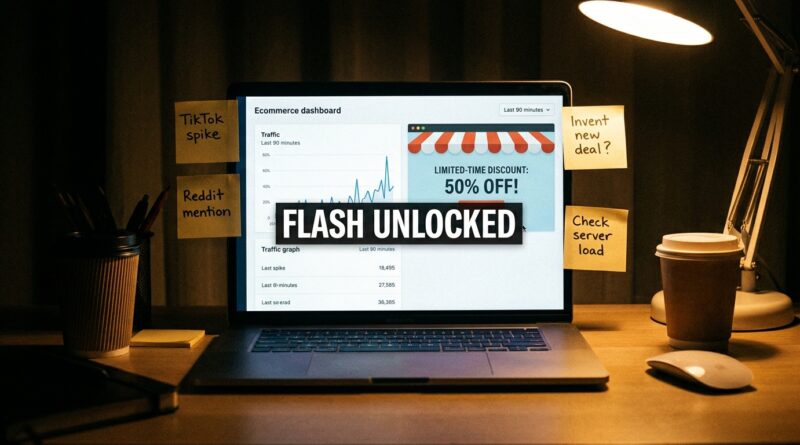
The ‘Traffic-Surge Flash’ Strategy: Turn One Viral Moment Into A 90‑Minute Sellout Window
You finally get the kind of traffic bump you have been hoping for. A TikTok mention lands. A Reddit thread pops off. Some niche blog links your product. You open your dashboard and think, this is it. Then nothing happens. People click around, maybe add something to cart, then disappear. By the time you throw together a coupon or post an Instagram Story, the moment is gone. That is maddening, especially for small shops that cannot afford to waste attention. The fix is simple in theory. Stop planning every promotion by calendar date. Start planning one by live demand. A traffic-surge flash sale is a short, tightly controlled offer that turns on only when a real crowd shows up. It gives you a way to catch buyers while they are warm, without running constant discounts that eat your margin the rest of the week.
⚡ In a Hurry? Key Takeaways
- A good ecommerce flash sale strategy for viral traffic spikes triggers offers when traffic jumps, not just on weekends or holidays.
- Keep the sale short, usually 60 to 90 minutes, and cap inventory so the deal feels real and your profit stays protected.
- Do not discount your whole store by default. Put your best offer on one hero product or a tight bundle and track conversion lift.
Why the usual promo calendar keeps failing
Most small stores still run promotions like it is 2018. Friday sale. Holiday sale. End-of-month sale. That approach assumes attention arrives on a schedule. It does not.
Social traffic is messy. A creator can mention you at 11:17 a.m. A meme page can send 4,000 visitors at midnight. A random blog can create a mini buying frenzy on a Tuesday afternoon.
If your strongest offer is saved for the weekend, you miss the people who are ready right now.
That is the core idea behind a traffic-surge flash sale. You do not show your best deal all the time. You wait for proof that a real crowd has arrived, then open a short window while buying intent is highest.
What the Traffic-Surge Flash strategy actually is
Think of it as a smart trap door.
When traffic crosses a threshold you set, a limited-time offer appears. It might run for 90 minutes. It might apply only to one product, one bundle, or the first 50 orders. Then it shuts off.
This does three useful things at once.
It catches attention while it is fresh
Visitors from TikTok or Reddit are often curious, impulsive, and fast-moving. If they do not see a clear reason to buy now, many will drift away.
It keeps your margins safer
You are not cutting prices all day. You are showing the deal only when traffic volume says there is a real chance to convert more people.
It makes the discount feel real
Shoppers are tired of endless “today only” sales that somehow last two weeks. A short, capped offer feels more honest because it actually ends.
If you want a related angle on this kind of real-time selling, The ‘Signal Flash’ Strategy: Turn Real-Time Traffic Surges Into Instant, Profitable Sales is worth a read. It tackles the same core problem from a live-response point of view.
How to know when to trigger the sale
You do not need a giant data team for this. You just need a simple threshold.
Start with one traffic rule
Pick a number that clearly signals “this is unusual.” For example:
- 3x your normal active visitors
- 100 visitors in 10 minutes from one referral source
- A sudden jump in product page views for one SKU
- A spike in add-to-cart activity without matching purchases
The point is not perfection. The point is speed. You need a rule simple enough to act on fast.
Match the trigger to the traffic source
TikTok traffic behaves differently from Google traffic. Social visitors often need a clearer nudge. Search visitors may already be further down the buying path.
So if the spike is coming from a social post, your offer can be stronger and shorter. If it is coming from a comparison blog, maybe the right move is free shipping or a bonus item instead of a deep price cut.
What to offer during the 90-minute window
This is where a lot of stores overdo it.
You do not need 25 percent off the whole site. In fact, that is often the worst move because it trains regular customers to wait and it slashes margin on products that would have sold anyway.
Best option: one hero product
Pick the item most likely to convert first-time visitors. It should be easy to understand, well reviewed, and priced low enough to feel like a quick decision.
Second-best option: a bundle
Bundles work well because they raise average order value without making the discount look huge. You can offer “best seller plus refill” or “starter kit plus accessory” and still protect profit.
Third option: shipping or bonus upgrade
If your margin is tight, the offer does not have to be a straight price drop. Fast free shipping, a free add-on, or a limited gift can do the job.
The key is clarity. The visitor should understand the deal in two seconds.
Why 90 minutes is the sweet spot
Too short, and people miss it. Too long, and the urgency dies.
Ninety minutes tends to be long enough for a viral wave to spread through shares, comments, and text messages, but short enough to feel like an event.
It also helps your operations. You can watch inventory, answer support questions, and measure results without letting the sale drag into the rest of the day.
Set two limits, not one
Use both a timer and an inventory cap.
- Sale ends in 90 minutes
- Only 40 units at this price
If one limit hits first, the sale ends. That protects your margin and keeps the offer believable.
What the page should look like when the surge hits
This part matters more than many merchants think. If the site still looks like a normal day, the offer loses power.
Add a simple on-site banner
Use plain language. Something like: “Traffic Surge Deal. 18% off for the next 90 minutes. Ends at 2:30 p.m. or when 40 units sell out.”
Put the offer near the add-to-cart button
Do not make people hunt for it. If they came from a fast-moving social post, they are not in the mood to browse your navigation.
Show the cap honestly
If you say only 40 units are available, mean it. Fake scarcity is easy to spot and hard to recover from.
How to avoid racing to the bottom on price
This is the fear behind every flash sale, and it is a fair one.
If you discount too often, customers stop trusting your regular pricing. If you discount too deeply, your viral win turns into a fulfillment headache with thin profit.
Use your strongest offer rarely
Save the best discount for true spikes, not every small traffic bump.
Keep the offer narrow
One product. One bundle. One collection at most.
Build in a floor
Know your minimum acceptable margin before the next spike arrives. That way you are not making emotional choices while your phone is buzzing.
A practical setup you can test this week
You do not need fancy software to start. Here is a simple version.
Step 1: Pick your trigger
Example: if live visitors go above 150, activate the flash deal.
Step 2: Pick one offer
Example: 15% off your best-selling starter item, limited to 30 units.
Step 3: Prepare the assets now
Create the banner, product page text, popup, and checkout code before you need them.
Step 4: Set a runbook
Who turns it on? Who watches stock? Who replies to support questions? Write it down.
Step 5: Review the numbers after each surge
Look at conversion rate, average order value, margin, and how many buyers were new customers.
The goal is not just to “have a sale.” The goal is to turn unpredictable attention into profitable action.
Common mistakes that kill the moment
Waiting too long
If you need 45 minutes to approve the discount, the crowd is already cooling off.
Discounting everything
This feels generous, but it usually creates more chaos than value.
Using confusing rules
If the offer needs three lines of fine print, it is too complicated for a viral moment.
Ignoring mobile
Most of these surges come from phones. Test the whole flow on mobile first.
Forgetting fulfillment
Do not trigger a 90-minute sellout window on an item you cannot pack quickly or restock cleanly.
Who this works best for
This strategy is especially useful for stores with one or more of these traits:
- Frequent social mentions
- Products that demo well on video
- A clear best seller
- Healthy but not huge margins
- Unpredictable traffic from creators, communities, or press
It can work for bigger stores too, but small merchants often benefit the most because every wasted spike hurts more.
At a Glance: Comparison
| Feature/Aspect | Details | Verdict |
|---|---|---|
| Static weekend sale | Runs on a calendar whether traffic is quiet or busy. Easy to plan, but often misses viral buying windows. | Fine for routine promotions, weak for sudden spikes. |
| Traffic-surge flash sale | Activates when live demand jumps. Uses a short timer and limited stock to convert warm visitors fast. | Best choice for social-driven bursts and protecting margin. |
| Sitewide emergency discount | Quick to deploy, but broad discounts can erase profit and train customers to wait for coupons. | Use sparingly, if at all. |
Conclusion
Right now, social-driven traffic is spiky, unpredictable, and often wasted because too many shops still schedule offers by date instead of by live demand. A traffic-surge flash sale gives small merchants a smarter option. You show your strongest, tightly capped offer only when a genuine crowd shows up, keep it off during quiet hours, and protect margins by limiting both time and inventory. That is the real win here. Not fake urgency. Not endless sitewide sales. Just a practical ecommerce flash sale strategy for viral traffic spikes that fits how people actually shop now. For The Deal readers who care about real discounts, that means fewer hollow promos and more short windows where the price is genuinely hard to beat. Better yet, this is something you can set up and test before your next lucky break turns into a missed chance.