The ‘Honest Scarcity Flash’ Strategy: Use Real Stock Limits To Boost Sales Without Killing Trust
People can smell fake urgency now. They have seen the countdown timer that restarts tomorrow. They have seen “only 3 left” on a product that somehow still has 3 left next week. And once shoppers think you are playing games, the discount stops feeling exciting and starts feeling suspicious. That is the real problem with a sloppy ecommerce flash sale scarcity strategy. It may lift clicks for a minute, but it chips away at trust, and trust is much harder to win back than a cart sale. The better move is simple. Use real limits. Show a verified stock number. Set a clear discount cap. End the sale when you said it would end, even if you are tempted to stretch it. That kind of honesty stands out because so many stores refuse to do it. It can still create urgency, but without making your brand look cheap or sneaky.
⚡ In a Hurry? Key Takeaways
- Use scarcity only when it is real. A fixed stock number and a firm end time work better long term than fake urgency.
- Tell shoppers exactly what is limited, how many units are available, and when the sale ends. Then stick to it.
- Honest scarcity protects trust, cuts down on buyer regret and cancellations, and helps your next flash sale perform better.
Why fake scarcity is backfiring
Scarcity still works. That part has not changed. If people know a deal is limited, they are more likely to act now instead of saying, “I’ll come back later,” and never returning.
What has changed is the customer’s radar. Shoppers are better at spotting fake pressure than they were a few years ago. They have learned the patterns. Endless timers. “Selling fast” labels with no proof. Stock warnings that never change. Once they catch one of those signals, the whole sale starts to feel less believable.
That hurts more than most store owners realize. It does not just lower that one conversion. It can lower open rates, repeat visits, and the odds that customers trust your next promotion.
What the Honest Scarcity Flash strategy actually is
The idea is straightforward. If you are going to run a flash sale, tie it to a real limit and show that limit clearly.
Use a real stock cap
Instead of saying “limited quantities” in a vague way, say something concrete like “120 units available at this price.” That number should come from actual inventory you have set aside for the event.
Use a real time limit
If the sale ends at 9 p.m. Friday, it ends at 9 p.m. Friday. No quiet extension. No “popular demand” relaunch five minutes later.
Use a capped discount
Pick the offer in advance and keep it fixed. If the promise is 25 percent off the first 120 units, do not turn it into 25 percent off all weekend just because sales started slower than hoped.
This is the core of a healthy ecommerce flash sale scarcity strategy. The urgency is still there. The difference is that it is believable.
Why honesty can lift conversions, not lower them
Some sellers worry that removing the tricks will make the sale feel less urgent. Usually, the opposite happens.
When buyers believe the limit is real, they do not waste mental energy trying to decode whether you are bluffing. They can make a decision faster. “Do I want this before it is gone?” is a much easier question than “Is this store messing with me?”
That matters because doubt is a conversion killer. Suspicion slows people down. It increases cart abandonment. It also increases buyer remorse, which can mean more cancellations and returns later.
Honest scarcity sends a useful signal. It tells shoppers your store is not trying to corner them with cheap tricks. For a lot of customers, that makes the offer feel safer.
How to set up a trustworthy flash sale
1. Reserve the inventory before the sale starts
Do not guess. Decide how many units are part of the flash sale and lock that number in. If you have 900 units total, maybe only 150 are part of the event. That gives you a clean number you can stand behind.
2. Explain the rule in plain English
Keep the wording simple. Try something like: “This flash sale covers 150 units only. When they are sold, the offer ends.”
No marketing gymnastics needed. Plain language is your friend here.
3. Show progress without being theatrical
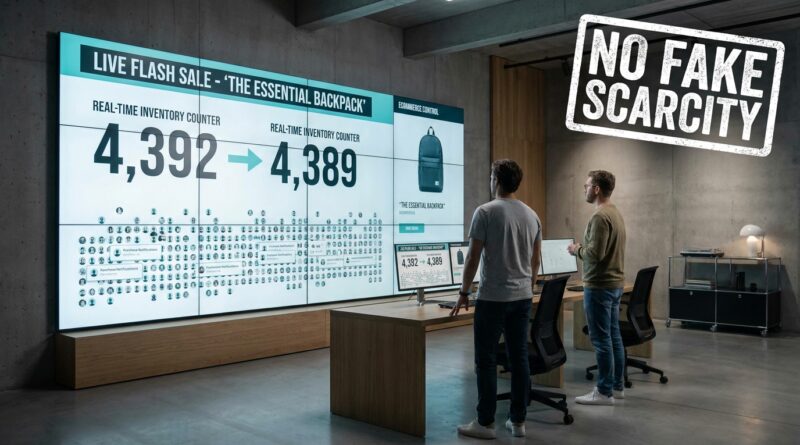
A live inventory count can work if it is accurate. So can milestone updates like “87 of 150 claimed.” What you want to avoid is cartoonish pressure. No flashing red warnings. No fake social proof popups every ten seconds.
4. Keep the timer honest
If you use a timer, connect it to the actual end time. Once it hits zero, the deal should end. This seems obvious, but it is where a lot of stores wreck credibility.
5. Say what happens after the sale
Tell people what the normal price will be once the flash ends. That gives the deadline context and makes the offer easier to judge.
What to say on the product page, email, and checkout
You do not need a dramatic copywriter voice. You need clarity.
Good examples
“Flash offer: 20% off the next 100 units. Ends Friday at 8 p.m. or when stock runs out.”
“We reserved 75 units for this event. After that, this item returns to its regular price.”
“No extensions. No restarts. Just a short, limited run.”
What to avoid
“Act now before it’s too late.”
“Once-in-a-lifetime,” when you run the same sale every month.
“Only 2 left,” if that number is not truly tied to available sale inventory.
Where many stores get this wrong
The biggest mistake is mixing a real sale with fake signals. For example, the stock cap may be real, but then the timer resets the next day. Or the sale ends, but the same discount quietly reappears in a popup for “selected customers.” That muddies the message.
The second big mistake is making the event too common. If every week is a flash week, nothing feels special. Scarcity works best when it is used with restraint.
This is also where prep matters. If your audience is cold, a truthful flash sale can still underperform because people were not paying attention in the first place. That is why it helps to warm interested shoppers before launch. A smart companion read is The ‘Warm-List Flash’ Strategy: Turn Quiet Browsers Into Buyers Before Your Sale Even Starts. It is a good reminder that urgency works better when the right people are ready for it.
How to measure whether your honest approach is working
Do not judge success by revenue alone. Watch the quality of the sale too.
Metrics worth tracking
Conversion rate during the event.
Cart abandonment rate.
Cancellation rate after purchase.
Refund rate and return rate.
Email open rate and click rate on future promotions.
Repeat purchase behavior from flash sale buyers.
If your honest scarcity setup brings slightly lower top-line sales on day one but better repeat business and fewer headaches after the sale, that is usually a win.
Who should use this strategy
This works especially well for brands that want to look dependable, not gimmicky. Think specialty goods, premium basics, limited runs, seasonal drops, handmade products, and any store trying to build repeat trust.
It is less useful if your stock data is messy or if your fulfillment process cannot keep up. In that case, fix the back end first. You cannot claim “real limits” if your inventory system is guessing.
At a Glance: Comparison
| Feature/Aspect | Details | Verdict |
|---|---|---|
| Stock limit | Use a fixed, verified number of units reserved for the sale. | Best for trust and believable urgency. |
| Countdown timer | Works only if it ends once and does not reset or quietly extend. | Useful, but only when fully honest. |
| Discount policy | Set a capped offer in advance and do not stretch it after the deadline. | Strong signal that your brand means what it says. |
Conclusion
Flash sales are not the problem. Fake flash sales are. Right now, promotions are everywhere, and shoppers are more suspicious than ever. Fresh research keeps pointing to the same basic truth: when customers feel a brand is insincere about scarcity, their willingness to buy drops, even when the deal itself is good. So if you want an ecommerce flash sale scarcity strategy that helps now and later, keep it real. Commit to a one-time, verified stock number. Set a discount cap that never quietly stretches. End the event when you said you would. That gives people something rare online, a reason to believe you. And that belief can turn into better conversion, fewer cancellations, and a customer base that actually pays attention the next time you run a flash.