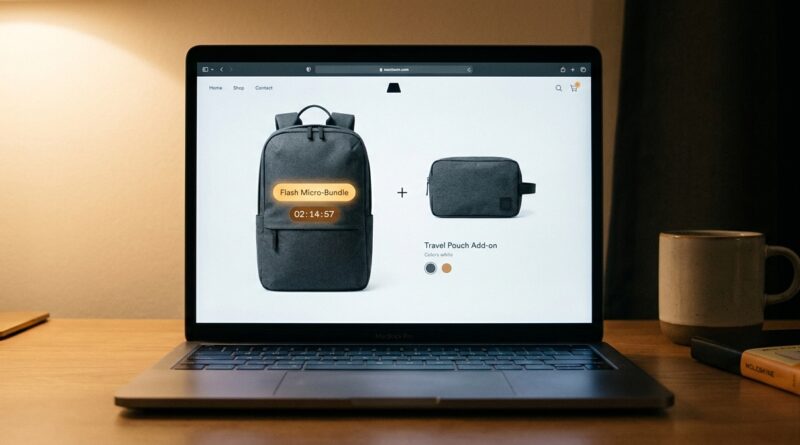
The ‘Micro-Bundle Flash’ Strategy: Turn One Smart Pairing Into Higher AOV Without Deeper Discounts
You know the feeling. You build a flash sale around your best product, traffic spikes, orders come in, and then you look closer. Most shoppers bought only the headline item. Your revenue looks decent, but your margins took a beating because the discount did all the work. That is the trap a lot of brands fall into with an ecommerce flash sale product bundling strategy. They either discount harder or throw up a messy sitewide bundle that feels pushy and confusing.
A better move is smaller and smarter. Instead of asking shoppers to sort through a pile of add-ons, you pair your hero product with one obvious sidekick and present it as a quick, limited-time upgrade. Think phone case plus screen protector. Coffee maker plus filters. Serum plus moisturizer. One pairing. One story. One cleaner choice. This is the micro-bundle flash strategy, and it works because it meets buyers right when they are already ready to say yes.
⚡ In a Hurry? Key Takeaways
- Use one tightly matched add-on with your best seller during a flash sale instead of broad bundles or deeper discounts.
- Put the micro-bundle on the product page, cart, or buy box with a simple “complete the set” message and a small bonus.
- This approach can lift average order value while protecting margin, as long as the add-on feels genuinely useful and not forced.
What the micro-bundle flash strategy actually is
A micro-bundle is not a giant package deal. It is a very small, very intentional pairing.
You take one hero item, usually the product already driving most of your flash sale clicks, and match it with one complementary item that makes immediate sense. Then you present the two together as a limited-time offer.
The key is restraint. Not three add-ons. Not “customers also bought” chaos. Just one smart pairing.
Why this works better than discounting the hero item alone
When shoppers land on a flash sale page, they are in decision mode. Fast. If they already want the main product, your job is not to distract them. Your job is to make the next best step feel easy.
A well-built micro-bundle does three things at once:
- Raises average order value without needing a much bigger discount
- Makes the purchase feel more complete
- Keeps the page cleaner than a broad bundle system
That last part matters more than people think. Too many offers can make a shopper pause. Pausing is dangerous in a flash sale. The second they start thinking, “Do I need this? What about that?” you lose momentum.
Why sitewide bundles often flop
On paper, sitewide bundles sound clever. In practice, they often feel like walking into a store where every shelf has a sticker screaming “buy more.”
That can hurt user experience fast.
Shoppers came for one item. Instead, they get a stack of bundle suggestions, progress bars, mix-and-match widgets, and coupon rules they need to decode. It starts to feel like work.
And if the extras do not feel tightly connected to the item they actually want, the bundle reads like a margin-saving trick. Customers are good at spotting that.
The big difference between a bundle and a micro-bundle
A broad bundle says, “Here are several ways to spend more.”
A micro-bundle says, “If you are buying this, you will probably want this too.”
That is a much more natural sales conversation.
How to pick the right pairing
This is where the strategy lives or dies. The second product has to feel like the obvious sidekick, not a random extra you are trying to clear out.
Ask one simple question
What is the one item that makes the hero product easier to use, better to use, or more complete to own?
Good pairings usually fit one of these buckets:
- Protection. A device and its case. Shoes and weather spray.
- Refill or maintenance. A gadget and the consumable it needs. A razor and blades.
- Performance boost. A camera and memory card. A lamp and smart bulb.
- Routine completion. A cleanser and moisturizer. A notebook and pen set.
What to avoid
- Low-relevance accessories just because they have high margin
- Too many size, color, or compatibility decisions
- Products that need a long explanation to justify the pairing
If you have to “sell” the connection hard, it is probably the wrong match.
How to frame the offer so people actually take it
The message matters as much as the pairing. You are not just bundling products. You are telling a tiny story.
The best flash sale micro-bundles usually answer an unspoken shopper question: “What else do I need so I do not have to come back later?”
Use clear, plain language
Good examples:
- Complete the set and save 10%
- Grab the starter pair before the flash sale ends
- Most buyers add this for day-one use
- Hero product + must-have add-on, limited-time bundle price
Bad examples:
- Curated premium upsell package
- Exclusive value stack
- Tiered accessory optimization offer
That kind of language sounds corporate. People tune it out.
Keep the math easy
If the savings take mental effort to understand, the offer gets weaker. Show the combined price, show the savings, and keep it simple.
For example: “Add the protective case for $12 more and save $5.”
That is easier to process than a bundle formula with multiple percentages and cart conditions.
Where to place the micro-bundle
You do not need a huge redesign. For most brands, this can be tested in an afternoon.
Best placement options
- On the product page. Near the add-to-cart button is usually best.
- Inside the buy box. This keeps the choice close to the action.
- In the cart. Useful if the buyer skipped it earlier, but do not overdo it.
- As a one-click pop-up after add-to-cart. Good if it is fast and dismissible.
If you can only test one placement, start on the hero product page. That is where purchase intent is hottest and where the pairing feels most natural.
What the module should include
- A short headline
- A photo of both products together
- The bundle price or add-on price
- One-sentence reason the products belong together
- A single click to add both
That is enough. More than that and you risk slowing the shopper down.
How much should the discount be?
Here is the nice part. The micro-bundle flash strategy is not about bigger discounts. It is about better context.
Often, a modest incentive is enough because the add-on already makes sense.
Good discount options
- 5% to 15% off the add-on when bought with the hero item
- A small fixed-dollar saving on the pair
- Free shipping unlocked by taking the bundle
- A bonus sample or small gift with the pair
The goal is to sweeten the choice, not bribe the customer into accepting a weak match.
If you need a huge discount to get anyone to take the bundle, the issue is probably the pairing, not the price.
What to measure so you know if it is working
Do not judge this strategy only by conversion rate. You need a fuller picture.
Watch these numbers
- Average order value. This is the headline metric.
- Bundle attach rate. What percentage of hero-item buyers add the sidekick?
- Margin per order. Make sure the extra item is truly helping profit.
- Cart abandonment. If this rises, the offer may be creating friction.
- Return rate. Forced-feeling bundles often come back later.
A useful test is hero-product-only flash sale versus hero-product-plus-micro-bundle flash sale. Same traffic source if possible. Same timing window. Then compare order value, attach rate, and profit, not just top-line sales.
Common mistakes that make micro-bundles backfire
1. Picking the sidekick you want to move, not the one customers want
This is the classic mistake. You have extra stock of Product B, so you try to strap it to Product A. Shoppers can feel that.
2. Making the offer too busy
One pairing means one pairing. If you show three “smart bundles,” it stops being a micro-bundle and turns into a decision tree.
3. Hiding the savings
If the offer is real, show it clearly. If the shopper has to get to checkout to understand the price, many will not bother.
4. Using weak creative
A side-by-side thumbnail and generic copy can make even a smart pairing look forgettable. Show the products together in a realistic use case when possible.
5. Ignoring mobile
Most flash sale traffic is not leisurely desktop browsing. If your bundle widget is clunky on a phone, it will get skipped.
A simple playbook for small brands
If you are a smaller ecommerce brand, this is good news. You do not need marketplace-scale personalization tools to start.
You just need to know your hero item well.
Try this 5-step setup
- Pick your best-selling or most-clicked flash sale product.
- Choose one obvious companion item.
- Create a short “complete the set” message.
- Add a modest incentive.
- Place it near the add-to-cart button and test it for one sale window.
That is a practical ecommerce flash sale product bundling strategy because it is focused. You are not rebuilding your store. You are improving one decision point.
At a Glance: Comparison
| Feature/Aspect | Details | Verdict |
|---|---|---|
| Hero item only flash sale | Fast and simple, but many shoppers buy just the discounted product, which can squeeze margin. | Good for volume, weaker for AOV. |
| Sitewide or large bundle offer | Can increase item count, but often adds clutter, more decisions, and higher cart friction. | Risky for user experience during short sales. |
| Micro-bundle flash strategy | Pairs one hero product with one relevant sidekick and a simple limited-time message. | Best balance of clarity, AOV lift, and margin protection. |
Conclusion
Flash sales do not have to mean cutting deeper and hoping shoppers somehow buy more. Right now, the biggest wins are coming from personalization and tight, story-driven offers, not louder countdown timers or bigger discount banners. A single, context-aware micro-bundle on your best seller gives buyers a cleaner “complete the set” moment and gives you a better shot at higher order values without wrecking margin. For a small brand, that is the real appeal. You can test it quickly, keep the shopping experience tidy, and play to your strengths. You know your hero product. You know its perfect sidekick. Put them together in a way that feels helpful, and your next flash sale can work a lot harder without looking more desperate.