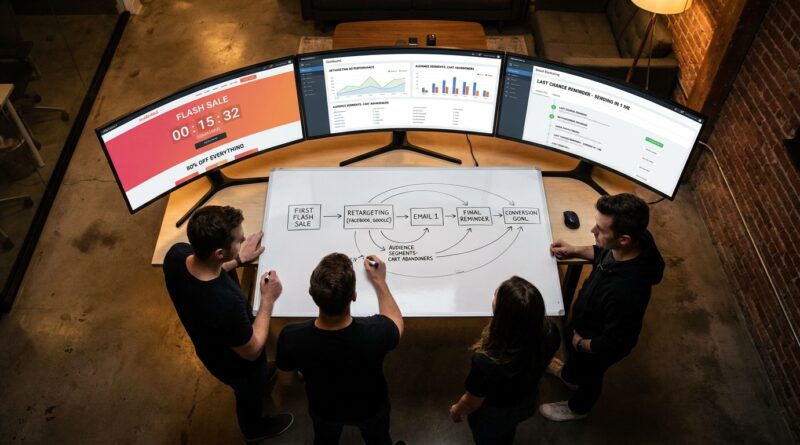
The ‘Retarget-Flash Relay’ Strategy: Turn One Short Sale Into Three Waves Of Buyers
Flash sales can be maddening. You line up the discount, pay for the traffic, watch the clicks roll in, and then… most people leave without buying. A few sales come through, the timer ends, and it feels like you just lit your budget on fire for customers who were probably ready to buy anyway. That is the real pain. Not that flash sales never work, but that too many brands treat them like a single blast instead of a sequence.
A smarter ecommerce flash sale retargeting strategy turns one short sale into three buyer waves. Wave one is your main flash. Wave two goes after people who clicked but did not check out. Wave three follows up with warm visitors again, usually with a tighter message, a smaller perk, or a different product angle. Same traffic. More chances to convert. Better control over margin. And in a pricey Q4 ad market, that can make the difference between a flashy campaign and a profitable one.
⚡ In a Hurry? Key Takeaways
- A relay-style ecommerce flash sale retargeting strategy turns one promotion into three timed chances to convert the same visitors.
- Start with a broad flash sale, then retarget clickers and cart visitors with narrower audiences, sharper copy, and smaller discounts.
- This helps protect margin, lowers wasted ad spend, and reduces the risk of training shoppers to only buy at huge markdowns.
Why the usual flash sale burns out so fast
The standard flash sale has one job. Create urgency fast.
That part usually works. People click. They browse. They think about it.
Then life gets in the way. A text comes in. A meeting starts. They want to compare prices. They are interested, but not quite ready. If your sale ends and your ads stop there, you lose all that warm attention.
This is why a one-shot promo can feel so disappointing. You paid to get noticed, but you only gave yourself one chance to close the deal.
What the Retarget-Flash Relay strategy actually is
Think of it like a relay race, not a firework.
The first leg gets attention. The second leg picks up people who showed intent. The third leg cleans up the high-probability buyers who still need one more nudge.
Wave 1: The main flash sale
This is your public offer. It runs to your normal sale traffic, email list, SMS list, paid social audience, and site visitors.
Keep it simple. One clear deadline. One hero product or product group. One obvious call to action.
Wave 2: The non-buyer retarget
Now you build an audience of people who clicked through or viewed product pages during the flash, but did not buy.
These people are your low-hanging fruit. They already raised their hand.
Your follow-up ad or message should change the angle, not just repeat the exact same sale banner. Try one of these:
- Show bestsellers from the same sale
- Answer an objection like shipping speed or return policy
- Highlight low stock or sale ending soon
- Offer a lighter incentive instead of a deeper discount
Wave 3: The last-chance warm push
This final wave is for the hottest non-buyers. Think cart abandoners, repeat product viewers, or anyone who clicked twice during the campaign.
By this point, you do not need a huge audience. You need a focused one.
Your message can be more direct here. “Still thinking it over?” works better than “Big sale now on.” You are speaking to people who already know your offer.
Why this works better than one giant discount
Most brands panic when sales slow down. They cut prices harder.
That can work in the short term, but it comes with a hidden cost. Customers learn to wait. If they believe a better deal is always around the corner, your regular pricing starts to look fake.
A relay setup gives you another option. Instead of going straight from 20 percent off to 50 percent off, you can use timing, targeting, and message changes to recover more sales first.
If you want to protect margin even more, this approach pairs nicely with The ‘Dynamic-Price Flash’ Strategy: Turn Real‑Time Discounts Into A Sellout Without Killing Your Margin. That way, you are not just chasing volume. You are shaping demand without giving away the store.
How to set it up without making it complicated
You do not need a giant ad team for this. You need a clean structure.
Step 1: Define your audiences before the sale starts
Create these groups in advance:
- All visitors who land on the sale page
- Product viewers
- Add-to-cart users
- Checkout starters
- Purchasers, who should be excluded from retargeting
This matters because once the sale is live, speed counts.
Step 2: Match each wave to a different message
Do not run the same creative to everyone.
For first-time clickers, focus on the offer and urgency. For product viewers, focus on social proof or product benefits. For cart abandoners, remove friction. Mention shipping, returns, or stock levels.
Step 3: Reduce the incentive as intent gets warmer
This sounds backwards, but it often works.
Someone who already added to cart may not need a bigger discount. They may just need reassurance. A modest bonus, such as free shipping or a bundle add-on, can be enough.
That is how you keep discounts under control.
Step 4: Set short windows
Retargeting works best when the click is still fresh.
Wave two might run 12 to 48 hours after the main sale click. Wave three might hit the next 24 to 72 hours for your hottest audiences. Wait too long and the urgency fades.
What to say in each retargeting wave
Copy matters here. A lot.
If your first ad says “Flash sale ends tonight,” your second ad should not just say it louder.
Good message angles for Wave 2
- “Still deciding? Here’s what customers love most.”
- “Your top picks are still on sale, but not for long.”
- “Fast shipping. Easy returns. Sale ends tonight.”
Good message angles for Wave 3
- “You were close. Finish your order before the deal disappears.”
- “Your cart is waiting. Last chance for today’s offer.”
- “One last reminder. This price ends at midnight.”
Notice the pattern. Less hype. More relevance.
Common mistakes that sink relay-style flash sales
Retargeting everybody the same way
A product viewer and a cart abandoner are not the same person. If you treat them the same, your follow-up gets weaker.
Keeping the discount too high for too long
If every follow-up wave offers a bigger cut, you teach shoppers to stall. Save your strongest offer for the smallest, hottest group, and only if needed.
Forgetting exclusions
Few things are more annoying than buying a product and then seeing ads for the same item an hour later. Exclude recent buyers right away.
Waiting until the campaign starts to build assets
By then, you are rushed. Have your audience rules, copy variations, and creative sizes ready before launch day.
How to measure whether the strategy is paying off
Do not just look at total revenue. Break performance down by wave.
Check:
- Click-through rate by audience
- Conversion rate by wave
- Cost per purchase on retargeting vs prospecting
- Average order value
- Margin after discount and ad spend
You may find that your second wave produces the cheapest conversions of the whole campaign. That is usually the sign you are finally getting more value from traffic you already paid for.
When this strategy works best
This setup is especially useful during crowded promo periods.
Black Friday. Cyber Monday. End-of-month payday pushes. Holiday shipping deadline sales.
Those are the times when ad auctions get expensive and attention gets scattered. A relay structure helps you stop relying on a single burst of performance.
It also works well if you have solid site traffic already but inconsistent conversion rates. In that case, the missing piece often is not more traffic. It is better follow-up.
At a Glance: Comparison
| Feature/Aspect | Details | Verdict |
|---|---|---|
| Standard flash sale | One-time push, broad audience, heavy focus on urgency and discounting | Fast attention, but lots of paid traffic goes cold after one visit |
| Relay-style retargeting | Three waves: main sale, non-buyer retarget, then hot-audience final push | Best for squeezing more orders from the same campaign budget |
| Discount control | Uses message changes, timing, and audience intent before offering deeper cuts | Better for margin and less likely to train shoppers to wait for 50 percent off |
Conclusion
A flash sale does not have to be one loud moment followed by silence. Right now ad costs are spiking going into Q4 and every flash sale is fighting in the same auctions. A relay-style flash sale that automatically re-engages people who clicked but did not convert lets you squeeze more revenue out of the same budget, keep discounts under control, and avoid training customers to only wait for 50 percent off. For The Deal community, this means you can plug a simple structure into your next Black Friday, Cyber Monday, or payday flash and walk away with more orders from the same traffic you already paid for. That is the real win. Not just more clicks, but more value from every click you already bought.