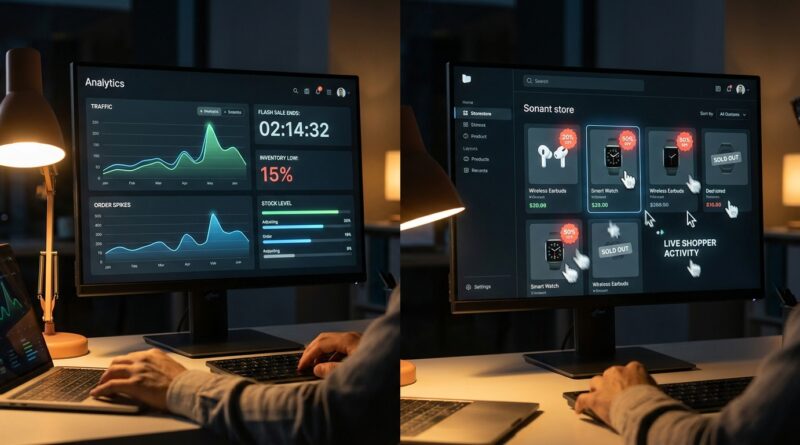
The ‘Tiered-Trigger Flash’ Strategy: Turn Live Buy Surges Into Automatic 24‑Hour Sellouts
You know the panic. A live stream starts humming, TikTok sends a wave of buyers, and suddenly your store goes from quiet to chaos in five minutes. That is when a plain sitewide coupon usually makes things worse. Too small, and nobody bites. Too big, and you burn margin right when ad costs, shipping pressure and stock risk are all climbing together. If you have ever watched orders flood in while you are refreshing inventory and praying your apps stay connected, you are not alone. A tiered flash sale strategy for live shopping is a calmer way to handle the rush. Instead of one blunt discount, you set staged offers that trigger based on traffic, order count, cart value or remaining stock. That means you can reward the crowd when the room gets hot, without handing away profit on every single order from the start.
⚡ In a Hurry? Key Takeaways
- A tiered-trigger flash sale raises or changes the offer only when live demand hits preset thresholds like orders, AOV or inventory levels.
- Start with 3 simple tiers, low-risk, mid-push and urgency mode, then connect each one to clear stock and margin rules.
- This setup helps prevent overselling, protects profit on slow days and avoids the damage of one-size-fits-all discounts during traffic spikes.
What a tiered-trigger flash actually is
Think of it like a thermostat for promotions.
You do not blast the same deal all day and hope it works. You set rules ahead of time. When the live session is quiet, shoppers see a lighter offer. When the room gets busy, the promotion steps up. When inventory gets tight, the deal changes again or shuts off.
That is the heart of a tiered flash sale strategy for live shopping. The offer reacts to what is happening right now.
Simple example
Let’s say you sell skincare during a live event.
- Tier 1. Under 25 orders per hour. Free shipping over $50.
- Tier 2. Once 25 orders hit. Free shipping plus a mini sample over $75.
- Tier 3. Once 50 orders hit, but only if 200 units remain. Buy 2, get 10% off.
- Stock safeguard. If inventory drops under 60 units, remove the discount and switch to a waitlist or back-in-stock alert.
Now you are not guessing in the middle of the rush. You already decided what happens next.
Why the generic flash sale keeps failing
Most small shops use one of two approaches. Neither is great.
The weak coupon problem
You run 10% off sitewide. Traffic spikes. Lots of browsing. Some carts. Not enough conversion. You gave up margin, but did not create much urgency.
The overreaction problem
You panic and launch 25% off because the live comments are flying. Orders jump, yes, but profit disappears. Then the best items sell out first, customer support gets messy, and the ad spend you used to bring people in gets harder to justify.
A tiered setup splits the difference. It gives you a controlled way to get more aggressive only when buyer intent is real.
How to build the tiers without making it too complicated
Keep this boring. Boring is good. Boring means it works.
Tier 1: Quiet room offer
This is your base layer. It should be easy to fulfill and easy on margin.
Good examples:
- Free shipping threshold
- Gift with purchase above a certain cart value
- Small discount on a slow-moving add-on item
The goal here is not fireworks. It is to warm up the room and lift cart size a bit.
Tier 2: Momentum offer
This kicks in once traffic or orders show that buyers are serious.
Good triggers:
- 20 orders in 15 minutes
- Conversion rate rises above your normal live average
- Average order value falls below target and needs a push
Good offers:
- Spend $75, get a free bonus item
- Second item 15% off
- Limited-time bundle
If you want a smart way to raise order value without slashing your hero product, this is where The ‘Micro-Bundle Flash’ Strategy: Turn One Smart Pairing Into Higher AOV Without Deeper Discounts fits nicely. A small bundle often performs better than a deeper blanket discount.
Tier 3: Hot room urgency
This is for the moment when comments are moving fast and shoppers are primed to buy now.
Important point. Do not make this your deepest discount by default.
Sometimes the smartest Tier 3 move is not a bigger percentage off. It might be:
- A bonus item for the next 100 orders
- Priority shipping upgrade
- Limited access to a color, size or early launch product
That keeps perceived value high without smashing margin.
The triggers that make the system work
The offer itself matters, but the trigger matters more.
Best trigger types for live commerce
Order count triggers. Easy to understand and easy to announce live. “When we hit 50 orders, the next tier unlocks.”
AOV triggers. Useful when traffic is strong but carts are too small. “Once average cart value drops under target, switch to a bundle or threshold gift.”
Inventory triggers. Vital if you have limited stock. “If remaining units fall below 80, remove the broad promo and switch to select SKUs only.”
Time-box triggers. Good for pacing the event. “For the next 15 minutes, Tier 2 is active.”
Traffic or click surge triggers. Helpful when your top-of-funnel channels are unpredictable, but these should be backed up by inventory checks so you do not invite a stampede you cannot fulfill.
My practical advice
Use no more than 3 primary triggers at first. One demand signal, one cart signal, one stock signal.
Too many rules and your team will forget what is live. Worse, your tools may trip over each other.
Protecting inventory when everything starts firing at once
This is where a lot of live-selling setups fall apart.
TikTok says one thing. Shopify says another. Your email app keeps promoting a deal that should have ended ten minutes ago. A webhook fails. Oversells happen. Then comes the apology tour.
Your safety checklist
- Reserve inventory buffers for promoted SKUs. Do not sell every last unit.
- Set a hard stock floor that automatically downgrades or pauses the offer.
- Limit top-tier deals to specific variants, not the whole catalog.
- Use one source of truth for inventory, usually your commerce platform, not a social channel.
- Test the rollback. Everyone tests launch. Fewer people test what happens when stock gets low.
If possible, build a “graceful failure” version of each promotion. For example, if a bonus gift sells out, the system swaps to store credit or a backup item instead of leaving customers confused.
Margin matters more than excitement
Live shopping can make you feel rich for an hour and poor by the weekly closeout.
Before you create any tier, know these numbers:
- Gross margin by SKU
- Max discount you can survive after shipping and fees
- Target AOV for the campaign
- Cost per acquired customer from the traffic source
If a tier does not support those numbers, it is not a strategy. It is adrenaline.
A better rule
Make the strongest tiers reward behavior you want.
- Higher cart value
- Bundles instead of single-item orders
- Specific inventory you need to move
- Faster checkout during the live window
That way, demand helps the business instead of just creating noise.
How to pitch it during the live event
This part gets ignored, but it matters.
If buyers do not understand the current tier, they will wait, hesitate or ask the same question 40 times in chat.
Keep the script simple
Try language like:
- “Right now, all carts over $50 get free shipping.”
- “When we hit 40 orders, we unlock the bonus serum.”
- “We are down to 70 units, so this bundle is the last active deal for tonight.”
People respond well to visible progress and clear limits. They do not respond well to confusing promo math.
The tools side, minus the jargon
You do not need an enterprise stack to do this. But you do need the basics to talk to each other reliably.
Minimum setup
- Your store platform tracks inventory in real time
- Your promo app can schedule or trigger rule changes
- Your live or social channel can update messaging fast
- Your email or SMS tools know when a deal starts and stops
If any one of those is flaky, keep the logic simpler. Fancy automations are not worth much if your customers see expired offers or sold-out items still being pushed.
A simple starter framework for small shops
If you want a starting point, use this:
Starter 24-hour sellout framework
- Tier 1: Free shipping over your normal AOV target.
- Tier 2: Once order count passes your average by 25%, add a gift-with-purchase at a higher threshold.
- Tier 3: Once inventory on the featured SKU drops below 35%, switch to a bundle or accessory offer instead of a deeper discount.
This is often enough to create urgency, protect your best margin and keep your hero item from vanishing too early.
Common mistakes to avoid
Making every tier a bigger discount
That trains shoppers to wait for the next price drop.
Ignoring operations
If fulfillment cannot handle the top tier, the sale is not really live-ready.
Triggering on traffic alone
Traffic is noisy. Orders and stock tell the truth.
Forgetting what happens after sellout
Have a backup CTA ready. Waitlist, preorder, back-in-stock signup, or a related bundle.
At a Glance: Comparison
| Feature/Aspect | Details | Verdict |
|---|---|---|
| Generic sitewide flash sale | One discount for everyone, regardless of demand, cart size or inventory pressure. | Easy to launch, but risky for margin and often too blunt for live spikes. |
| Tiered-trigger flash sale | Offers change when preset thresholds are met, such as order count, AOV or low stock. | Best balance of urgency, control and profit protection. |
| Inventory safety controls | Hard stock floors, auto-pause rules, variant limits and backup offers keep the sale honest. | Not optional. This is what keeps a good live event from becoming a support nightmare. |
Conclusion
If live commerce keeps hitting your store like a thunderstorm instead of a forecast, a tiered-trigger setup is one of the sanest upgrades you can make. You do not have to guess the perfect flash offer in real time, and you do not have to hand out a storewide discount just because the room suddenly gets loud. This helps the community right now because live and social commerce are sending traffic in violent spikes, not gentle curves, and many small shops are getting crushed by oversold inventory, dead webhooks or one-size-fits-all coupons that erase profit. A tiered flash sale strategy for live shopping gives you a safety net. You protect margins on quiet days, push AOV higher when the room is hot and keep inventory honest while TikTok, Shopify and your email platform all fire at once.