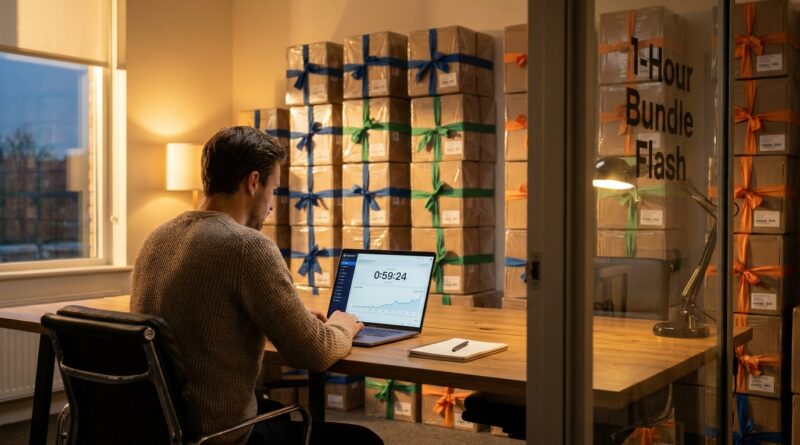
The ‘One-Hour Bundle Flash’ Strategy: Turn Quiet Traffic Spikes Into Your Highest AOV Of The Week
Running yet another 15 percent off code and watching shoppers still buy just one cheap item is exhausting. You get the traffic spike. You pay for the clicks. You add the countdown bar. Then the orders come in looking suspiciously small, and the margin damage is very real. If that sounds familiar, the fix is not always a bigger discount. Often, it is a better offer. A one-hour bundle flash is exactly that. Instead of discounting your whole store for half a day, you switch on a tight bundle deal only when traffic is already climbing. That means you are using urgency where it counts, pushing customers toward higher-value carts, and protecting full-price demand the rest of the time. This ecommerce flash sale bundle strategy is simple, fast to test, and far less messy than training your audience to wait around for endless sitewide promos.
⚡ In a Hurry? Key Takeaways
- Use a one-hour, bundle-only flash during a live traffic spike to lift average order value without cutting your whole catalog.
- Build bundles from products that naturally go together, keep the offer easy to understand, and run it only when sessions are already peaking.
- This approach is safer on margin than blanket discounting because you control which items get discounted and avoid underpricing orders you likely would have won anyway.
Why regular flash sales keep disappointing
Most flash sales are not really strategic. They are just broad discounts with a timer slapped on top.
That is the problem.
If every shopper gets the same code across the whole store, many will still buy the one item they came for. You have lowered the price, but you have not changed cart behavior. So average order value barely moves.
Worse, you may be giving away margin to people who were already ready to buy at full price.
A smarter ecommerce flash sale bundle strategy changes the offer itself. Instead of saying, “Everything is cheaper,” you say, “This exact mix is the best value, but only for the next hour.” That pushes the shopper toward a bigger cart by design.
What the one-hour bundle flash actually is
Think of it as a controlled mini-event.
You wait until traffic is already elevated. Maybe an email just landed. Maybe your paid social campaign is peaking at 8 p.m. Maybe an influencer mention sends a surge. Then you turn on a bundle-only discount for one hour.
Here is the basic structure
Pick two to four products that fit together. Offer a clear savings amount on that bundle only. Run it for 60 minutes. Put it in the cart drawer, on product pages, and at the top of the site. Then turn it off.
That last part matters. Off means off.
The short window creates urgency, but the bundle format does the heavy lifting. It raises basket size without turning your whole store into a discount bin.
Why this works better than sitewide codes
Shoppers are not always against spending more. They are against making extra decisions.
A good bundle removes friction. It answers the “what else should I get?” question for them.
It increases AOV with less guesswork
If someone came for a single serum, pairing it with a cleanser and moisturizer at a bundled price gives them a reason to build a routine, not just buy one item.
It protects your margin
You decide which products join the deal. That means you can include healthy-margin add-ons, slower-moving stock, or complementary items with good attachment rates.
It feels special
Shoppers are tired of constant discount noise. A short, bundle-only flash feels more intentional. It also trains your audience to pay attention when you do run a promo.
When to trigger the flash
This is where many stores get it wrong. They schedule the discount first and hope traffic arrives.
Try the reverse.
Wait for signs that people are already showing up. Then layer the bundle flash on top.
Good trigger moments include
Email campaign click peaks. Strong retargeting traffic in the evening. A social post that starts outperforming. A product mention from a creator. Payday traffic surges. Even a live launch window.
You are not using the sale to create all the momentum from scratch. You are using it to convert an existing spike into larger carts.
If you are also trying to capture newer shopping behaviors from search and chat tools, it is worth reading The ‘AI-Ready Flash’ Strategy: Turn ChatGPT Shoppers Into Your Highest-Converting Traffic Overnight. It pairs well with this approach because both focus on matching the offer to the traffic source instead of spraying discounts everywhere.
How to build a bundle people actually want
This is not about stuffing random items together and hoping the math looks appealing.
Start with natural companions
Choose products that already belong in the same buying journey. Think shampoo plus conditioner plus mask. Or laptop sleeve plus wireless mouse plus stand. Or coffee beans plus filters plus mug.
Keep the bundle easy to explain
If the shopper needs a chart to understand the savings, it is too complicated. “Buy any 3 from this set and save 20 percent” works. “Get the nightly skin reset bundle for $79, save $24” works too.
Use one hero item
Lead with the product people already know. Then use the bundle to pull in the supporting items.
Do not overpack it
Two or three items is often enough. Four can work if the category is simple. Beyond that, decision fatigue kicks in.
How much should you discount?
You do not need a dramatic markdown.
In many cases, 10 to 20 percent off the bundle is enough because the shopper sees the total package value, not just the discount line. Sometimes a free add-on works even better if that add-on has a strong perceived value and a low real cost.
A simple rule
If your old sitewide discount was 20 percent, try offering the bundle at an effective 12 to 15 percent savings first. You may find AOV rises enough that total profit per order improves even with a smaller discount rate.
How to set this up on Shopify, WooCommerce, and similar stores
You do not need a fancy rebuild.
On Shopify
Use native discounts, automatic discounts, bundle apps, or cart upsell tools. Many themes also let you feature a collection or product block at the top of the store during the hour.
On WooCommerce
Use bundled product plugins, dynamic pricing rules, and a sitewide announcement bar. Cart notices and one-page checkout prompts can help too.
On most mainstream stacks
The essentials are the same. A time-limited discount rule. A clear landing page or featured product block. Cart visibility. A timer if you want one. And a hard end time.
You are not trying to build a huge campaign machine. You are setting up a switch you can flip during live demand.
What to say in the promo message
Keep it direct.
Tell people what the bundle is, what they save, and when it ends. That is it.
Good example
For the next 60 minutes only, get the Complete Desk Setup Bundle and save 15 percent. Ends at 9 p.m.
Bad example
Massive flash event. Limited-time exclusive savings experience across selected curated essentials.
Nobody talks like that. Your customers do not want a press release. They want a reason to act.
How to measure if it worked
Do not judge this only on conversion rate.
The whole point is to improve order quality, not just order count.
Watch these numbers
Average order value during the hour. Bundle attach rate. Gross margin per order. Revenue per session. Cart completion rate. Percentage of flash orders that include more than one item.
Then compare them to your normal flash-sale windows.
If AOV climbs and profit per visitor improves, you are on the right track, even if total order count stays flat.
Common mistakes to avoid
Running it too long
A six-hour “flash” is just a regular sale with a louder name. The one-hour limit is what keeps it sharp.
Discounting your bestseller too heavily
Use the bestseller to anchor the offer, but do not gut its margin if you do not have to.
Offering too many bundle choices
One great bundle often beats five decent ones. Less clutter, faster decisions.
Launching when traffic is dead
This strategy works best when attention already exists. Quiet traffic plus a timer is still quiet traffic.
Forgetting the end
If the deal “accidentally” stays live, you undercut trust and train shoppers not to take your deadlines seriously.
A simple test plan for one evening
Here is the low-stress version.
Pick one traffic window that usually performs well. Build one bundle around a hero product. Set a 60-minute discount. Add a homepage banner, a product-page block, and a cart reminder. Send one email or SMS when traffic starts rising. Then shut it down on time and review the numbers the next morning.
That is enough to learn a lot.
You do not need a quarter-long roadmap to test an ecommerce flash sale bundle strategy. You need one focused offer and the discipline not to overcomplicate it.
At a Glance: Comparison
| Feature/Aspect | Details | Verdict |
|---|---|---|
| Sitewide flash sale | Easy to launch, but discounts everyone and often keeps carts small. | Good for clearing stock. Weak for margin control. |
| One-hour bundle flash | Targets a live traffic spike with a curated multi-item offer and a hard stop. | Best balance of urgency, AOV growth, and margin protection. |
| Long promo window | Gives shoppers too much time and weakens urgency. | Avoid if your goal is fast action and stronger carts. |
Conclusion
If your current flash sales are bringing noise without much lift, this is a smarter place to start. Right now, brands are leaning hard into urgency, but most flash sales are still lazy: blanket discounts, long windows, and no control over who actually gets the deal. With ad costs up and shoppers more price sensitive than ever, a short, bundle-only flash that you switch on when traffic is already peaking gives small and mid-sized stores a realistic way to ride those spikes without giving away margin on orders they would have won anyway. It is simple to test in a single evening, it works on Shopify, WooCommerce and most mainstream stacks with basic discount tools, and it trains your audience to expect one tight, high-value window instead of constant, noisy promos.