The ‘Staggered Send Flash’ Strategy: Protect Your Email Reputation While Still Printing Cash
You know the feeling. A flash sale goes out, revenue jumps, everyone celebrates, and then the hangover starts. Open rates sink. Gmail gets chilly. The next two or three campaigns land like a wet paper bag. That is the ugly little tax many ecommerce brands pay when they dump 4x their normal email volume into inboxes all at once. The sale “worked,” but your sender reputation took the punch.
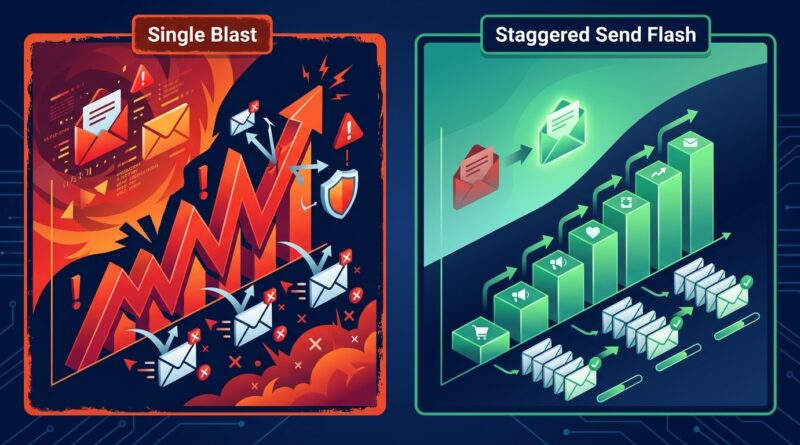
A smarter flash sale email deliverability strategy is to stagger the send instead of blasting the whole list at once. You still push the same offer. You just send it in waves, starting with your hottest, safest audience first, then widening only if engagement stays healthy. Think of it like crowd control for your email program. You are not making the promo weaker. You are making the mailbox providers trust it more. And right now, with heavier promo calendars and tighter inbox filtering, that trust can be worth as much as the discount itself.
⚡ In a Hurry? Key Takeaways
- Do not send your full flash sale list at once. Send in timed waves based on engagement and buyer intent.
- Start with recent openers, clickers, and shoppers first. Expand only after you confirm good inbox placement and complaint rates.
- This protects sender reputation, reduces volume spike penalties, and helps your next campaigns perform better too.
Why flash sales keep hurting deliverability
Mailbox providers notice patterns. If you usually send 100,000 emails and suddenly fire off 400,000 in one short burst, that does not look normal. It looks risky.
Even if your list is mostly clean, a giant spike can trigger more filtering. If engagement is mixed, or if some of that bigger audience has not interacted in a while, things get worse fast. More ignores. More spam complaints. More soft bounces. More messages pushed to promotions or spam.
That is why flash sales often create a strange result. Revenue from the sale looks good, but your email channel gets weaker right after it.
What the staggered send flash strategy actually is
The idea is simple. Instead of one giant send, break the campaign into smaller waves over several hours, or in some cases over a full day.
Wave 1: Your strongest audience
Send first to the people most likely to engage right away:
- Clicked in the last 30 days
- Opened in the last 30 to 60 days
- Purchased recently
- Browsed the category or product in the last week
This first wave acts like a trust signal. Good opens, clicks, and conversions tell inbox providers that your campaign is wanted.
Wave 2: Your solid middle group
Once the first wave performs normally, send to people with decent but not top-tier engagement. Maybe they opened in the last 90 days, clicked once recently, or bought a little further back.
Wave 3: The broad audience
Only after the first two waves look healthy should you send to the wider promo list. If performance starts slipping, you can slow down, trim the segment, or stop before you do damage.
Why this works better than a one-shot blast
Inbox providers care less about your marketing calendar than your sending behavior. A staggered send keeps your behavior closer to normal.
It also gives you a live read on campaign health. With a one-shot blast, if something is wrong, a weak subject line, a stale segment, a spammy creative angle, you find out after the damage is done. With a staged rollout, you get checkpoints.
That control matters.
How to build your send waves
1. Rank your list by recent engagement
If your email platform has engagement filters, use them. If not, create simple buckets:
- Tier 1: Opened or clicked in last 30 days
- Tier 2: Opened or clicked in last 31 to 90 days
- Tier 3: Opened in last 91 to 180 days
- Tier 4: Older or unengaged names
For a flash sale, Tiers 1 and 2 should do most of the heavy lifting.
2. Layer in intent data
Not all engaged subscribers are equal. Someone who viewed the sale category yesterday is hotter than someone who opened a newsletter three weeks ago.
This is where pre-sale behavior becomes powerful. If you want to get even sharper with segmentation, read The ‘Warm‑Up Wallet’ Flash Strategy: Turn Pre‑Sale Browsing Data Into Your Highest‑Intent Buyers. It pairs nicely with staggered sends because it helps you decide who should be in Wave 1, not just when to hit send.
3. Set time gaps between waves
You do not always need huge delays. For many brands, 2 to 4 hours between waves is enough. Bigger lists may benefit from longer spacing. The goal is to avoid one giant spike, not to turn a flash sale into a week-long event.
A simple model looks like this:
- 8:00 AM: Tier 1 and high-intent shoppers
- 11:00 AM: Tier 2 if metrics are healthy
- 2:00 PM: Tier 3 or selected broader audiences
4. Watch the right metrics, not just revenue
Revenue matters. But for this strategy, you also need to monitor:
- Open rate by wave
- Click rate by wave
- Spam complaint rate
- Bounce rate
- Inbox placement, if your tools provide it
If Wave 1 is underperforming badly, do not blindly release Waves 2 and 3. That is how a manageable problem becomes a reputation problem.
Who should not get the flash sale right away
This part stings a little, especially if you are under pressure to “mail the whole list.” But some people should wait, or skip the send entirely.
- Subscribers with no opens for 180 days or more
- People acquired very recently with no engagement yet
- Old promo-heavy segments that rarely click
- Addresses with a history of bouncing or poor activity
Sending to everyone may feel aggressive. In reality, it is often expensive. It can cost future inbox placement across the whole file.
How to keep urgency without sending all at once
A common fear is that staggered sending will kill momentum. Usually it does not, if you handle the message well.
Use a real deadline
Make the sale window clear. “Ends tonight at midnight” still works whether someone gets the email at 8:00 AM or 1:00 PM.
Keep the creative consistent
Do not rewrite the whole campaign every wave unless something is clearly broken. Small subject line tests are fine. Radical changes muddy your data.
Reserve reminders for engaged non-buyers
If you send a last-chance email, aim it at people who opened or clicked but did not purchase. That reminder group is much safer than blasting the full list again.
A practical example
Let’s say your normal campaign volume is 120,000 emails. Your flash sale plan calls for 450,000. That is where the trouble starts.
Instead, try this:
- Wave 1: 60,000 recent clickers, recent buyers, and fresh browsers
- Wave 2: 90,000 recent openers and moderate engagers
- Wave 3: 120,000 broader active subscribers
- Holdout or suppress: the oldest, coldest 180,000 names
Yes, you mailed fewer people. But the people you did mail were more likely to engage, more likely to convert, and less likely to hurt reputation. In many cases, total revenue is surprisingly close to the giant blast, while the fallout is much smaller.
Common mistakes that ruin this strategy
Sending Wave 2 before Wave 1 data settles
If your platform reports with a delay, give it breathing room. Do not hit go just because the schedule says so.
Using stale segments for “extra reach”
That extra reach often means extra complaints and ignores.
Treating all mailbox providers the same
Gmail, Yahoo, and Outlook do not always react the same way. If your platform allows domain-level reporting, use it.
Repeating the same spike every week
Even a better flash sale email deliverability strategy needs limits. If every weekend is a panic blast, mailbox providers will learn that pattern too.
At a Glance: Comparison
| Feature/Aspect | Details | Verdict |
|---|---|---|
| One-shot blast | Fastest way to reach everyone, but creates a sharp volume spike and gives you no chance to react if performance dips | Good for convenience, bad for reputation stability |
| Staggered send by engagement | Starts with your safest, highest-response audience and expands in waves based on live results | Best balance of sales pressure and inbox protection |
| Broad send to cold subscribers | Adds volume quickly but usually drags down engagement and raises complaint risk | Avoid for flash sales unless you are willing to absorb deliverability damage |
Conclusion
Big flash sales do not have to come with a deliverability hangover. If you stagger your sends, start with engaged buyers, and let performance guide the rollout, you can keep the promo aggressive without torching inbox trust. Right now a lot of ecommerce brands are quietly getting hammered by volume spike penalties when they mail huge flash-sale blasts, and that kills the upside of running more promos. This approach gives you a concrete way to keep doing hard-hitting sales while protecting sender reputation, which matters even more as promo season gets crowded. The discount gets attention. Inbox trust gets you paid.