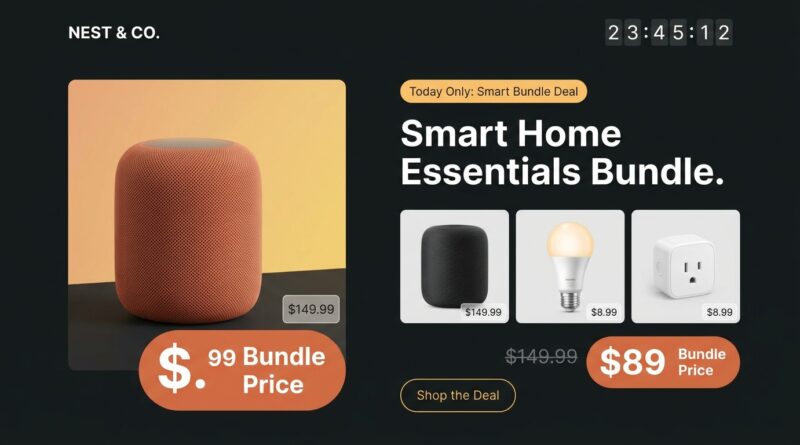
The ‘Smart Bundle Flash’ Strategy: Turn One High‑Margin Combo Into Your Most Profitable 24‑Hour Sale
You can feel the pain of a sitewide sale the morning after. Orders came in, sure, but so did thinner margins, lower profit per box, and a fresh batch of customers now trained to wait for the next coupon. Worse, many shoppers only grab the cheapest item they can find and leave the high-margin add-ons sitting on the shelf. That is why a smarter move is often a tighter one. Instead of cutting prices across your whole store, build one carefully chosen bundle around a product people already want, then pack in the attachments, refills, accessories, or upgrades that carry better margin. Put that bundle on a true 24-hour timer, give it a clear value story, and suddenly you have a sale that feels exciting to shoppers without quietly wrecking your numbers. The goal is not more orders at any cost. It is better orders, better profit, and less discount addiction.
⚡ In a Hurry? Key Takeaways
- Use one high-margin bundle for a 24-hour sale instead of discounting your whole store.
- Start with a proven hero product, then add accessories or attachments that raise average order value without crushing profit.
- Keep the offer simple and time-limited so customers see a real bargain, while you still protect margin and clear the right stock.
Why sitewide discounts keep backfiring
Sitewide sales look easy because they are easy. One code. One banner. One email. Done.
But easy for the merchant often becomes expensive for the merchant. You cut margin on strong sellers that would have sold anyway. You discount weak items that still do not move enough. And you teach customers that full price is for other people.
That is the hidden problem behind the typical discount calendar. It boosts volume, but not always profit.
A sharper ecommerce flash sale bundle strategy solves a different problem. It asks, “How do we make each order worth more, while still giving shoppers something that feels special?”
What a Smart Bundle Flash actually is
Think of it as one headline offer for one day only.
Not 20 products on sale. Not a blanket code. One bundle.
The best version usually includes:
- A hero product shoppers already understand
- One or two high-margin attachments, accessories, refills, or care items
- A bundle price that feels clearly better than buying each item alone
- A real 24-hour deadline
For example, if you sell espresso machines, your flash bundle might not be “20% off everything.” It might be “Espresso Starter Set Today Only,” with the machine, descaling tablets, a milk pitcher, and premium beans.
The machine gets attention. The extras protect profit.
Why bundles are working so well right now
Bundles are trending hard in ecommerce because they do two jobs at once. They lift average order value and protect margin.
That balance matters. If your sale only creates more orders but lowers profit per order, you are working harder for less. A good bundle flips that. It gives customers a bigger cart naturally, without forcing them to browse your whole site or stack codes.
It also simplifies the buying decision. People like being told, in plain English, “Here is the best setup.”
That confidence can increase conversion faster than another 10% off banner.
Build the bundle around attachments, not around deep cuts
This is where many stores get it wrong. They discount the main product too heavily and treat the add-ons like an afterthought.
Do the opposite.
Start with a product that already has demand. Then look for attached items with better margin. These are often:
- Refills and consumables
- Accessories
- Protection items
- Cases, cables, stands, or holders
- Care kits
- Replacement parts
The hero product gets the click. The attachment mix makes the bundle profitable.
Quick gut check for bundle picks
Ask three simple questions:
- Does the main product already sell without much persuasion?
- Do the extra items improve the customer’s first-use experience?
- Do the add-ons carry enough margin to support a visible discount?
If the answer is yes across the board, you may have a winner.
How to price it so it feels like a deal
You do not need a crazy discount. You need a clear one.
That means customers should instantly see what the items would cost separately, what the bundle costs today, and how much they save.
Keep the math easy. If the separate total is $142, a flash price of $119 feels stronger than a messy number like $123.47.
And be honest. If the claimed savings are fuzzy, shoppers notice.
A solid bundle price usually comes from shaving enough off the total to create urgency, while letting your high-margin extras carry the economics. That is the quiet power of this strategy.
Make the 24-hour window do the heavy lifting
The flash part matters.
If the bundle sits around for a week, it stops feeling special. If it keeps coming back every few days, customers catch on and wait.
A real 24-hour sale works because it creates focus. Your email, homepage, SMS, and social posts all point to one offer. That concentration often performs better than spreading attention across dozens of discounted products.
Keep the message simple:
- What is included
- Why the bundle is useful
- How much they save
- When it ends
That is enough. No need for marketing gymnastics.
Use this with abandoned cart traffic too
If you already have shoppers showing intent, this works even better.
For example, if someone abandoned a cart with your hero product, a bundle flash can be the nudge that gets them over the line. Instead of reminding them about the same lone item, you can reframe the offer as a better-value package for a limited time.
That fits nicely with The ‘AI Cart Rescue Flash’ Strategy: Turn 100 Abandoned Carts Into Your Fastest High-Intent Sale Of The Week, especially if your store already has enough cart data to spot which products naturally lead to useful add-ons.
Inventory strategy matters more than most stores think
A bundle flash is not just a pricing move. It is an inventory move.
This is where the strategy gets even better. You can use the sale to move the stock you actually want to move, instead of discounting your whole catalog evenly like every item deserves the same push.
Good bundle candidates often include:
- Accessories with healthy stock levels
- Seasonal attachments that need a nudge
- High-margin items shoppers forget to buy on their own
- Slow-moving complements that become appealing beside a popular product
The trick is to avoid stuffing the bundle with random leftovers. Customers can smell that from a mile away.
The bundle should feel curated, not padded.
How to present the offer on the page
Keep the product page clean and obvious.
Show what is inside
Use a simple visual stack or checklist. People should know exactly what they are getting in two seconds.
Explain why the combination makes sense
Do not just list items. Say what they do together. “Everything you need to get started” is stronger than a cold parts list.
Show separate price versus bundle price
This is not the place to be subtle. Make the savings easy to understand.
Use a real countdown carefully
A timer can help, but only if the deadline is real. Fake urgency hurts trust.
Mistakes that can sink a bundle flash fast
Some common ones show up again and again.
- Picking a weak hero product that needs too much explanation
- Adding low-value extras customers do not care about
- Discounting so deeply that the bundle still loses money
- Making the page too complicated
- Running “flash” sales so often they stop feeling urgent
If the bundle feels confusing, random, or fake, conversion drops. If it feels useful and time-sensitive, shoppers move.
A simple launch plan for your first one
If you want to test this without overthinking it, start here:
- Pick one hero SKU with steady demand.
- Choose two or three complementary items with better margin.
- Check total landed cost so you know your profit floor.
- Set a bundle price with clean, visible savings.
- Run it for 24 hours only.
- Promote it through email, SMS, homepage banner, and product page callouts.
- Measure average order value, conversion rate, and profit per order, not just top-line sales.
That last point is important. The goal is not simply to have a “busy” sales day. The goal is to have a better one.
At a Glance: Comparison
| Feature/Aspect | Details | Verdict |
|---|---|---|
| Sitewide discount vs bundle flash | Sitewide sales cut margins across many SKUs. A bundle flash concentrates demand on one curated offer. | Bundle flash is usually better for profit control. |
| Hero product selection | The main product should already have demand, while attachments do the margin work. | Pick proven winners, not problem products. |
| 24-hour urgency | A short, real deadline keeps the message sharp and gives shoppers a reason to act now. | Strong if used honestly and not too often. |
Conclusion
If you are tired of watching margins evaporate every time you need a sales bump, this is a smarter path. A focused ecommerce flash sale bundle strategy lets you stop discounting everything just to move something. Bundles are trending hard in ecommerce this year because they lift average order value and protect margin at the same time, especially when they are built around high-margin attachments rather than your hero product. Turn that into a real 24-hour offer, and you give shoppers a headline-worthy bargain without dragging your whole store into a price war. For The Deal community, that means better inventory control, healthier profit per order, and a sale format that feels exciting instead of desperate.