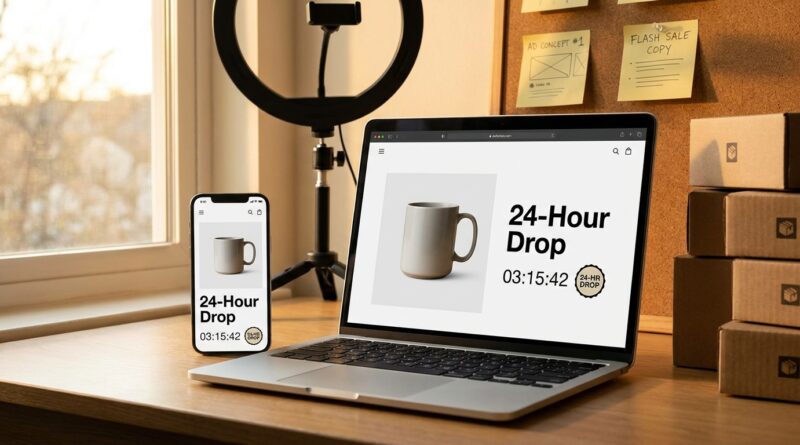
The ‘One-SKU Flash’ Strategy: Turn A Single Hero Product Into Your Highest‑Margin 24‑Hour Sale
Chaotic flash sales wear small brands out fast. You cut prices across half the store, customers bounce between too many options, margins get thin, and your inbox fills with oddball questions about products you barely wanted to promote in the first place. If that sounds familiar, the fix is often simpler than people think. A one sku flash sale strategy ecommerce brands can run in a day is exactly what it sounds like. Pick one hero product, give it a clean 24-hour offer, and make everything else on your site play backup. That keeps the message sharp, the math easier, and the experience more premium. It also helps you learn something useful right away. If one item can pull clicks, sales, and repeat interest under pressure, that is probably the product worth pushing hardest this season. For a small team, that kind of clarity is gold.
⚡ In a Hurry? Key Takeaways
- A one-SKU flash sale works best when you focus all traffic, messaging, and discounting on one proven hero product for 24 hours.
- Start with the item that already converts well, has healthy margin, and causes the fewest support headaches.
- This is safer than a sitewide flash because forecasting, fulfillment, and customer service stay much easier to manage.
Why this works better than the usual messy flash sale
Most storewide flash sales fail for a boring reason. They ask a small team to act like a giant retailer.
Big platforms can run bundles, lightning deals, and category-wide discounts because they have massive traffic, deep stock, and ad budgets that can soak up mistakes. Smaller brands do not get that luxury. If you spread your promotion across 30 or 40 products, you also spread customer attention, inventory risk, and support load.
A one-SKU flash flips that around. One product gets the spotlight. One offer gets repeated everywhere. One inventory pool gets watched closely. One landing page does the heavy lifting.
That is why the one sku flash sale strategy ecommerce teams use can feel almost suspiciously simple. Simpler is the point.
What a one-SKU flash actually looks like
Think of it as a limited 24-hour drop built around your best sales candidate.
The basic setup
You choose one hero product. Then you give it:
- A clear start and end time
- A clean offer, like 20 percent off or a bonus gift
- A single landing page or homepage takeover
- Email and social posts that all point to the same product
- Minimal distractions from the rest of your catalog
You are not hiding your other products. You are just not letting them steal the show.
Why customers respond
Too much choice slows people down. One product plus a deadline speeds them up.
That is especially helpful with cold traffic. If someone has never heard of your brand, asking them to browse your full catalog is a bit like dropping them in a supermarket with no shopping list. A hero item gives them a starting point.
How to pick the right hero product
This is where most of the result gets decided. Do not pick the product you wish would sell. Pick the one that gives you the best shot at a smooth win.
Good hero products usually have these traits
- They already convert at full price or close to it
- They have enough margin to handle a strong offer
- They are easy to explain in one sentence
- They are easy to pack and ship fast
- They do not create lots of sizing, setup, or compatibility questions
If you are torn between two products, choose the one with fewer support tickets. During a flash sale, operational calm matters almost as much as conversion rate.
What not to choose
Avoid products with confusing variations, fragile packaging, or a history of returns. Also avoid anything with shaky stock levels. A sellout is nice. Overselling and refunding people is not.
The margin trick people miss
You do not need the deepest discount. You need the cleanest offer.
A lot of brands panic and slash too hard because they are comparing themselves to giant marketplaces. But your goal is not to beat every deal on the internet. Your goal is to make one item feel special, limited, and easy to buy.
That can mean:
- 15 to 25 percent off one hero item
- Buy the hero item and get a low-cost bonus
- Free shipping for that product only
- Early access for email subscribers, then public access later
The best one sku flash sale strategy ecommerce owners use often protects margin by removing complexity, not just by raising price. Fewer products in the campaign usually means fewer mistakes, fewer abandoned carts, and fewer support hours.
How to set it up in the next 48 hours
You do not need a big rebuild. You need a short checklist.
1. Build one sales page
Use one page with one message. Lead with the product benefit, the time limit, the offer, and a simple call to action. Keep extra navigation light if you can.
2. Put the rest of the site in supporting mode
Your homepage banner, announcement bar, pop-up, and top email slot should all point to the same product. Treat the rest of your catalog like the supporting cast.
3. Cap the quantity if needed
If stock is tight, say so. “Only 200 units in this drop” is clearer and more believable than fake scarcity tricks.
4. Prep support before launch
Create canned replies for the top five questions. Shipping times, returns, product specs, discount timing, and stock status are the usual ones.
5. Schedule the full 24-hour arc
Plan three moments at minimum:
- Launch message
- Mid-sale reminder
- Last-chance countdown
Do not write 12 different angles. Repetition wins here.
What to say in your marketing
The offer should sound focused, not desperate.
Better messaging angles
- “24-hour drop on our best-selling daily essential”
- “One-day price on the product our customers reorder most”
- “Our hero item gets the spotlight for the next 24 hours”
Notice what is missing. No giant wall of promo codes. No “everything must go” panic. No confusing menu of discounts.
If your store has slow-moving singles you also want to fix later, that is a different play. In that case, The ‘Micro-Bundle Flash’ Strategy: Turn Slow-Moving Singles Into High‑Margin 24‑Hour Packs is a better fit. But for speed and clarity, one hero product is often the cleaner move.
How to know if it worked
Do not judge the sale on revenue alone.
Watch these numbers
- Conversion rate on the hero product page
- Average order value
- Customer acquisition cost
- Email click-through rate
- Support tickets per 100 orders
- Sell-through speed
If the hero item converts well, support stays manageable, and the economics hold up, you just learned something valuable. You found a product worth pushing harder during the holiday stretch.
If traffic was decent but conversion was weak, that tells you something too. Maybe the product is not actually your hero. Better to find that out in a controlled 24-hour test than after spending weeks on a bigger campaign.
Common mistakes to avoid
Running the sale on your “favorite” product
Your favorite product and your best flash-sale product are not always the same thing.
Giving customers too many choices
If the “hero” product comes in 14 versions with tiny differences, the offer starts to feel like homework.
Forgetting operations
A sale is only exciting until fulfillment breaks. Double-check stock, labels, and packaging before launch.
Making the discount confusing
One item. One offer. One timer. Clean beats clever.
At a Glance: Comparison
| Feature/Aspect | Details | Verdict |
|---|---|---|
| Offer focus | One hero product gets all the traffic, messaging, and urgency for 24 hours. | Best for clarity and stronger conversion. |
| Operational complexity | Forecasting, shipping, support, and inventory planning are much simpler than a sitewide sale. | Safer for small teams. |
| Margin control | You can give one deeper, cleaner offer without discounting the whole catalog. | Usually better than broad markdowns. |
Conclusion
If your past flash sales felt like a lot of noise for not much reward, this is the reset button. Right now the big platforms are gearing up for the golden retail quarter with mega events, bundles, and sitewide promos, which small brands cannot win on scale or ad spend. A tightly focused one-SKU flash lets you ride the same wave of urgency in a way that actually fits a small team. Forecasting is simpler, traffic does not get split across 40 products, and you can afford to give a deeper, cleaner offer on one hero item without wrecking your business. For The Deal readers, this is the most practical move to test in the next 48 hours. Pick your best product, frame it as a limited 24-hour drop, and treat everything else on your site like supporting cast. It is the lowest-complexity way to run a flash sale that feels exclusive, converts cold traffic, and teaches you instantly which product deserves more firepower this season.