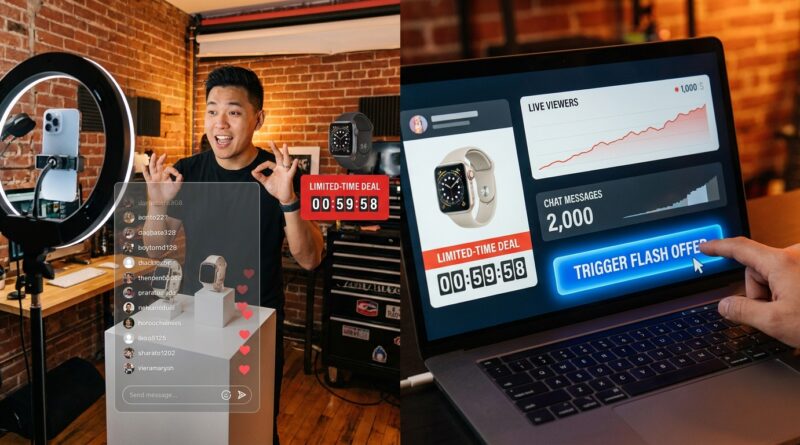
The ‘Live-Trigger Flash’ Strategy: Turn Real‑Time Viewer Spikes Into Instant Sell‑Outs
You know the feeling. You line up the products, write the emails, set the timer, post the sale, and then wait. Maybe traffic comes. Maybe it does not. Meanwhile, another brand goes live, drops a surprise code when comments start flying, and sells out before your scheduled promo email even gets opened. That is the frustrating part. A normal flash sale is planned in advance, but attention online is messy and real time. It spikes without warning. A creator mentions you. A Reel takes off. A live stream suddenly doubles in viewers. If your offer stays fixed while buyer interest jumps, you miss the easiest money of the day. A live shopping flash sale strategy fixes that by tying short, instant offers to what people are doing right now, not what your calendar said they might do three days ago.
⚡ In a Hurry? Key Takeaways
- A live shopping flash sale strategy works best when offers unlock only after real-time signals like viewer spikes, comment bursts, or sudden clicks.
- Start simple. Pick one trigger, one product, and one short offer window on TikTok Shop, Instagram Live, or your site’s live shopping tool.
- Keep guardrails in place so you do not kill margins or confuse shoppers with too many changing deals.
What a Live-Trigger Flash Sale Actually Is
Think of it like a flash sale with a pulse.
Instead of saying, “Everything goes live at 2 p.m.,” you say, “When live viewers hit 800, unlock 15 percent off for five minutes,” or “If this product gets 100 clicks from this Story in 10 minutes, open a bundle deal.”
That is the core idea. The sale reacts to demand as it forms.
This matters because social commerce is now full of impulse moments. People are not always shopping with a plan. They are watching, chatting, tapping, and buying because the moment feels hot. A static sale page cannot keep up with that. A live-trigger sale can.
Why Static Flash Sales Miss the Best Buyers
Most flash sales are built like posters. They announce a deal and hope people show up.
But live content does not behave like a poster. Attention rises and falls by the minute. One product mention can wake up a sleepy stream. One comment thread can turn into a buying rush. One influencer clip can send a burst of traffic to a single product page.
If your promotion stays the same during those spikes, you waste momentum.
The best buyers are often the people already watching, already engaged, and already close to buying. They do not need a week of reminders. They need a reason to act now.
How the Strategy Works in Plain English
You set a trigger. You attach a reward. You keep the window short.
Common triggers
Good triggers are easy to measure and tied to real buyer intent:
- Concurrent live viewers hit a set number
- Comments on one product pass a threshold
- Clicks from one video suddenly jump
- Add-to-cart activity rises in a short window
- Product saves, hearts, or shares cross a set mark
Common rewards
The reward should feel special, but not wreck your pricing:
- 5-minute discount code
- Free gift for the next 25 orders
- Bundle upgrade
- Free shipping unlock
- VIP-only color or size release
Why the short window matters
The short window is what turns interest into action. If the offer sits around for hours, it stops feeling earned and starts feeling ordinary.
A Simple Example
Let’s say you sell skincare.
You are on Instagram Live doing a quick demo. Normally, you would mention a sale code once and hope for the best. With a live-trigger setup, you do this instead:
- At 500 viewers, unlock 10 percent off the featured serum for 7 minutes
- If comments hit 200 during the demo, add a free mini cleanser to the next 30 orders
- If click-throughs from the Live product tag jump by 25 percent in 5 minutes, open a two-item bundle
Now the audience is not just watching. They are helping unlock the next offer. That creates urgency, but it also creates participation.
Why This Strategy Works So Well
It lines up with actual human behavior.
People respond when they see momentum. If a live host says, “We just crossed 1,000 viewers, here’s the 5-minute deal,” that feels timely and real. It feels connected to the moment they are in.
It also removes some of the guesswork for the brand. You are not constantly discounting just in case. You are waiting for proof that attention is turning into demand.
That is a smarter way to use your margin.
Where to Set This Up Without Rebuilding Everything
The nice part is you do not need some giant custom system to test this.
TikTok Shop
Use creator live sessions, product pins, and time-limited coupons. Watch live viewer counts, clicks, and conversion bursts. Have prebuilt offers ready so your team can trigger them fast.
Instagram Live and Stories
Use Story link spikes, comment waves, and DM replies as your signal. Pair that with limited codes, product drops, or free-shipping windows.
On-site live shopping tools
If you run live shopping on your own site, you often get better control. You can connect viewer counts, clicks, and cart events to pop-up offers, bundles, or countdown modules.
If you also want to improve what happens after the click, it is worth reading The ‘Dynamic-Countdown Flash’ Strategy: Use Smart Pricing To Turn Window Shoppers Into Same‑Session Buyers. It fits nicely with this approach because one strategy catches the spike, and the other helps finish the sale before shoppers drift away.
How to Start Small Without Making a Mess
Do not begin with ten triggers and a giant rule book. That is how teams get confused and customers get mixed signals.
Step 1: Pick one hero product
Choose something with good margin, proven interest, and enough stock.
Step 2: Pick one signal
Viewer count is usually the easiest. Comments are also useful if your audience is active.
Step 3: Pick one reward
Make it simple. “10 percent off for 5 minutes” is enough for a first test.
Step 4: Set your guardrails
Decide ahead of time:
- Minimum margin you will allow
- Maximum number of times a trigger can fire
- Inventory cap for the offer
- Whether the trigger resets or is one-time only
Step 5: Script the host
Your live host should know exactly what to say. The smoother the announcement, the stronger the response.
Best Triggers to Watch
Not every spike means “discount now.” You want signals that suggest buying intent, not just random curiosity.
Strong triggers
- Rapid product-tag clicks from one piece of content
- Comment bursts about price, availability, or shade/size
- Sudden increase in add-to-cart actions
- Repeat traffic from a creator mention or affiliate push
Weaker triggers
- Views with no clicks
- Likes with little product interaction
- Traffic from very broad, low-intent content
The point is to reward heat that looks like shopping, not just scrolling.
What to Avoid
This strategy is powerful, but it can get sloppy fast.
Do not train shoppers to wait forever
If every live moment leads to a better deal, people will hold off. Keep the rewards meaningful but controlled.
Do not make the rules confusing
If customers cannot tell what unlocked the offer or how long it lasts, urgency turns into friction.
Do not ignore stock reality
Nothing kills trust faster than unlocking a deal on inventory that is almost gone unless “almost gone” is the point and clearly stated.
Do not let vanity metrics run the show
A big audience is nice. Buyers are better. Watch the path from attention to order.
How to Measure Whether It Worked
You are looking for more than a fun live session.
Track these numbers:
- Conversion rate during trigger windows
- Revenue per minute of the live event
- Average order value after each offer unlock
- Click-to-purchase time
- Sell-through rate on featured items
- Margin impact by offer type
After a few tests, patterns show up. You may learn that comment-triggered bundles beat viewer-count discounts. Or that five-minute windows work better than ten-minute ones. That is where the strategy starts getting really useful.
Who Should Try This First
You do not need to be a giant brand.
This works especially well for:
- Beauty and skincare brands doing demos
- Fashion sellers with limited runs
- Home and kitchen brands with creator partners
- Collectibles and hobby sellers with active live audiences
- DTC brands already getting traffic from short-form video
If your buyers respond to personality, demos, and impulse moments, this is a strong fit.
At a Glance: Comparison
| Feature/Aspect | Details | Verdict |
|---|---|---|
| Static flash sale | Fixed start time, fixed offer, little reaction to live audience behavior | Easy to run, but often leaves demand spikes unused |
| Live-trigger flash sale | Offers unlock when viewers, comments, clicks, or carts hit preset thresholds | Best for turning real-time attention into fast conversions |
| Risk control | Needs inventory limits, margin rules, and clear messaging to avoid confusion | Worth it if you set simple guardrails before going live |
Conclusion
Social commerce and live shopping are where buyers now discover and impulse-buy, but most brands still treat flash sales like static billboards that never react to what is actually happening on screen. A live shopping flash sale strategy changes that. You tie small offers to live data like viewer spikes, comment streaks, or sudden clicks from one video, then act when demand is clearly building. That means you stop guessing when to push harder. You unlock the better deal only when the moment is real. For The Deal community, that is a practical edge right now. You can add this logic to TikTok Shop, Instagram Live, or on-site live shopping tools without starting from scratch. Done well, every content spike becomes a timed, trackable, higher-converting flash event instead of just a nice-looking metric on a dashboard.