The ‘Cart-Stack Flash’ Strategy: Turn One Simple Code Into The Best Deal On The Entire Web
Your shoppers are not lazy. They are tired. Tired of opening three tabs, checking coupon sites, trying random promo codes, and doing mental math during a flash sale. The moment they suspect your deal is not really the best one, they pause. Then they wander off to Amazon, Google, or a browser extension that promises something better. That is how a good sale dies in the cart.
A smart fix is the ecommerce flash sale discount stacking cart strategy I call the Cart-Stack Flash. The idea is simple. You use one easy promo code, combine it with automatic discounts you already control, and show every discount clearly on the cart page before checkout. No scavenger hunt. No mystery savings. Just a cart that says, in plain English, “here is exactly why this is a great deal.” When shoppers can see the stack working line by line, the offer feels stronger, faster, and safer to buy right now.
⚡ In a Hurry? Key Takeaways
- Use one simple promo code plus automatic cart discounts, then show the full stack in the cart before checkout.
- Build your flash sale around clear thresholds like “buy 3, save 10%” or “spend $75, get free shipping” so the value is easy to understand.
- Keep the rules honest and easy to follow. If shoppers feel tricked by hidden exclusions, conversion drops fast.
Why shoppers leave during a flash sale
Most store owners think cart abandonment during a sale is about price alone. Sometimes it is. But often it is about doubt.
The shopper sees your banner. They click. They add items. Then the little voice starts up. “Is there a better code?” “Does free shipping kick in later?” “If I add one more item, does the deal improve?” “Can I beat this on Amazon?”
That uncertainty is expensive.
What big retailers understand is that shoppers do not just want a discount. They want confidence. They want to feel they found the best practical deal without needing detective work.
What a Cart-Stack Flash actually is
A Cart-Stack Flash is a short sale built around one visible promo code and one or two automatic discount rules that stack in a planned way.
For example:
- Promo code FLASH10 for 10% off
- Automatic discount for buying 3 or more items
- Automatic free shipping at $75
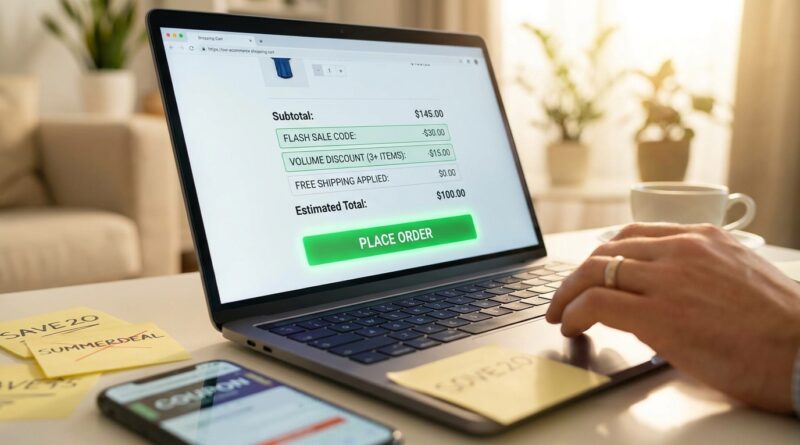
The important part is not just that these discounts exist. It is that the cart shows them clearly, one line at a time:
- Items subtotal: $84
- Volume discount: -$8.40
- Promo code FLASH10: -$7.56
- Free shipping unlocked: -$6.99
- Total savings: $22.95
That is the moment the deal becomes real.
Why this works better than a “mystery coupon” sale
Hidden savings create friction. Visible savings create momentum.
When the cart itself proves the customer is getting a strong offer, you remove the need to keep searching. The shopper stops asking, “Can I do better?” and starts thinking, “I should grab this before the sale ends.”
This is the part many smaller stores miss. They spend time building the discount, but not enough time showing the discount.
It reduces coupon hunting
If there is one simple code, shoppers are less likely to leave and look for five different ones.
It makes adding more items feel smart
If the cart shows that adding one more item unlocks another saving tier, shoppers have a reason to increase their order.
It lowers checkout surprises
Nobody likes finding out the “real” deal only appears at the last step. That feels slippery. Showing it early feels fair.
How to build a Cart-Stack Flash without fancy enterprise tools
You do not need Amazon’s engineering team. You need a plan.
1. Pick one code people can remember
Use something simple like FLASH10, SAVE15, or STACK20. Avoid weird strings full of numbers. If the code looks annoying, people are less likely to trust it and more likely to leave for coupon sites.
2. Pair it with one automatic rule
This is where the stack gets interesting. Good options include:
- Buy 2 or more, get 10% off selected items
- Spend $50, get free shipping
- Spend $100, get a bonus gift
- Buy 3, save more than buying 2
Do not pile on five rules. That turns into tax code. Keep it clean.
3. Make the cart do the selling
Your cart should show:
- What discount applied
- Why it applied
- How much it saved
- What the shopper could unlock next
That last one matters. A small line like “Add $9 more to unlock free shipping” can be more powerful than another ad.
4. Test the stack before the sale goes live
This sounds obvious, but it gets missed all the time. Test every path.
- Does the promo code work with the volume discount?
- Does free shipping still apply after discounts?
- Are excluded products clearly marked?
- Does the cart show savings on mobile too?
If the stack breaks or gets confusing, trust breaks with it.
The psychology behind the “holy crap this is a steal” moment
People do not always respond to the biggest raw discount. They respond to visible value.
A single 20% off banner can feel vague. A cart that shows stacked savings feels concrete. The shopper sees proof. It feels like they unlocked something.
This is why line-by-line savings can beat a larger but less visible offer. It turns the checkout process into a little win.
And once that win happens in the cart, not after a long hunt, you have a much better shot at closing the sale.
Common mistakes that ruin the strategy
Too many codes
If shoppers have to choose between WELCOME10, FLASH15, VIP20, and FREESHIP, they start optimizing instead of buying.
Hidden exclusions
If the code does not work on half the store and that is only revealed late, expect anger and drop-off.
Weak cart visibility
If the stack only appears at the final payment step, you waited too long. The cart is where the reassurance should happen.
Messy math
If shoppers cannot quickly tell whether the deal is good, they will leave and compare elsewhere.
Where this fits in a bigger sales plan
A Cart-Stack Flash is great for getting the first order. But it can also set up the next one.
That is why it pairs nicely with post-purchase reward offers and return-buyer campaigns. If you want that next step, The ‘Stacked-Reward Flash’ Strategy: Turn One Short Sale Into Weeks Of Repeat Orders is a useful follow-up. It focuses on how a short burst of sales can turn into repeat business instead of a one-day spike and silence.
Best use cases for this ecommerce flash sale discount stacking cart strategy
This works especially well when:
- Your products are easy to buy in multiples
- You have a free shipping threshold
- Your average order value has room to grow
- Your shoppers compare prices across marketplaces
- Your current flash sales get clicks but weak cart conversion
If your store already has strong traffic during promotions, this strategy can help more of that traffic actually finish the purchase.
A simple example you can copy
Say you sell supplements, coffee, skincare, or accessories.
Try this setup:
- Code: FLASH10
- Automatic rule: Buy any 3 items, get 10% off
- Automatic rule: Free shipping at $60
- Cart message: “You saved $18.40 so far. Add $7 more to unlock free shipping.”
That is clear. It is believable. And it gives the shopper a reason to stay in your store instead of wandering off to compare codes on some sketchy coupon site.
At a Glance: Comparison
| Feature/Aspect | Details | Verdict |
|---|---|---|
| Promo code setup | One short, easy code combined with pre-planned automatic discounts | Best for reducing confusion and coupon hunting |
| Cart transparency | Shows each saving line by line before checkout, including thresholds and free shipping | Strongest part of the strategy for boosting trust |
| Complexity to run | Moderate. Requires rule testing, clean messaging, and mobile-friendly cart display | Very doable for most Shopify and ecommerce stores |
Conclusion
The smart part of this strategy is not just the discount. It is the clarity. Big stores quietly obsess over how deals stack behind the scenes, but very few make that stacking obvious on the cart page itself. When you run a Cart-Stack Flash, you borrow that same thinking without needing giant budgets or custom tools. Plan one simple code. Pair it with automatic cart rules like volume discounts or free shipping thresholds. Then show every saving clearly, line by line, before checkout. That is how you create the “holy crap this is a steal” feeling early, while the customer is still deciding. Done well, this can mean more conversions, fewer abandoned carts, and a better chance that your offer feels like the best one your shopper will see anywhere today.