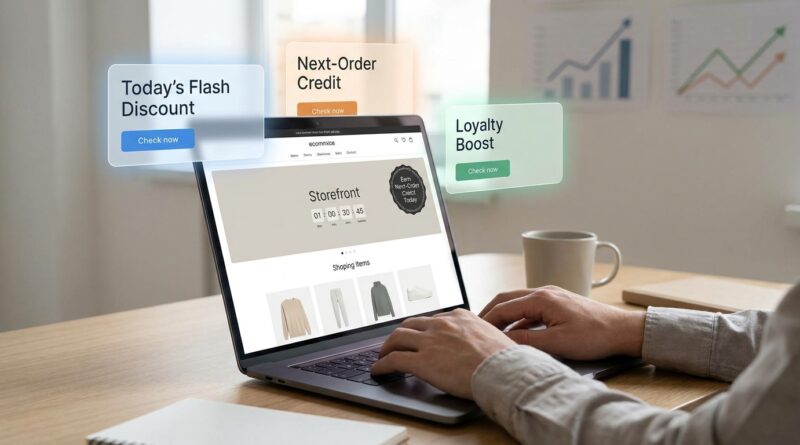
The ‘Stacked-Reward Flash’ Strategy: Turn One Short Sale Into Weeks Of Repeat Orders
You run a flash sale, the orders finally come in, and for a few hours it feels like you cracked the code. Then the sale ends, the traffic dries up, and those shiny “new customers” vanish like they were only renting space in your store. That sting is real. A lot of brands are not building loyalty with flash sales. They are just teaching people to wait for the next coupon. A smarter ecommerce flash sale loyalty strategy is to make the first discount do two jobs at once. It should move inventory now and set up the next purchase before the shopper forgets you exist. That is where the stacked-reward flash comes in. Instead of one flat discount and a goodbye, you give the customer an immediate deal plus a locked follow-up reward they can use soon. Same sale. Better behavior. More repeat orders. Less dependence on begging people back with another 40 percent off blast.
⚡ In a Hurry? Key Takeaways
- A stacked-reward flash pairs today’s discount with a time-limited reward for the next order, so one sale can create repeat purchases instead of one-and-done bargain hunters.
- Start with a simple structure: a modest flash discount now, then a bounce-back credit, gift, or member perk valid for 7 to 21 days.
- If your margins are tight, avoid stacking deep discounts on both orders. Use the second reward on higher-margin items, bundles, or minimum-spend thresholds.
Why ordinary flash sales keep disappointing you
Most flash sales are built like a fireworks show. Loud, exciting, over fast.
You send the email. You post the countdown. Orders spike. Then it is over. What you often bought was not loyalty. It was temporary attention.
The problem is simple. A plain discount answers one question only. “How cheap is this right now?” It does not answer the more important one. “Why should I come back?”
That is why so many stores see the same pattern. New customers arrive during the sale, buy once, then disappear until the next markdown. You end up training shoppers to time your desperation.
What a stacked-reward flash actually is
A stacked-reward flash is a two-step offer.
Step 1: Give a clear reason to buy now
This is your flash sale. It could be 20 percent off for 6 hours, a bundle price, or a free shipping window.
Step 2: Lock in the next purchase before checkout ends
As soon as they buy, they earn something for order number two. That could be:
- $15 store credit valid in the next 10 days
- A free add-on with their next order
- Early access to a members-only drop
- Double loyalty points on a second purchase
- Buy now, unlock a gift at a set spend next week
The key is that the second reward is not a vague future promise. It is specific, useful, and expires soon enough to create momentum.
Why this ecommerce flash sale loyalty strategy works better
It works because it changes the shopper’s mental math.
With a normal flash sale, the customer thinks, “Nice deal. I saved money.”
With a stacked-reward flash, the customer thinks, “Nice deal. I also have something waiting for me if I come back.”
That second thought matters. It turns a finished transaction into an open loop.
You are also reducing the pain of discounting. Instead of giving one huge cut up front, you can split the value across two moments. That protects margin and increases the chance of a second sale.
How to build one without making it confusing
Keep it easy enough to explain in one sentence.
Here is the formula:
Buy during today’s flash. Get a reward for your next order within the next 7 to 21 days.
Good example
“Today only: 20% off sitewide. Every order also gets a $15 bounce-back credit valid for the next 10 days on orders over $50.”
Bad example
“Save up to 35% on selected items. Unlock special member benefits and possible future surprise perks based on tier qualification.”
That sounds like homework. Do not make people decode your sale.
Pick the right second reward
The best reward depends on your margins, product type, and buying cycle.
Use store credit if you want a fast second order
Store credit feels like money already earned. It often pulls people back quickly.
Use a gift with purchase if you want to protect margin
A low-cost but high-perceived-value item can work better than another discount.
Use points or VIP access if you want long-term retention
This is useful if you already have a loyalty program or want to start one without a full rebuild.
Use minimum spend thresholds if you want bigger baskets
Example: “Unlock $20 off your next $75+ order.” This can raise average order value on round two.
Timing matters more than most brands think
If the second reward lasts too long, people forget. If it expires too fast, it feels stressful.
A good starting window is 7 to 14 days for products people can reorder quickly, and up to 21 days for more considered purchases.
Think about your category:
- Beauty, snacks, supplements: shorter windows can work well
- Apparel, home goods: give a little more time
- High-ticket products: use the reward toward accessories or replenishment items
What to say in your email and onsite messaging
Your customer should understand the whole offer in seconds.
Use plain language:
- “Flash sale today. Bonus reward for your next order.”
- “Buy now, get $15 to use next week.”
- “Today’s deal also unlocks your next one.”
Then repeat the details in three places:
- On the landing page
- In the cart or checkout area
- In the order confirmation email or SMS
This is where many brands drop the ball. They announce the first discount loudly, then whisper the second reward. The bounce-back offer should not feel hidden.
Use the post-purchase moment properly
The thank-you page is not just a receipt screen. It is your best chance to set the next action.
Show the reward clearly. Explain how to use it. Include the deadline. If possible, add one or two suggested products that fit the second order.
For example:
“Thanks for your order. You just unlocked $15 for your next purchase. Use it in the next 10 days on orders over $50. Best picks for your next order: refill packs, matching accessories, and our new fall bundle.”
Do not copy this blindly if your flash is tied to viral traffic
If you are getting a burst of shoppers from social, the structure may need to move faster. A creator-driven wave behaves differently than a normal list send. If that is your situation, read The ‘Creator-Surge Flash’ Strategy: Turn One Viral TikTok Into A 90-Minute Storewide Frenzy. It is a useful companion playbook for turning sudden attention into actual orders before the moment passes.
Common mistakes that ruin the strategy
Making the first discount too deep
If you slash too hard up front and then add another rich reward, you can win revenue and lose profit.
Giving the second reward with no spend floor
If a shopper can use it on a tiny order, you may train them to cherry-pick cheap items.
Using a reward that does not fit your catalog
A refill credit makes sense for consumables. It makes less sense for furniture.
Waiting too long to remind them
Send reminder messages before the reward expires. One right after purchase, one mid-window, one final reminder near the end.
Making the terms messy
If your customer needs to read fine print like a phone contract, you already lost them.
A sample rollout you can test this month
Here is a simple version that many stores can adapt:
- Flash offer: 15% to 20% off for 8 hours
- Second reward: $10 to $20 credit for the next order
- Minimum spend on second order: set it above your average item price
- Expiry: 10 days
- Reminder flow: confirmation email, day 5 reminder, final 24-hour reminder
Then measure four things:
- First-order conversion rate
- Second-order redemption rate
- Average order value on both purchases
- Total profit per customer over 30 days
That last number matters most. A flashy revenue graph can hide a weak strategy.
Who should use this first
This approach is especially useful for brands that:
- Rely too much on discount emails
- Have decent first-order conversion but weak repeat purchase rates
- Sell products people can buy again, collect, refill, or pair with accessories
- Want a stronger loyalty habit before Q4 promotion season gets noisy
If your store only gets sales when you go loud and cheap, this is a strong test to run.
At a Glance: Comparison
| Feature/Aspect | Details | Verdict |
|---|---|---|
| Standard flash sale | One short discount window, strong urgency, but no built-in reason to return after purchase. | Good for quick spikes, weak for retention. |
| Stacked-reward flash | Immediate sale plus a time-limited bounce-back reward for a second order. | Best balance of urgency, repeat orders, and smarter discount use. |
| Deep discount repeat blasting | Frequent 30% to 40% off sends to pull customers back again and again. | Risky. Can damage margin and train shoppers to wait. |
Conclusion
If your flash sales keep bringing in tourists instead of regulars, the problem is not urgency. It is structure. Most ecommerce brands are already crowding inboxes with generic flash discounts, and the race to the bottom is getting louder every week. A stacked-reward flash gives your audience a real win on price today while locking in a second purchase and a deeper relationship without inflating your ad spend. Done properly, this structure cuts the pain of discounting, shifts shoppers from deal tourists into members, and gives your community a smarter playbook they can run before Q4 chaos really starts.