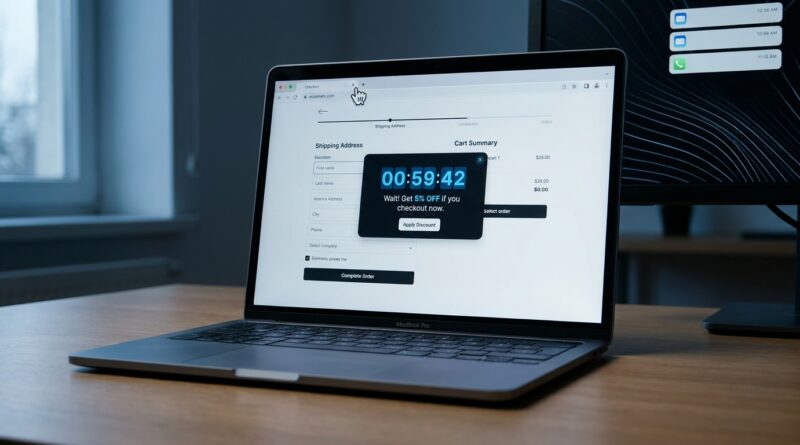
The ‘Cart-Exit Flash’ Strategy: Turn Almost-Lost Checkouts Into Your Highest-ROI Sale Of The Day
You paid to get that shopper all the way to checkout. They picked a product, entered details, hovered over the buy button, then vanished. It is maddening, especially when you know those almost-orders are some of your warmest leads. The usual fix, an abandoned-cart email sent hours later, often lands too late. By then the shopper is distracted, comparison shopping, or simply over the moment. A smarter move is to catch that hesitation right as it happens with a short, targeted offer that feels helpful instead of desperate. That is the point of an ecommerce flash sale abandoned cart strategy built around cart exit. You show a brief, time-boxed incentive only when buying intent is high and only when the numbers make sense. Done right, this can become one of the highest-ROI sales you run all day, because you are rescuing traffic you already paid for instead of chasing brand new clicks.
⚡ In a Hurry? Key Takeaways
- A Cart-Exit Flash offer works best when it appears the moment a shopper shows real checkout exit intent, not hours later in a generic email.
- Start with short countdowns, 10 to 30 minutes, and match the discount to your margin band so you protect profit while still giving shoppers a reason to finish.
- Do not blast the same code to everyone. Use behavior-based triggers and sync the on-site message with SMS or email follow-up for better recovery and less discount waste.
Why standard cart recovery feels weak now
Most stores treat abandoned carts and flash sales like two separate tools. One is a slow follow-up system. The other is a broad promo sent to everybody.
That split made more sense a few years ago. It makes less sense now. Shoppers are more price sensitive, more distracted, and more likely to bounce between tabs before finishing a purchase.
If someone is already at checkout, you do not have an awareness problem. You have a hesitation problem. Maybe shipping cost surprised them. Maybe they want a little reassurance. Maybe they just need a tiny push to stop procrastinating.
That is why a tight, well-timed checkout offer can outperform a bigger sale sent later to your whole list.
What the Cart-Exit Flash strategy actually is
Think of it as a rescue offer that appears when someone is about to leave checkout without buying. It is not a sitewide sale. It is not a blanket 20% off coupon.
It is a short countdown offer shown only to high-intent shoppers, then reinforced through one or two quick follow-ups on the channels they actually use.
The basic flow
Here is the simple version:
- Shopper adds items and reaches checkout.
- Your store detects exit intent or inactivity at a key step.
- An on-site banner, pop-up, or slide-in appears with a time-limited offer.
- If they still leave, a matching email or SMS lands soon after.
- The offer expires fast, so the shopper has a reason to act now.
That is the whole idea. Fast trigger. Short window. Smart discount. Consistent messaging.
When to trigger the offer
This is where many stores get sloppy. If you trigger too early, you train shoppers to wait for deals. Too late, and you lose them.
Good trigger points
Use one or more of these:
- Mouse movement toward the browser bar or back button on desktop
- Rapid tab switching or page close behavior where your tools can detect it
- 45 to 90 seconds of inactivity on the payment or shipping step
- Error loops, such as repeated coupon attempts or payment retries
- Returning checkout visitors who abandoned once in the last 24 to 72 hours
Bad trigger points
- Showing an offer the moment someone lands in cart
- Offering discounts before shipping or taxes are visible
- Giving the same deal to every visitor, every time
A good rule is simple. Trigger only when the shopper has shown enough intent that saving the order is worth a small concession.
How long should the flash window be?
Shorter than most merchants think.
The point is to break hesitation, not create a leisurely shopping holiday. In many stores, the sweet spot is 10 to 30 minutes. Long enough for someone to finish checking out. Short enough to feel real.
Recommended countdown windows
- 10 to 15 minutes: Best for impulse buys, low-ticket items, and mobile shoppers
- 20 to 30 minutes: Better for higher-priced carts or purchases with more comparison shopping
- Over 60 minutes: Usually too long to feel urgent
If your audience is used to fake countdowns, trust drops fast. So keep the timer real. If it expires, it expires.
How deep should the discount be?
This is where profit can quietly leak away if you are not careful. The smart move is to tie your incentive to margin bands, not gut feel.
A practical discount framework
Start with this:
- High-margin products: 10% to 15% off can work
- Mid-margin products: 5% to 10% off, or free shipping
- Low-margin products: free shipping, bonus gift, or loyalty points instead of a price cut
If shipping sticker shock is your big drop-off point, free shipping often works better than a percentage discount anyway. It feels cleaner to the shopper.
Behavior should shape the offer
Not every abandoning shopper needs the same nudge.
- If they spent time on payment and almost finished, try a smaller offer.
- If they bounced after seeing total cost, test free shipping.
- If they viewed the same product several times over a week, a modest discount may close the gap.
This is also why broad flash campaigns are often less efficient. If you want the wider version of this thinking, The ‘Real-Time Intent Flash’ Strategy: Turn Live Browsing Signals Into Your Highest-ROI Sale Of The Month does a nice job showing how live behavior signals can shape offers before people disappear.
What the on-site message should say
Do not write this like a desperate coupon blast. Write it like a helpful nudge.
Good message structure
- Acknowledge what is happening
- Present one clear benefit
- Show the countdown
- Give one obvious next step
Example
Still thinking it over?
Finish your order in the next 15 minutes and get free shipping.
Timer: 14:59
Button: Complete My Order
That is better than stuffing the screen with five offers, a spinning wheel, and a giant wall of coupon text.
Why email alone is too slow
Email still matters. It just should not be your only move.
If the shopper is on mobile, an SMS reminder can outperform email for speed. If they are a logged-in user with push enabled, browser or app notifications can help too. The point is not to spam every channel. The point is to use two connected touches instead of one lonely message six hours later.
A simple multi-channel recovery sequence
- Step 1: On-site offer at exit or inactivity moment
- Step 2: SMS or email within 10 to 20 minutes if they opted in
- Step 3: Final reminder before expiration, usually 30 to 60 minutes later
Keep the offer and countdown consistent across each touch. If the site says 15 minutes and the email says 24 hours, shoppers notice. And not in a good way.
How to set this up in one afternoon
You do not need a six-month rebuild. Most stores can test this with tools they already have.
Your quick wiring diagram
- Use your cart or checkout platform to detect checkout exit intent or inactivity
- Create one on-site banner or modal with a real expiry timer
- Generate a unique or tightly controlled discount code if needed
- Map offers by margin band, not one-size-fits-all
- Connect one follow-up email and one SMS template
- Suppress the offer for recent purchasers and chronic discount hunters if your data allows
Minimum viable test
If you want to start small, test one segment first:
- Carts above a certain value
- Checkout visitors with no prior purchase
- Products with healthy margins
That gives you clean data without putting your whole pricing strategy on autopilot.
Common mistakes to avoid
This strategy can work beautifully. It can also backfire if you get lazy.
1. Training shoppers to wait for a discount
If the offer appears every single time, repeat buyers will catch on. Use limits. For example, one Cart-Exit Flash per user every 14 or 30 days.
2. Discounting low-margin carts too deeply
A recovered order that loses money is not a win. Always know your margin floor.
3. Sending too many follow-ups
One or two messages are enough. More than that starts to feel like nagging, which is the exact complaint shoppers already have about standard abandoned-cart flows.
4. Ignoring checkout friction
Sometimes a discount is masking a site problem. If lots of shoppers stall at shipping or payment, fix that too. A cleaner checkout may outperform any offer.
What to measure so you know it is working
Do not judge this only by recovered revenue. Look at the full picture.
Track these metrics
- Checkout completion rate after trigger
- Recovered revenue by offer type
- Average discount cost per recovered order
- Profit per recovered order
- SMS and email click-through rate
- Repeat use or offer abuse rate
The goal is not just more orders. It is more profitable rescued orders.
At a Glance: Comparison
| Feature/Aspect | Details | Verdict |
|---|---|---|
| Trigger timing | Cart-Exit Flash triggers during checkout exit intent or meaningful inactivity, while standard abandoned-cart emails often go out much later. | Immediate timing usually wins because buying intent is still warm. |
| Discount strategy | Uses margin-based and behavior-based offers instead of one blanket coupon for everyone. | Better for profit protection and less discount waste. |
| Recovery channels | Combines on-site messaging with email and SMS follow-up, all using the same countdown and offer logic. | Stronger than email-only recovery, especially for mobile shoppers. |
Conclusion
Right now, too many ecommerce operators are treating abandoned carts and flash sales like separate jobs, when shoppers are telling you the real issue is timing. They are more distracted at checkout and more careful with money than ever. A Cart-Exit Flash strategy bridges that gap. It gives hesitant buyers a small, believable reason to finish now, not later. The real win is that you do not need to spray 20% off codes at everyone to make it work. You can trigger the offer at the right moment, keep the countdown tight, match the discount to your margins, and sync the on-site prompt with follow-up messages in a way that feels consistent instead of pushy. Set it up in an afternoon, test it on your highest-intent carts, and you may find that your best sale of the day was the one that was almost lost.