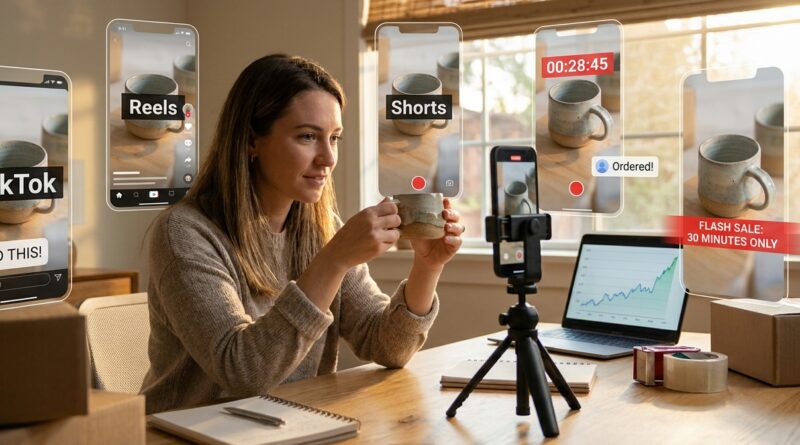
The ‘Live Clip Flash Sale’ Strategy: Turn Your Best 30 Seconds Into A 30‑Minute Revenue Spike
You know the feeling. You launch a flash sale, post the graphic, maybe add a countdown sticker, and then. Nothing much happens. Not because the offer is bad, but because people never really saw it. Your best promo gets buried under old posts, ignored like every other “last chance” banner in the feed. That is the real problem. Attention is now the first discount you need to win. A live video flash sale strategy for ecommerce fixes that by using the one thing that still gets people to stop scrolling, a strong short clip. Instead of stretching a sale across days and training buyers to wait, you build a tight 30-minute window around your best-performing 30 seconds of video. That clip becomes the hook, the proof, and the trigger. It feels more like an event than a markdown. And when done right, it can lift conversions fast without crushing your margins all week.
⚡ In a Hurry? Key Takeaways
- A Live Clip Flash Sale uses one proven short video to drive a limited sale window, usually 30 minutes, instead of relying on stale sale graphics.
- Start with a clip that already gets strong watch time, comments, saves, or clicks, then build the offer and live reminder around that exact moment.
- Keeping the sale short protects margin, feels more exclusive, and fits how TikTok, Instagram, and YouTube currently push short and live video.
Why old flash sale posts are losing steam
People are tired. Not of buying, but of being interrupted by the same visual tricks. A red badge. A countdown. “Only today.” Then the same post comes back tomorrow wearing a different hat.
That is why a lot of static flash sale graphics quietly die in the feed. They ask for urgency before they earn attention. Short video works better because it shows the product in action first. It gives people a reason to care before asking them to act.
This is the core idea behind a live video flash sale strategy for ecommerce. You do not start with the discount. You start with the clip that already proved it can stop the scroll.
What a Live Clip Flash Sale actually is
Think of it as a mini event built around one hero clip.
You take your best 15 to 30 seconds of product content. Maybe it is a demo, a before-and-after, a reaction shot, a problem-solving moment, or a founder explaining one useful feature. Then you attach a short sale window to it. Usually 30 minutes to one hour.
The clip does three jobs at once:
- It grabs attention.
- It proves the product is worth looking at.
- It gives you a natural entry point for urgency.
Instead of saying, “Here is a discount, please notice me,” you are saying, “Here is why this product matters, and for the next 30 minutes you can get it on special terms.” That is a much easier sell.
Why this works better in 2026
Platforms are making the choice for you. TikTok Shop, Instagram, and YouTube are all pushing short video and live discovery harder than static promo posts. They want content that creates response, not just content that announces a price drop.
That matters because reach now follows behavior. If people watch, comment, tap, and share, your content gets shown to more people. A hero clip with a flash sale attached gives you a better chance of getting that response than another flat sales graphic ever will.
This is also why sellers are moving away from week-long blanket discounts. Long sales train shoppers to delay. Short, focused sale windows create a reason to buy now while keeping your pricing structure more intact.
How to choose the right 30-second clip
Do not pick the clip you personally like best. Pick the one your audience already voted for.
Look for proof, not polish
Your best hero clip is usually the one that already has one or more of these signals:
- High watch time or retention
- Strong click-through to product pages
- A burst of comments asking where to buy
- Shares or saves
- A clear moment where the product “clicks” for viewers
Sometimes the winner is not your nicest video. It is the messy live demo where the result is obvious in three seconds. That is fine. Response matters more than production value.
Choose one promise
A great flash sale clip should communicate one simple thing fast. For example:
- This cleans faster.
- This saves space.
- This fixes a common annoyance.
- This looks better on real people.
- This sells out every time because it works.
If the clip needs too much explanation, it is probably not your hero clip.
How to build the sale around the clip
This is where most sellers overcomplicate things. Keep it tight.
Step 1: Set a narrow window
Thirty minutes is often enough. An hour can work too. The point is to feel special, not endless.
A short window does two useful things. It creates real urgency, and it protects your margin because you are not discounting all afternoon.
Step 2: Give one clean offer
Pick one offer people can understand instantly:
- 15 percent off for 30 minutes
- Free gift for live buyers only
- Bundle upgrade during the flash window
- Free shipping until the timer ends
Do not stack five offers. That creates friction, not excitement.
Step 3: Match the landing page
If the clip says “see it in action,” the product page should open with action. If the clip highlights one color or bundle, the page should match that. Any mismatch causes drop-off.
Step 4: Use live to amplify the clip
You do not need a huge production. A simple live session can do the job. Pin the product. Replay the hero clip. Answer buyer questions. Remind viewers how much time is left. Show social proof as orders come in if your platform allows it.
The live is not there to replace the clip. It is there to deepen trust after the clip pulls people in.
A simple format you can copy
Here is a practical version:
- Post hero clip 2 to 3 hours before the event.
- Post a reminder story or short follow-up 30 minutes before.
- Go live at the top of the hour.
- Pin the product and state the offer in the first minute.
- Replay or reference the hero moment during the live.
- Close the offer on time.
That last part matters. If the sale always “accidentally” stays open, buyers learn not to rush next time.
What to say during the live
This is where people freeze. The good news is you do not need to sound like a shopping channel host.
Just keep it clear and human:
- What the product does
- Who it is for
- Why this short window exists
- What happens when the timer ends
- Answers to the top 3 buyer objections
If viewers ask the same question twice, answer it on camera and then repeat it later. Late joiners need context.
How this differs from a standard SMS or email blast
SMS and email still matter. They just work differently. A text message is great for pulling warm buyers back in after attention has already been won elsewhere. If you want a good example of that approach, The ‘Text-Back Flash Sale’ Strategy: Turn One SMS Into A 24-Hour Revenue Loop shows how a simple reply-based campaign can keep a sale moving after the first spike.
The Live Clip Flash Sale is better at the top of the funnel and mid-funnel. It earns attention and creates momentum. Then SMS, email, and retargeting can catch the people who clicked but did not buy.
Mistakes that quietly kill the spike
Using a clip that was never a winner
Do not try to force a sale onto weak creative. If the video did not hold attention before, urgency will not magically save it.
Making the offer too broad
“Everything on sale” sounds exciting, but often performs worse than one featured product or one tight bundle. Broad offers blur the message.
Talking too long before showing the product
Open strong. Show the item. State the benefit. Then explain details. Attention is fragile.
Ignoring comments during the live
Comments are not a distraction. They are your sales floor. Answering them is part of the event.
Breaking trust on timing
If you say 30 minutes, mean 30 minutes. Scarcity only works when it is real.
Who should use this first
This strategy is especially useful for:
- Brands with one clear hero product
- Shops already posting short-form video
- Sellers on TikTok Shop, Instagram, or YouTube
- Merchants who want short bursts of revenue without week-long markdowns
- Teams with limited ad budget but decent organic content
If you have one clip that consistently wakes up your audience, you already have the raw material.
How to measure whether it worked
Do not only look at total sales. Check the full picture:
- View-to-click rate on the hero clip
- Live attendance and average watch time
- Comment volume and questions asked
- Conversion rate during the 30-minute window
- Average order value
- How many buyers were new versus returning
If conversion was good but attendance was low, your promotion timing may be the issue. If attendance was high but sales were soft, your offer or product page may need work. The clip is the spark, but the whole path still matters.
At a Glance: Comparison
| Feature/Aspect | Details | Verdict |
|---|---|---|
| Hero content | One proven 15 to 30 second clip with strong engagement, tied to a short live sale window. | Best choice when you already know which video stops the scroll. |
| Offer style | A narrow, clear incentive such as a timed discount, gift, bundle, or shipping perk for 30 to 60 minutes. | Better for protecting margin than running broad discounts all week. |
| Platform fit | Works especially well on TikTok Shop, Instagram, and YouTube, where short video and live discovery get extra distribution. | Strong fit for 2026 platform behavior and product discovery trends. |
Conclusion
Flash sales do not fail because people hate deals. They fail because too many of them never earn attention in the first place. That is why this shift matters. Social platforms are rewarding short, high-engagement video more than static sale graphics, and smart sellers in 2026 are using live demos and shoppable clips to create fast conversion spikes during tight windows instead of dragging discounts across the whole week. A Live Clip Flash Sale gives you a practical way to use that change. You recycle content that already proved it can stop the scroll, add real urgency on top of that proof, and keep more margin by limiting the offer to a focused window built around one hero clip. If you can learn to turn one strong 30-second video into a 30-minute event, you are not just running a sale. You are building a repeatable revenue habit that fits how people actually shop now.