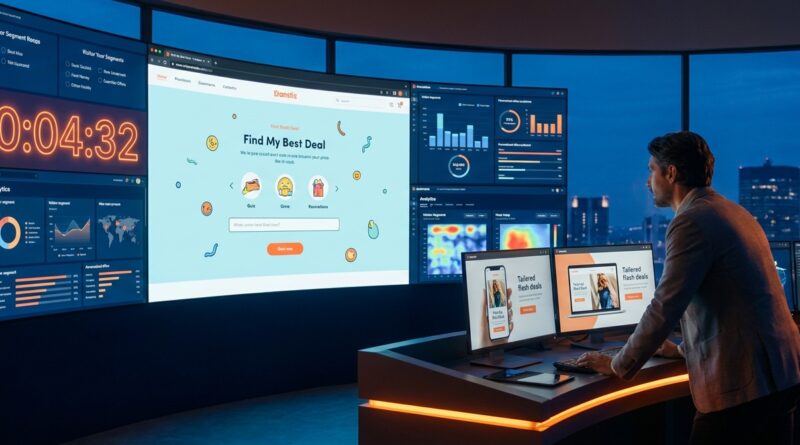
The ‘AI Deal Match Flash Sale’ Strategy: Let Shoppers Ask For Their Own Discount
Flash sales can feel a little desperate. You slap 20 percent off across the site, send the email, watch a spike in clicks, and then realize half your shoppers still are not buying. That is frustrating, especially when ad costs keep rising and customers have learned to wait for a better coupon. Many are already doing their own version of price discovery anyway. They open ten tabs, hunt for codes, abandon cart, and come back only if the deal feels right.
That is why the ai personalized flash sale strategy is so interesting right now. Instead of guessing what offer might work, you simply ask. A shopper answers a few quick questions like what they want to buy, how soon they need it, whether they prefer a bundle or a discount, and what would make them check out today. Then your system instantly returns a tailored flash offer. It feels less like a generic blast and more like a fair, fast negotiation. For many brands, that can mean higher conversions, less wasted margin, and a sale that actually matches shopper intent.
⚡ In a Hurry? Key Takeaways
- An AI Deal Match flash sale asks shoppers what they want, then gives a personalized offer instead of one blanket discount.
- Start with a simple on-site quiz or popup using 3 to 5 questions, then map answers to offers like 10 percent off, a bundle, free shipping, or a higher save for at-risk buyers.
- Keep it privacy-safe by using information shoppers choose to share in the moment, not creepy tracking or hard-to-explain data grabs.
What an AI Deal Match flash sale actually is
Think of it as a smarter version of the old “spin to win” popup.
But instead of random luck, the shopper tells you what matters to them. Maybe they want running shoes under a certain price. Maybe they are buying a gift and need fast shipping. Maybe they were about to leave because the total cost felt too high.
Your system uses those signals to show the best-fitting flash offer right away.
That could be:
- 10 percent off a product category
- 25 percent off for a likely churn-risk shopper
- Free expedited shipping for a deadline-driven buyer
- A bundle offer for someone who wants value more than a simple discount
- A gift-with-purchase for a shopper who does not need a lower price
The key idea is simple. Stop asking, “What sale should we run?” Start asking, “What sale does this shopper need?”
Why the old flash sale model is wearing out
Blanket discounts still work sometimes. They are easy to launch, easy to explain, and easy to measure.
They are also blunt instruments.
If you offer the same 20 percent off to everyone, you usually create three problems at once.
You give away margin to people who would have bought anyway
Some shoppers are already ready to buy. They do not need a deeper discount. They may respond just as well to free shipping, a bundle, or a limited-time bonus.
You still miss shoppers who wanted something different
Another group may not care about 20 percent off if the item is still above budget, or if they were hoping for a bundle, installment option, or free returns.
You train your audience to wait
When every sale looks the same, customers learn the pattern. They delay purchases because they assume another generic promo is coming soon.
This is where the ai personalized flash sale strategy stands out. It makes the sale feel specific, not automatic.
Why this works so well right now
Ecommerce is full of AI talk, but most of it sits behind the scenes. Product recommendations. Subject lines. Retargeting. Audience scoring.
Useful, sure. But shoppers rarely feel that intelligence directly during the sale itself.
An AI Deal Match flash sale brings personalization into the most visible part of the buying moment.
It works for a few reasons.
It reduces guesswork
You do not have to assume whether a shopper values price, shipping speed, bundles, or exclusivity. They tell you.
It feels interactive
People like getting an offer that feels earned or tailored. Even a short two-minute flow can feel more personal than a sitewide banner screaming “FLASH SALE.”
It can be privacy-safe
You are not depending only on third-party tracking. You are using zero-party data, meaning the customer is directly sharing preferences with you.
It protects margin better
Not every shopper gets the deepest discount. That is the whole point.
What the shopper experience should look like
Keep this simple. If it feels like homework, conversion will drop.
A good setup often looks like this:
- Shopper sees a message like “Tell us what deal would help you buy today.”
- They answer 3 to 5 quick questions.
- AI or simple rules map those answers to an offer type.
- A personalized flash offer appears instantly with a short countdown.
- The offer is applied automatically or with a unique code.
Questions worth asking
- What are you shopping for today?
- What matters most right now: lowest price, fastest shipping, bundle savings, or bonus gift?
- Are you buying today or still comparing?
- What price range feels right?
- Is this your first order or are you coming back?
Notice what is missing. You are not asking for life history. You are not making people fill out a form that belongs in a mortgage application.
Quick in. Quick out. Instant reward.
How to build it without a giant tech project
This is the part many teams overcomplicate.
You do not need a six-month rebuild to test this. A lean team can often launch a basic version in days using tools they already have, plus a popup, quiz, or landing page builder.
Step 1: Pick 3 or 4 offer types
Do not create twenty branches on day one. Start small.
For example:
- 10 percent off for high-intent shoppers
- 20 to 25 percent off for cart abandoners or return-risk visitors
- Free shipping for urgency-driven buyers
- Bundle pricing for shoppers buying across categories
Step 2: Define simple rules first
You can add more advanced AI later. At first, even logic trees work well.
Example:
- If shopper says “buying today” and cart value is high, offer bundle or free shipping.
- If shopper says “still comparing” and exit intent fires, offer a stronger discount.
- If shopper selects “gift” and “need it this week,” prioritize shipping incentive.
Step 3: Add AI where it helps, not where it sounds fancy
AI is useful for classifying intent, spotting churn risk, generating offer copy, and choosing the best offer based on past conversion data.
It is not useful if it turns a clear test into a confusing science project.
Step 4: Cap your discounts
Set guardrails. Always.
Give the system boundaries on maximum discount, excluded products, minimum order values, inventory rules, and frequency per shopper.
Where this fits with micro-segmentation
If this idea sounds a little familiar, that is because it overlaps with segmentation, just in a more visible and interactive way.
One useful companion read is The ‘Micro‑Segment Flash Sale’ Strategy: Let AI Build Different Deals For Different Shoppers In The Same Hour. That approach focuses on splitting audiences into groups and serving different deals during the same sales window.
The AI Deal Match version goes one step further. Instead of only grouping people behind the scenes, you let the shopper actively shape the offer. That is a big difference. It feels more human.
Common mistakes to avoid
Making the quiz too long
If it takes more than a minute or two, many people will bail. Keep only the questions that clearly change the offer.
Offering huge discounts too often
Personalized does not mean reckless. If every answer leads to 30 percent off, you have just built a fancier margin-killer.
Ignoring inventory and profitability
Do not push bundle offers on products with thin stock. Do not deep-discount items already selling well at full price.
Being vague about the reward
Tell the shopper what they are doing and why. “Answer 3 quick questions to unlock your best deal” is better than a mysterious popup asking for preferences with no promise attached.
Forgetting to measure incrementality
You need to know whether the personalized offer created a sale, improved average order value, or just gave away discount to someone who would have bought anyway.
What to measure in your test
If you want to know whether your ai personalized flash sale strategy is working, track more than conversion rate.
- Offer completion rate
- Redemption rate by offer type
- Conversion rate versus your standard flash sale
- Average order value
- Margin per order
- Repeat purchase rate
- Cart abandonment rate
Look for the pattern, not just the headline number. A slightly lower conversion with much healthier margin can still be the better result.
Who should try this first
This strategy is especially useful for brands that already see one or more of these issues:
- High traffic but weak flash sale conversion
- Heavy coupon dependency
- Wide product catalog with different buyer intents
- Rising paid acquisition costs
- Shoppers who often compare before buying
It is also a smart fit for lean teams because the first version does not need to be perfect. You can test one category, one traffic source, or one audience slice before rolling it out sitewide.
At a Glance: Comparison
| Feature/Aspect | Details | Verdict |
|---|---|---|
| Traditional flash sale | Same discount for every shopper, easy to launch but often wastes margin and misses intent. | Fast, but blunt. |
| AI Deal Match flash sale | Shopper answers a few questions, then gets a personalized offer based on needs and buying signals. | Best balance of relevance and control. |
| Complex full-stack personalization | Deep data, lots of integrations, powerful but often slower and harder for small teams to test quickly. | Strong long-term option, not always the best first move. |
Conclusion
Most flash sales still treat every shopper like they walked in with the same budget, same urgency, and same reason for buying. That is rarely true. The real opportunity is to stop guessing and let people tell you what kind of offer would move them. Then respond instantly with something that fits. That is why this approach matters so much right now. AI discovery and personalization are exploding in ecommerce, but most examples stay tucked away in recommendations and email flows. Using that same thinking to power the flash sale itself makes the experience feel personal, useful, and timely. It also helps protect margin in a world where traffic is expensive and discount fatigue is real. You do not need a massive rebuild to try it. Start with a few questions, a few offer types, and clear rules. A lean team can test this week and learn fast.