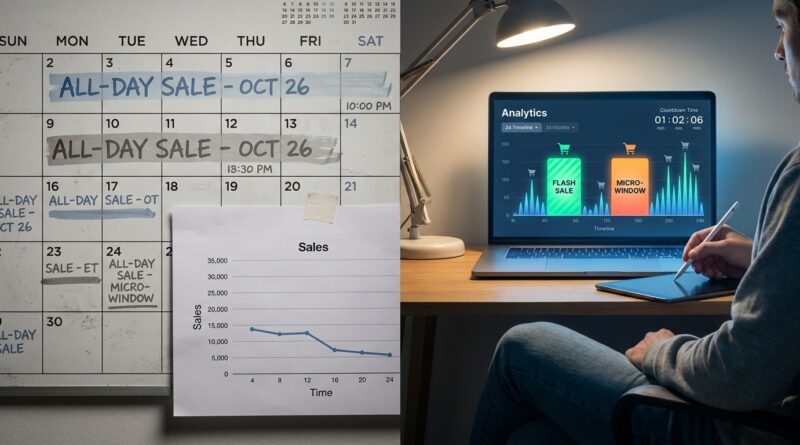
The ‘Micro‑Window Flash Sale’ Strategy: Turn Dead Traffic Hours Into Your Highest‑Converting Minutes
You can feel it when a flash sale flops. You picked the creative, set the discount, sent the emails, posted on social, and still got that flat, disappointing result. Part of the problem is timing. Too many stores cram their offers into the same busy midday slot, which means your deal lands in a pile of other deals. Shoppers get numb. Urgency drops. Your margins take the hit anyway. The smarter move is simpler than it sounds. Stop asking only what to discount, and start asking when your store already has a natural edge. An ecommerce micro window flash sale strategy means watching your real traffic and conversion patterns, then placing short 30 to 60 minute offers into the small pockets when buyers are already more likely to act. That turns quiet, oddball traffic hours into focused bursts of revenue, without training your audience to expect discounts all day.
⚡ In a Hurry? Key Takeaways
- Micro-window flash sales work best when you run them during 30 to 60 minute periods that already show higher conversion intent.
- Start by checking hourly traffic, add-to-cart, and purchase data from the last 30 to 90 days, then test two or three strong windows this week.
- Short, controlled offers protect margins better than broad all-day discounts and reduce the risk of training shoppers to wait for sales.
Why the usual flash sale timing stops working
Most small ecommerce brands follow the same playbook. Lunch break sale. Friday afternoon sale. Big weekend sale.
That sounds sensible until everyone else does it too.
When shoppers see discount after discount at the same time every week, the offer stops feeling special. It becomes background noise. You may still get clicks, but clicks are not the same as purchases. That is where discount fatigue creeps in.
The real issue is not always your product or your copy. Sometimes the timing is doing most of the damage.
What a micro-window flash sale actually is
An ecommerce micro window flash sale strategy is exactly what it sounds like. Instead of running one long sale, you run a very short offer inside a narrow time slot where your store already tends to convert better.
Think 8:30 to 9:00 p.m. on Tuesdays. Or 7:15 to 8:00 a.m. on weekdays. Or that odd little post-dinner stretch on Sundays when browsing turns into buying.
These are not random guesses. They come from your own store data.
The point is to catch people when their buying intent is naturally higher, not to force urgency into a dead hour and hope for the best.
Why this works better than longer sales
It feels more urgent
A 45-minute offer is easier to believe than a “flash sale” that runs all afternoon. Short windows make shoppers feel the clock.
It protects your margins
You are not discounting for six or eight hours just to chase the same number of conversions. You are using less time and often less discount to get a stronger result.
It helps you stand out
If competitors are all yelling at noon, your 8:00 p.m. burst may land in a much quieter inbox and ad feed.
It teaches you more, faster
Because the window is small, each test gives you cleaner feedback. You can compare one slot against another without waiting weeks to spot a pattern.
How to find your hot micro windows
You do not need fancy software to start. Use what you already have. Shopify analytics, GA4, Klaviyo, your ad dashboard, even a simple spreadsheet can get you moving.
Step 1: Pull the last 30 to 90 days of data
Look at hourly patterns, not just daily totals. You want to know when people visit, add to cart, begin checkout, and buy.
Step 2: Ignore traffic alone
This is where people get tripped up. Your busiest hour is not always your best hour. A smaller traffic block with stronger conversion can be much more valuable than a big, casual browsing period.
Step 3: Look for repeat spikes
You are hunting for consistent mini patterns. Maybe conversion rate rises between 9:00 and 10:00 p.m. three nights a week. Maybe mobile purchases jump early in the morning. Those are clues.
Step 4: Pick only two or three windows
Do not overcomplicate this. Start with a short list. Test the windows that show the strongest mix of buyer intent and manageable traffic volume.
What to put inside the window
The offer should match the short format. Keep it simple and easy to explain fast.
Good examples include:
- 10% off one featured product category for 45 minutes
- Free shipping for the next 30 minutes
- A low-inventory bundle available for one hour
- A small gift with purchase for the next 50 orders in that time block
You do not always need a deep discount. Often, speed and clarity beat size.
How to announce it without exhausting your audience
This part matters. If you blast your full list every time, you will wear people out.
Instead, keep the audience tight. Use the segment most likely to care. Recent visitors. Cart abandoners. Category browsers. VIP buyers.
If you want to get more precise, this pairs nicely with audience-level offer testing. A good next read is The ‘Micro‑Segment Flash Sale’ Strategy: Let AI Build Different Deals For Different Shoppers In The Same Hour. That approach is about changing the offer by shopper type, while the micro-window method changes the timing. Put together, they can make a short sale feel much smarter.
A simple test plan for this week
Day 1: Find your windows
Review hourly data and pick three candidate slots.
Day 2: Match each slot with one offer
Keep the product and discount clean. No complicated rules.
Day 3: Build the message
Write one email, one SMS if you use it, and one onsite banner. Make the deadline obvious.
Day 4 to Day 7: Run the tests
Launch one micro-window at a time. Do not stack too many variables. If possible, keep traffic sources and product focus fairly stable so you can compare results.
After each test: Record four numbers
- Revenue during the window
- Conversion rate during the window
- Average order value
- Margin impact
If one slot wins with a lighter discount, that is gold. Keep going.
Mistakes to avoid
Running them too often
If every day has a micro-window sale, it is not a micro-window strategy anymore. It is just constant discounting in smaller pieces.
Choosing windows based on guesswork
Your own buying behavior is not your customer data. Check the numbers first.
Using weak creative
Short sale windows need clear language. Say what the deal is, who it is for, and exactly when it ends.
Ignoring margin
A short sale that boosts orders but crushes profit is still a bad sale. Measure both.
Training customers to wait
Rotate products, segments, and timing. The goal is to create sharp moments of action, not a pattern shoppers can game.
Who should use this strategy first
This works especially well for solo founders, lean ecommerce teams, and stores with uneven traffic throughout the day.
If you have those strange pockets where visitors show up but standard campaigns underperform, this is worth trying. It is also useful if you are tired of spending time building giant sale events that barely move the needle.
You do not need more noise. You need better timing.
At a Glance: Comparison
| Feature/Aspect | Details | Verdict |
|---|---|---|
| Traditional flash sale timing | Usually runs during crowded midday or weekend periods when many brands are promoting at once. | Easy to schedule, but often weaker urgency and more discount fatigue. |
| Micro-window timing | Targets 30 to 60 minute windows when your own conversion data already looks stronger. | Best for protecting margins and getting more from smaller traffic bursts. |
| Operational effort | Needs simple analytics review, tight messaging, and disciplined testing rather than big campaign planning. | Very practical for small teams using tools they already have. |
Conclusion
If your flash sales keep feeling like a lot of work for a lot of shrugging, the fix may not be a bigger discount. It may be a smaller window. Right now, everyone is shouting about what to discount and almost no one is talking about when not to discount. Micro-window flash sales help our community protect margins by only dropping prices in the 30 to 60 minute pockets where conversion is already naturally higher, so every sale feels like a win instead of a gamble. It is a simple shift that solo founders and small teams can implement this week using tools they already have. Read your real-time traffic and conversion data, pick two or three hot micro windows, and run tightly controlled offers that disappear before they can burn out your list or train shoppers to wait for deals.