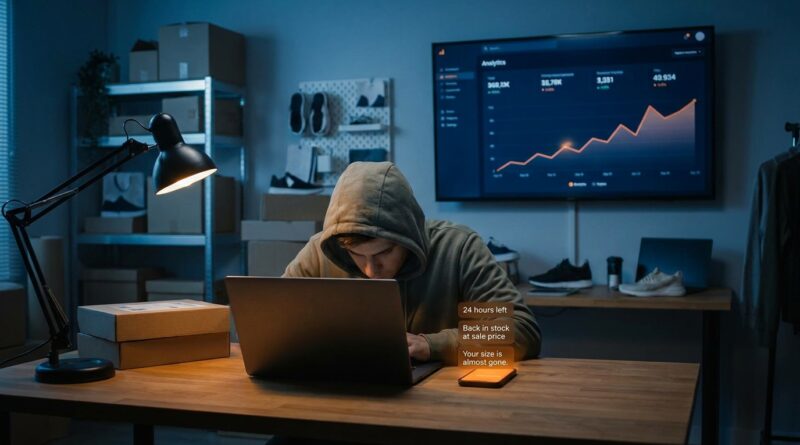
The ‘Text-Back Flash Sale’ Strategy: Turn One SMS Into A 24-Hour Revenue Loop
Flash sales can feel embarrassing when you have spent hard money on ads, watched traffic pop for a few hours, then seen the whole thing go quiet before lunch. That is the part nobody likes to say out loud. The sale is not always bad. The problem is often the setup. A lot of brands treat a flash sale like a single announcement, then hope people come back on their own. Most do not. That is where a smart ecommerce sms flash sale strategy earns its keep. Instead of paying again to chase the same shopper, you use text messages to bring back the people who already showed intent. One text starts the sale. A few well-timed follow-ups keep it alive for 24 hours. Done right, this is not spammy. It is simple timing. You are catching product viewers, cart abandoners, and last-minute fence sitters right when they are most likely to buy.
⚡ In a Hurry? Key Takeaways
- A strong ecommerce sms flash sale strategy turns one launch text into a 24-hour revenue loop with follow-ups tied to shopper behavior.
- Start with three core triggers: product view, cart view or abandoned cart, and final countdown before the offer ends.
- Keep texts short, send only to opted-in users, and cap frequency so urgency feels helpful instead of annoying.
Why flash sales fade so fast
The usual pattern is painfully familiar. You send an email, post on social, turn on ads, maybe get a nice spike, then things flatten out. Not because nobody cares, but because most people do not buy on the first look.
Some browse. Some compare prices. Some get distracted by work, kids, dinner, life. By the time they remember, the moment feels gone.
That is why the one-and-done approach is weak. It depends too much on first-touch traffic. If you already paid to get that shopper to your site, you should have a plan to bring them back while the sale is still live.
What the text-back flash sale strategy actually is
Think of it as a simple sequence, not a giant automation project.
You send the first SMS when the sale starts. Then, over the next 24 hours, you send behavior-based texts to people who showed intent but did not finish buying. That includes people who viewed a product, added to cart, or clicked but left. Then you close with a countdown text near the end.
The goal is not to blast everyone over and over. The goal is to send the right nudge at the right moment.
The 4-part loop
Here is the basic flow.
1. Launch text. Announce the sale clearly. State the offer, the time limit, and the link.
2. Product-view reminder. If someone looked at a sale item but did not buy, text them a few hours later with that product or category in mind.
3. Cart recovery text. If they added to cart and left, send a direct reminder while urgency is still real.
4. Final countdown text. Send a last call message when the sale is close to ending.
That is your 24-hour revenue loop. Same audience. More chances to convert.
Why SMS works better here than just more ads
Ads are still useful, but they are expensive and noisy. SMS is different. It lands in a place people actually check. More important, it works best with high-intent shoppers who already know your brand.
You are not trying to introduce yourself from scratch. You are reminding someone who was already close.
This is also why flash sales pair so well with SMS. The timing matters. Urgency matters. A text can reach someone fast enough to influence the sale window, not three days later when the energy is gone.
How to build a practical ecommerce sms flash sale strategy
Step 1: Start with one clean offer
Do not make the sale confusing. Pick one offer people can understand in a second.
Examples:
20% off sitewide for 24 hours.
Buy one, get one 50% off until midnight.
Free gift with orders over $75, today only.
If the offer needs a paragraph of explanation, it is too messy for SMS.
Step 2: Segment by intent, not just by list size
This is where many brands miss easy money. They send the same message to the whole list.
Better approach:
- All subscribers get the launch text.
- Product viewers get a product-specific reminder.
- Cart abandoners get a checkout-focused reminder.
- Recent buyers can get a cross-sell or second-order text if the offer makes sense.
The more the message matches what the shopper actually did, the better it usually performs.
Step 3: Time the texts around behavior
You do not need ten messages. Three or four good ones is often enough.
A practical schedule for a 24-hour sale might look like this:
9:00 AM: Sale launch text to your opted-in list.
1:00 PM: Product-view reminder to people who browsed but did not buy.
5:00 PM: Cart reminder to shoppers who started checkout or added to cart.
8:00 PM or 2 hours before close: Final countdown text.
That spacing gives the sale room to breathe while still keeping urgency alive.
Step 4: Keep the copy short and human
SMS is not the place for brand poetry. Be clear. Be warm. Get to the point.
Here are some examples:
Launch:
Flash sale is live. 20% off ends tonight at midnight. Shop now: [link]
Product view:
Still thinking about that hoodie? It is part of today’s flash sale. 20% off ends tonight: [link]
Cart reminder:
Your cart is still waiting. Checkout now before the flash sale ends tonight: [link]
Final countdown:
Last call. Flash sale ends in 2 hours. Grab your favorites before it is gone: [link]
No tricks. No fake hype. Just helpful urgency.
Where the extra revenue really comes from
The win is not just recovering abandoned carts. It is also creating second and third chances to buy from the same paid traffic.
That matters because ad costs are rough right now. If a shopper clicks an ad, visits a product page, leaves, then comes back from a text and buys, you just stretched the value of that original click.
If someone buys early in the day and gets a smart follow-up for a matching item before the sale ends, that can raise average order value too.
In other words, the sale stops being one spike. It becomes a loop.
Common mistakes that make SMS flash sales flop
Sending too many texts
Urgency is useful. Annoyance is expensive. If every few hours brings another generic message, unsubscribe rates go up fast.
Use suppression rules. If someone buys, stop sending them cart reminders for that sale.
Making every text identical
If the launch text, reminder text, and countdown text all say the same thing, shoppers tune out.
Each message should have a job.
Ignoring product viewers
Most brands focus only on abandoned carts. That leaves a lot on the table.
Product viewers are warm. They may not have added to cart yet, but they were interested enough to browse. A good reminder can move them over the line.
Forgetting the landing page experience
If the text says “ends tonight” but the site is slow, cluttered, or unclear, you lose the moment.
The sale page should load fast, show the discount clearly, and make checkout easy on a phone.
How this compares to social-led flash sales
If your sale starts with short-form video buzz, that can work very well too. In fact, pairing a social spike with SMS follow-up is often even stronger. If you want to see the social side of that setup, The ‘TikTok Warm-Up Flash Sale’ Strategy: Turn One Viral Clip Into A 3‑Hour Revenue Spike is worth a look. TikTok can create the rush. SMS can keep it going after that first burst fades.
A simple setup any merchant can start with
You do not need enterprise software and a seven-person retention team to test this.
Start with:
- An SMS platform that supports opted-in subscriber campaigns
- Basic behavior triggers for product views and carts
- One sale landing page
- A 24-hour message plan written before the sale starts
Then run one flash sale and compare it to your last one.
Look at:
- Revenue from SMS
- Recovered carts
- Conversion rate by text send
- Average order value
- Unsubscribe rate
You do not need perfection. You need proof that better timing beats louder spending.
At a Glance: Comparison
| Feature/Aspect | Details | Verdict |
|---|---|---|
| One-time blast vs timed SMS loop | A single announcement creates a spike. A timed loop follows up with product viewers, cart abandoners, and last-call shoppers. | Timed SMS loop wins for sustained 24-hour sales. |
| Audience targeting | Generic sends treat everyone the same. Behavior-based texts match the message to the shopper’s actual actions. | Behavior-based targeting usually converts better. |
| Cost efficiency | More ads often mean more spend. SMS follow-up squeezes more value from traffic you already paid to acquire. | Better for merchants trying to protect margins. |
Conclusion
Flash sales do not hit like they used to when they rely only on the first burst of traffic. That is the real issue. Not that flash sales are dead, but that too many brands stop after the first announcement. A smart ecommerce sms flash sale strategy gives your sale a second life, and sometimes a third, without paying all over again for the same attention. By timing simple, high-intent text pings around product views, carts, and the final countdown, you can squeeze more revenue from the exact audience you already worked hard to bring in. With ad costs where they are, that is not a nice bonus. It is one of the easiest ways to stop leaving money on the table.