The ‘Inbox-Surge Flash’ Strategy: Turn One Smart Email Sprint Into A 6‑Hour Revenue Spike
You send one “48 hours only” promo, watch a nice sales bump come in, then spend the next week wondering why open rates fell off a cliff. That is the trap. Email is still the best converting channel for most ecommerce brands, but it is also the easiest one to overwork. If every soft week gets fixed with a giant last-chance blast, your list gets tired, spam filters get suspicious, and the next campaign has to fight harder just to be seen. Frustrating, because the problem is not that flash sales do not work. It is that most brands send them too wide, too fast, and too often.
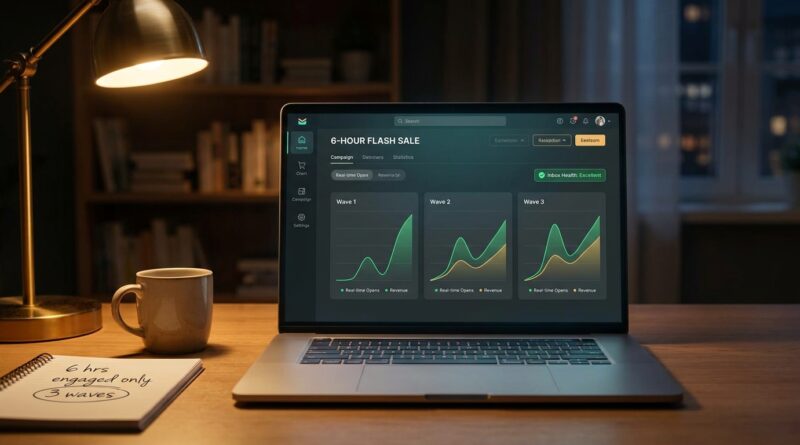
A better ecommerce flash sale email strategy is the “Inbox-Surge Flash.” Think of it as a controlled 6-hour sprint, not a panic blast. You send three short waves to your warmest recent buyers and engagers, pace volume by region so emails land during real shopping hours, and make each wave a little stronger than the last. The goal is simple. More revenue per subscriber, less damage to list health, and a repeatable playbook you can use whenever cash flow needs a quick lift.
⚡ In a Hurry? Key Takeaways
- Use a 6-hour, three-wave send to recent openers, clickers, and buyers instead of blasting your whole list.
- Split sends by region and local shopping time, then increase the offer strength slightly in each wave.
- This approach protects deliverability better than a full-database promo and is easy to set up in Klaviyo, Omnisend, Postmark, or similar tools.
Why the usual flash sale email causes trouble
Most brands do the same thing under pressure. Sales are soft. Inventory needs to move. Cash is tight. So they send one big promo to everyone with a subject line that screams urgency.
It feels efficient. It often is not.
Inbox providers look at engagement patterns. If a big chunk of your list ignores the email, deletes it, or never opens it, that sends a bad signal. Not always instantly. But enough of those signals can drag down placement for days after the sale.
That is why the best ecommerce flash sale email strategy is usually more selective, not louder.
What the “Inbox-Surge Flash” actually is
The Inbox-Surge Flash is a short promotional window, usually 6 hours, broken into three waves. Each wave goes to the people most likely to buy, and each one gets a slightly stronger reason to act.
Wave 1: Warmest buyers first
Start with your hottest audience. People who bought recently, or opened or clicked in the last 30 days. These subscribers are the least likely to hurt deliverability and the most likely to convert fast.
Wave 2: Engaged, but not hottest
About 2 hours later, send to a slightly broader segment. Think openers or clickers in the last 45 to 60 days who did not receive Wave 1, or who received it but did not buy.
Wave 3: Strongest incentive, still controlled
In the final 2 hours, send the strongest version of the offer to the non-buyers from the first two waves and any remaining warm segment you trust. This is where you add the extra nudge. Free shipping. A gift. A deeper discount on select items.
The key point is this. You are not sending three times to everybody. You are sequencing warm segments on purpose.
Why this works better than one giant blast
It matches how people actually shop.
Some buyers jump on a good offer right away. Others need a reminder. Others only move when the deal gets a little sweeter. The three-wave setup captures all three behaviors without dragging your entire database into a high-risk send.
It also gives you a chance to react in real time. If Wave 1 is converting like crazy, maybe you do not need to open the gates wider. If Wave 1 underperforms, you can adjust the subject line, creative, or offer before Wave 2 goes out.
Who should get these emails
This part matters more than the copy.
Your safest audience is people who have shown recent intent. A simple version looks like this:
- Placed an order in the last 60 days
- Opened an email in the last 30 to 45 days
- Clicked an email in the last 45 to 60 days
- Did not unsubscribe, bounce, or mark spam
If your list is smaller, you can loosen the engagement window a bit. If your deliverability has been shaky, tighten it. The goal is not maximum reach. It is maximum response from the people most likely to welcome the message.
How to cap volume by region
This is one of the smartest parts of the system, and it is often missed.
If you send your whole list at once, you create a sharp spike in volume. That can look suspicious to mailbox providers, especially if engagement is mixed. It also means plenty of subscribers get the email at a bad local time.
Instead, group your send by region or time zone.
Simple example
Send Wave 1 to East Coast subscribers at 10 a.m. their time. Then Central. Then Mountain. Then Pacific. Keep each regional block aligned with a realistic shopping hour.
This spreads demand, smooths sending volume, and gives the campaign a better shot at landing when people are actually checking email.
How the offers should change across the three waves
You do not need to start with your deepest discount.
That is one of the big mistakes brands make. They train subscribers to wait for the biggest offer. Better to step the offer up gradually.
Wave 1 offer
Use the cleanest, simplest version. Example: 15% off for 6 hours.
Wave 2 offer
Keep the main discount, but add urgency or specificity. Example: 15% off ends today, bestsellers are going fast.
Wave 3 offer
Add the stronger incentive only if needed. Example: 15% off plus free shipping for the final 2 hours, or a free gift over a threshold.
This structure protects margin while still giving late buyers a real reason to move.
What to write in each email
Keep it short. Flash sale emails are not the place for long storytelling.
Wave 1 copy
Clear subject line. Clear deal. Clear button. Show 1 to 3 products, not 20.
Wave 2 copy
Use a reminder angle. Mention the end time. Feature social proof or a bestseller.
Wave 3 copy
Use your strongest urgency. Be specific. “Ends at 6 p.m.” works better than vague pressure.
A good rule is one email, one message, one click path.
How to set it up in one afternoon
You do not need an enterprise team for this.
In Klaviyo, Omnisend, or similar tools, create three segments or dynamic audiences based on recent engagement and purchase behavior. Build one email template and make light edits for each wave. Then schedule the sends with regional timing and suppression rules so buyers from Wave 1 do not get pushed into Wave 2.
If you use Postmark or another sending setup, the same logic still applies. The tool matters less than the segmentation and pacing.
Guardrails that keep list health intact
Think of these as your “do not be clever” rules.
- Do not send to cold subscribers just because revenue feels urgent.
- Do not hit the same people with multiple waves if they already bought.
- Do not change your sending domain or from-name right before the flash.
- Do not use fake scarcity or fake countdowns.
- Do not run this every other day. The whole point is control.
If your brand also runs bigger event-based promotions, it helps to keep those structured too. A good example is The ‘Anniversary Anchor Flash’ Strategy: Turn Brand Birthdays Into Your Highest-Converting 48 Hours, which works well when you want a planned promotional moment instead of a quick 6-hour cash burst.
What success should look like
Do not judge this only by top-line revenue.
Look at:
- Revenue per recipient
- Open rate by wave
- Click rate by wave
- Spam complaints
- Unsubscribes
- Conversion rate from warm segments
If revenue is solid and complaints stay low, you have a repeatable playbook. That is far more useful than one lucky blast that trashes next week’s sends.
When not to use this strategy
If your deliverability is already in rough shape, fix that first. Warm your domain. Clean your list. Improve your regular campaigns. A flash strategy cannot rescue a deeply unhealthy email program.
Also skip this if your audience buys on a long consideration cycle. A 6-hour sprint works best for brands with impulse-friendly products, repeat purchase behavior, or a community already trained to respond to short promos.
At a Glance: Comparison
| Feature/Aspect | Details | Verdict |
|---|---|---|
| Audience targeting | Recent buyers, openers, and clickers from the last 30 to 60 days only | Best for protecting deliverability and improving conversions |
| Send structure | Three waves over 6 hours, paced by region and local shopping time | Smarter than a single full-list blast |
| Offer strategy | Start with a clean offer, then add stronger urgency or perks in later waves | Helps maximize revenue without giving away margin too early |
Conclusion
Flash sales are not going away. If anything, more ecommerce brands are leaning on them to patch soft weeks and generate fast cash. The problem is that inbox fatigue and stricter spam filtering can turn a quick win into a deliverability headache that hangs around for days. That is why this ecommerce flash sale email strategy makes sense. A simple 6-hour, three-wave Inbox-Surge Flash lets you use email’s huge conversion power without beating up your list. Send only to buyers and subscribers who opened or clicked recently. Cap volume by region so emails land during real shopping hours. Increase the offer strength across the waves so you earn more from each subscriber instead of carpet-bombing your whole database. For lean teams, this is practical. You can build it in one afternoon in Klaviyo, Postmark, Omnisend, or whatever you already use, then pull it off the shelf whenever you need a controlled revenue spike instead of gambling on one giant blast getting clipped, filtered, or ignored.