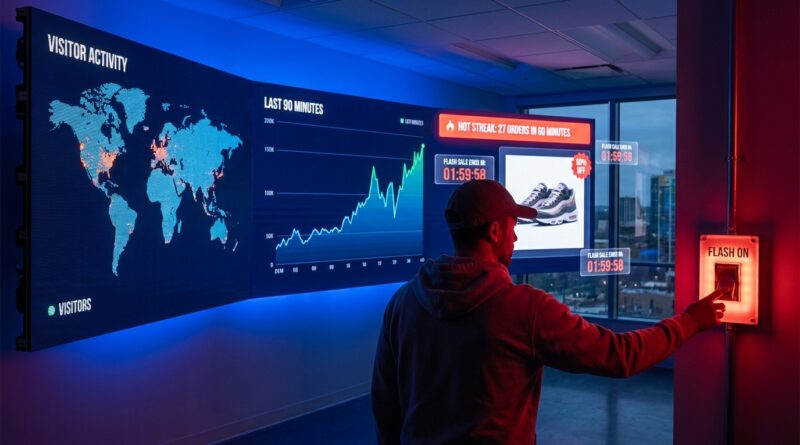
The ‘Hot Streak Flash’ Strategy: Turn Live Buyer Surges Into Your Highest-Converting 90‑Minute Sale
You know the feeling. You finally run a flash sale, slash prices, send the email, post the story, and then. Nothing special happens. Or worse, traffic had spiked two hours earlier and you missed the moment. That is what makes flash sales so frustrating. The timing matters more than the discount, but most stores still plan promos by date instead of buyer behavior. A real time ecommerce flash sale strategy fixes that. Instead of guessing when shoppers are ready, you watch for a short burst of clear buying signals, then launch a tight 90-minute offer while interest is already hot. It is less about being loud and more about being well-timed. The good news is you do not need a giant team or fancy software to start. You just need a simple trigger, one focused offer, and a fast way to get the sale in front of shoppers before that little wave disappears.
⚡ In a Hurry? Key Takeaways
- A real time ecommerce flash sale strategy works best when you trigger it from live buyer behavior, not a preset calendar date.
- Start with one product, one clear trigger, and a 90-minute window so you can move fast without training customers to wait for big discounts.
- Keep discounts modest and honest. The goal is to catch real buying intent, protect margins, and avoid fake scarcity tactics.
Why most flash sales underperform
Most stores do not have a discount problem. They have a timing problem.
A flash sale dropped on a quiet Tuesday afternoon can flop even if the offer is good. The exact same offer can do very well if buyers were already circling, adding items to cart, revisiting product pages, or coming in from a creator mention or email click burst.
That is the heart of the Hot Streak Flash strategy. You do not create demand out of thin air. You catch it while it is forming.
This is why behavior-based promos are getting more attention. Ad costs are high. Attention is all over the place. And every store has those odd little surges where one product suddenly wakes up for no obvious reason. If you can spot that mini wave and respond fast, you can often get a stronger conversion lift with a smaller discount.
What a ‘Hot Streak Flash’ actually is
A Hot Streak Flash is a short sale, usually 90 minutes, triggered by live shopper activity on a product or small product group that is already showing stronger-than-normal intent.
The key idea
You are not asking, “When should we run a sale this week?”
You are asking, “What are shoppers trying to buy right now?”
Common signs of a hot streak
Look for simple signals like these:
- A product page gets 2x to 3x its normal traffic in the last hour
- Add-to-cart rate jumps above its daily average
- Repeat visits rise for the same item
- An email click, influencer mention, or social post sends a sudden burst of targeted traffic
- Checkout starts increase, but orders are not closing at the same pace
That last one is especially useful. It often means buyers are interested but need a nudge, not a giant markdown.
Why 90 minutes works so well
Ninety minutes is short enough to feel urgent and long enough to spread through your channels.
It gives you time to send an email, post on social, trigger your SMS list, and show an on-site banner without leaving the offer open so long that the urgency dies. It also helps avoid the “I’ll come back later” problem.
A good flash sale should feel like a moment, not a week-long event pretending to be urgent.
How to build a tiny Hot Streak Flash playbook
1. Pick your trigger before the surge happens
This is important. Do not make the rules while you are in the middle of a traffic spike.
Create 2 or 3 triggers in advance. For example:
- Product gets 150 visits in 60 minutes and add-to-cart rate is above normal
- Cart adds double versus the same hour over the last 7 days
- Traffic from a campaign lands on one SKU and conversion starts lagging
Keep it simple. If your team needs a spreadsheet, a Slack alert, and a committee meeting just to decide whether to act, you will miss the streak.
2. Choose one offer type
Do not overcomplicate the incentive. Pick one format and repeat it until you know what works.
Common options include:
- 10 percent off for 90 minutes
- Free shipping for the hot product category
- A free gift with purchase on the featured item
- A small bundle upgrade
If you want to make the offer more profitable, pairing this approach with a bundle can work really well. That is where The ‘Smart Bundle Flash’ Strategy: Turn One High‑Margin Combo Into Your Most Profitable 24‑Hour Sale is worth a look. It is a nice fit when your hot streak is centered around products that naturally sell better together.
3. Set a discount ceiling
This protects you from panic decisions.
Write down your maximum acceptable offer for each product tier. Maybe it is 10 percent for premium items, 15 percent for aging stock, and free shipping only for low-margin goods. The point is to stop the team from reaching straight for 25 percent off just because traffic got exciting.
4. Prepare your launch assets now
You do not want to write copy from scratch during a live surge.
Have these ready:
- One site banner template
- One email layout
- One SMS template
- One social post format
- One countdown block or announcement bar
Then you just swap in the product name, offer, and end time.
5. Make the message match the moment
The copy should sound direct and honest.
Something like: “This item is getting a lot of attention today, so we are opening a 90-minute offer. Take 10% off until 3:30 PM.”
That feels more believable than shouting “LAST CHANCE” for the fourth time this week.
What data you actually need
You do not need a giant analytics stack to run a real time ecommerce flash sale strategy.
For most stores, these five numbers are enough:
- Product page sessions by hour
- Add-to-cart rate
- Checkout starts
- Conversion rate
- Revenue per visitor
If you can compare the last 60 to 90 minutes against a recent baseline, you can spot a hot streak.
A simple rule of thumb
If traffic is up but add-to-cart rate is flat, the product may just be getting curiosity clicks.
If traffic is up and cart activity is up, you may have a real buying wave.
If checkout starts are up but purchases lag, that is often your best window for a flash incentive.
How to avoid training shoppers to wait for discounts
This is the fair concern with any flash tactic. If you run them too often, customers catch on.
That is why Hot Streak Flash works best with guardrails.
Use it selectively
Do not trigger on every little bump. Save it for products with real movement.
Keep the window tight
Ninety minutes feels special. A 24-hour “flash” sale feels routine.
Vary the incentive
Not every streak needs a percent-off deal. Sometimes free shipping or a bonus item protects margin better.
Do not fake scarcity
If stock is plentiful, do not pretend otherwise. Real urgency comes from timing, not gimmicks.
Where this strategy works best
Not every product deserves the same treatment.
Best fits
- Items with solid margins
- Products that already get repeat visits before purchase
- Products boosted by social mentions or creator content
- Seasonal or trend-sensitive items
- Products with natural add-ons or bundle potential
Use caution with
- Very low-margin products
- Custom or made-to-order items
- Products with inventory issues
- Items that sell steadily without incentives
A practical example
Let us say one skincare serum usually gets 40 product views an hour. Suddenly it gets 130 in 50 minutes after a creator mention. Add-to-cart rate jumps from 5 percent to 11 percent. Checkout starts rise too, but completed orders do not.
That is your signal.
You launch a 90-minute offer. Maybe it is free shipping plus a sample with purchase. You push it through the site banner, SMS, and email. Because buyers were already interested, you do not need a giant discount. You are just helping them decide now instead of later.
That is the difference. You are not trying to wake up a sleepy product. You are stepping into a live conversation shoppers are already having with their wallets.
Common mistakes that kill the result
Making the sale too broad
A sitewide offer is tempting, but it waters down the signal. Stay close to the product or category showing the heat.
Waiting for perfect certainty
You will never get a flashing sign that says, “Run the promo now.” Build a clear threshold and act when it hits.
Discounting too deeply
If buying intent is already high, a small nudge often does the job. Bigger discounts are not always smarter. They are just more expensive.
Skipping the post-mortem
After each flash, review what happened. Which trigger worked? Which channel moved fastest? Did margin hold up? Did conversion lift justify the offer?
This is how you turn a tactic into a repeatable system.
How often should you use it?
For most stores, less is better.
One or two strong Hot Streak Flash events a week can outperform a constant stream of random promotions. You want customers to feel a real moment when it appears, not assume another one is coming by dinner.
At a Glance: Comparison
| Feature/Aspect | Details | Verdict |
|---|---|---|
| Trigger timing | Behavior-based. Launches when traffic, cart adds, or checkout starts spike on a product. | Better than calendar-only sales for catching real buyer intent. |
| Discount size | Usually smaller. The sale rides an existing surge instead of trying to create one from scratch. | Good for margin protection if your trigger is strong. |
| Operational effort | Needs simple alerts, prebuilt creative, and a fast approval path. | Very manageable for small teams if the playbook is prepared ahead of time. |
Conclusion
You do not need more noise. You need better timing. That is the real promise of a real time ecommerce flash sale strategy. The shift right now is moving away from calendar-based promos and toward behavior-based promos that respond to what shoppers are doing this hour, not this month. By building a small Hot Streak Flash playbook, The Deal community can squeeze more revenue out of traffic they already have instead of waiting for cheaper ads or a bigger email list to save the day. That matters because ad costs are up, attention is scattered, and every store has products that suddenly catch fire for no clear reason. If you can spot those mini waves and drop a fast, honest, time-boxed incentive while intent is peaking, you can lift conversions with a smaller discount, protect your margins, and create real FOMO without resorting to fake scarcity.