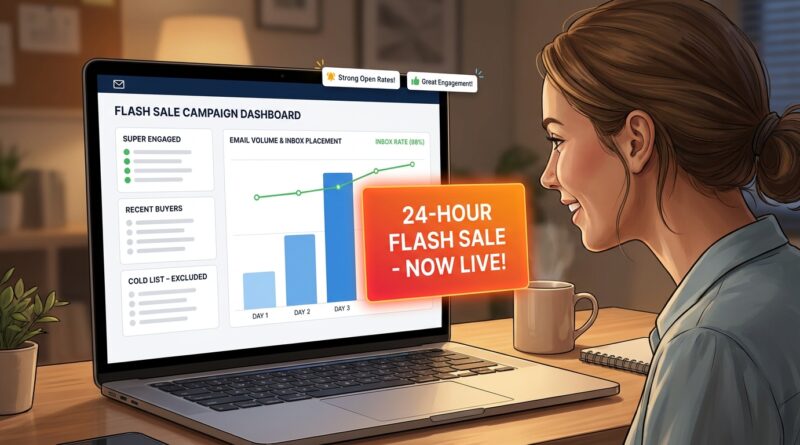
The ‘Deliverability-Safe Flash’ Strategy: Run Aggressive Sales Without Killing Your Email Reach
You line up a flash sale, hit send harder than usual, and for a few hours it feels great. Orders come in. Then the hangover starts. Open rates sag. Gmail gets suspicious. Outlook gets picky. Your ESP starts tossing little warning signs at you, and the next campaign underperforms before it even has a chance. That is the part most brands do not plan for. A flash sale is supposed to create urgency, not quietly damage the email channel you depend on every week. The fix is not to stop promoting. It is to change how you ramp up and ramp down. A smart flash sale email deliverability strategy uses smaller early sends, tighter segments, one true peak, and a controlled cooldown after the sale. That keeps engagement healthier, complaint rates lower, and inbox placement steadier. You still get the sales bump, but you are less likely to spend the next week trying to recover from it.
⚡ In a Hurry? Key Takeaways
- Do not blast 3 to 4 times your normal volume all at once. Stair-step your sends so inbox providers can adjust.
- Start with your most engaged segment, expand carefully, then reduce volume gradually after the sale ends.
- This protects deliverability now and helps the next 10 campaigns land in the inbox instead of spam or promotions limbo.
Why flash sales hurt deliverability so easily
Email providers watch patterns. Not just content, but behavior. If you normally send 40,000 emails on a campaign day and suddenly fire off 140,000 in one shot, that looks risky. Even if your intentions are fine, the systems at Gmail, Yahoo, and Outlook do not know that. They just see a volume spike, changing engagement, and more chances for complaints or ignores.
That is why so many ecommerce founders see the same ugly pattern. Day one revenue looks solid. Day two and day three inbox placement drops. Fewer people see the offer. Fewer people click. The sale did not just cost you performance on that send. It may have hurt the next few sends too.
What a deliverability-safe flash looks like
A better flash sale email deliverability strategy treats the promotion like a ramp, not a cannon blast. You warm the audience, send hardest to the people most likely to engage, hit your highest volume only once trust signals are strong, then walk volume down after the event.
Think of it like merging onto a highway. Smooth is fast. Jerky is dangerous.
Step 1: Warm up before the sale
Do not make the first sign of your promotion the biggest send of the month. Start 24 to 72 hours before the flash with smaller, high-interest messages. These can be early access teasers, VIP notice emails, waitlist reminders, or product-specific alerts.
Your goal here is simple. Generate opens and clicks from the people who already like hearing from you. That gives inbox providers a fresh signal that your mail is wanted.
This is also where list quality matters. If you have a quiet chunk of subscribers you want to wake up before the main push, it is worth reading The ‘Warm List Flash’ Strategy: Turn Quiet Subscribers Into Your Highest-Converting Sale Of The Month. It pairs well with this approach because it helps you decide who should get the first nudge and who should not.
Step 2: Send to your hottest segment first
Your first meaningful sale send should go to the people most likely to open, click, and buy. Usually that means subscribers who engaged in the last 30 to 60 days, recent customers, VIPs, and anyone who clicked similar product categories lately.
Why start there? Because high engagement early in the promo creates the strongest possible reputation signal. That gives you a safer runway for later sends.
If your list is large enough, break this group into waves over several hours instead of all at once.
Step 3: Expand in controlled stages
Once your first wave performs normally or better, expand. Move to moderately engaged subscribers. Then to broader segments if needed. This is the stair-step part.
A simple version might look like this:
- Wave 1: Engaged in last 30 days
- Wave 2: Engaged in last 31 to 90 days
- Wave 3: Category browsers, past buyers, or sale-specific interest groups
- Wave 4: Broader promotional audience, only if your earlier waves held up well
This is much safer than dumping the whole database into one send and hoping the algorithm is in a good mood.
Step 4: Peak once, not repeatedly
Many brands make the same mistake twice. They spike volume in the morning, then do another near-identical blast in the evening. That can push complaint rates up and tank engagement fast.
A safer plan is to build to one main peak. Make that your biggest send. Then use more selective follow-ups after that. For example, resend to non-openers only if your deliverability is holding up and your segment is reasonably engaged. Better yet, use a different subject line and a narrower audience.
Step 5: Cool down after the flash
This is the part people skip. The sale ends, and they either go silent or suddenly switch back to business as usual. Neither is ideal.
Instead, step volume down. Send a post-sale message to buyers. Send a gentler follow-up to engaged non-buyers. Then return to normal cadence over the next few campaigns. This helps inbox providers see a controlled return to baseline instead of chaotic swings.
How to segment without making it complicated
You do not need a giant data team to do this well. For most small ecommerce brands, four simple segments are enough:
- Highly engaged: Opened or clicked in the last 30 days
- Moderately engaged: Opened or clicked in the last 31 to 90 days
- Recent buyers: Purchased recently, even if email engagement is mixed
- Cold subscribers: No engagement in 90 days or more
Your flash sale should focus first on the top three groups. Cold subscribers are where trouble starts. If you hit them hard during a volume spike, they are more likely to ignore, delete, or complain. All three hurt reputation.
If you insist on mailing them, do it later, in a smaller batch, and only if the earlier waves were healthy.
What to watch during the sale
You do not need to stare at a dashboard every five minutes, but you do need a few basic signals:
- Open rate trend: A sudden drop can mean placement trouble
- Click rate: Better than opens alone for measuring real interest
- Complaint rate: Even a small rise matters during high-volume sends
- Bounce rate: If it jumps, list quality may be worse than you thought
- Spam folder placement clues: Seed tests or inbox reports from your ESP can help
If these start moving the wrong way, do not force the next wave just because it is on the calendar. Slow down. Narrow the audience. Adjust the message.
Creative choices that make sends safer
Deliverability is not only about send volume. Relevance matters too. The more a subscriber feels like the message is for them, the safer the campaign usually is.
Use specific angles
Instead of one generic “Flash Sale Ends Tonight” email to everybody, send category-specific versions where possible. Running shoe shoppers should not get the same pitch as home decor buyers.
Keep subject lines urgent, not shady
You can create urgency without sounding like a scam. Clear beats clever. “VIP early access: 24 hours only” is better than “OPEN NOW!!!”
Do not over-mail the same person
Frequency matters during a flash. Two or three well-timed emails to the right person can work. Five or six broad sends in a day usually does more harm than good.
A sample 24-hour schedule
Here is a simple version many brands can use for Memorial Day, Hot Sale-style events, or any one-day promotion:
- Day before, morning: Teaser to highly engaged subscribers
- Day before, evening: Early access or reminder to VIPs and recent buyers
- Sale day, morning: Main send to highly engaged group
- Sale day, early afternoon: Expand to moderately engaged group if metrics are stable
- Sale day, evening: Final-hours send to clickers, product viewers, and non-buying engaged subscribers
- Next day: Thank-you or post-sale follow-up, then return toward normal cadence
Notice what is missing. No giant all-list blast. No panic resend to everyone. No sharp stop right after peak volume.
Common mistakes that quietly wreck the week after
Sending to cold subscribers just to pad reach
This feels smart in the moment. It often backfires. More total sends does not mean more inbox placement.
Ignoring promo fatigue
If people got multiple sale emails last week, they may not tolerate the same pressure this week. Watch recency and fatigue, not just list size.
Stopping volume too abruptly
Inbox providers notice spikes and crashes too. A smooth comedown is safer than a cliff.
Judging the sale only by day-one revenue
If your flash made money but hurt the next five campaigns, you need to count that cost too.
At a Glance: Comparison
| Feature/Aspect | Details | Verdict |
|---|---|---|
| Big one-shot blast | Fast to set up, but causes sudden volume spikes, weaker engagement, and higher spam risk | Good for convenience, bad for long-term inbox health |
| Stair-stepped segmented send | Starts with engaged users, expands in waves, peaks once, then cools down gradually | Best balance of revenue and deliverability safety |
| Post-sale cooldown | Reduces volume slowly and targets follow-ups by behavior instead of blasting everyone again | Important for protecting the next week of campaigns |
Conclusion
Inbox providers are punishing sudden email spikes harder than ever, and that is a real problem because many small ecommerce brands still depend on one giant flash-sale blast to hit their numbers. The pattern is painfully common. You send 3 to 4 times your normal volume in a day, then spend the rest of the week wondering why results collapsed. A better flash sale email deliverability strategy protects the one channel you really own. Warm up first. Send to your best segments first. Hit peak volume once the inbox providers have seen strong engagement. Then walk volume back down instead of slamming the brakes. It is practical, it is usable right away for a holiday push or a 24-hour promo, and it gives you the thing most founders actually want: more revenue during the sale without sacrificing the next ten campaigns to get it.