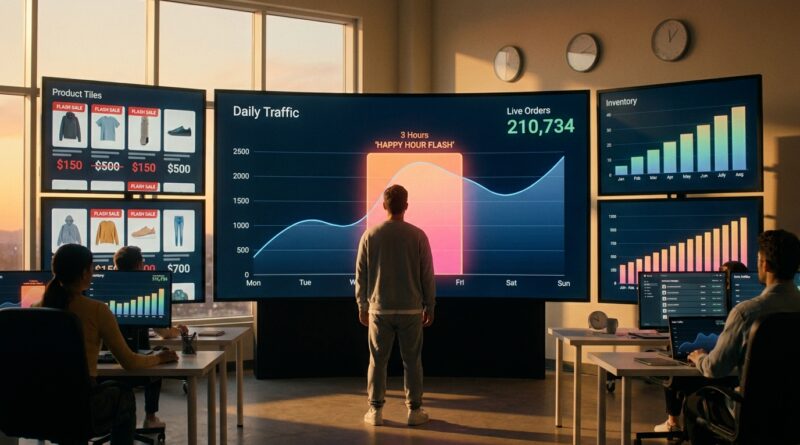
The ‘AI Happy Hour Flash’ Strategy: Turn 3 Quiet Hours Into Your Store’s Daily Profit Spike
Nothing is more annoying than running a “today only” sale, watching a small bump in traffic, and then realizing you just trained people to wait for the next discount. Or worse, you get a spike, but the margin damage makes the whole thing feel pointless. That is the trap a lot of store owners are in right now. Traffic comes in waves. Conversion changes by the hour. And a blunt sitewide promo often hits your best products, your best customers, and your profit all at once. A smarter fix is an ecommerce happy hour flash sale strategy. Instead of discounting everything for everyone, you create a short daily window, usually three quiet hours, and reserve the offer for a few products and a smaller audience already close to buying. Think of it less like a clearance event and more like a controlled pressure valve. You create urgency without turning your whole pricing strategy into chaos.
⚡ In a Hurry? Key Takeaways
- A daily AI Happy Hour Flash works best when it is short, predictable, and limited to a few SKUs and high-intent shoppers.
- Start with a simple rule tonight, such as “6 to 9pm, five products, only for repeat visitors or cart viewers.”
- This protects trust and margin better than constant sitewide discounts or always-on dynamic pricing.
Why most flash sales feel broken
The old flash sale playbook is too broad. You blast your full list. You cut prices across the site. You hope urgency does the rest.
Sometimes it works. But often it creates three problems.
You discount people who would have bought anyway
If someone was already ready to buy at full price, your sale just gave away money. That is the silent cost most brands miss.
You teach shoppers to wait
If every slow day gets a 20 percent off banner, customers catch on fast. Full price starts to look fake.
You make your calendar harder to manage
Big promos spill into everything. Your emails, your ads, your homepage, your support inbox. A “quick sale” turns into a full-day operation.
That is why a tighter format matters. The ecommerce happy hour flash sale strategy is not about more discounting. It is about better timing and smaller targets.
What the AI Happy Hour Flash actually is
At its simplest, this is a three-hour daily promo window aimed at people already showing buying intent.
You pick a quiet period, say 6pm to 9pm. Then you choose:
- A short list of products
- A small discount or bonus
- A specific audience segment
- A simple trigger to announce it
The “AI” part can be fancy, but it does not have to be. If your platform can identify repeat product viewers, cart abandoners, email clickers, or returning visitors, that is enough to start. Even rule-based logic counts here.
For example:
Only these five SKUs. Only from 6 to 9pm. Only for visitors who viewed the product twice in the last 7 days.
That is already much smarter than “20 percent off everything before midnight.”
Why this works better than blanket promotions
It compresses urgency
A short, predictable window feels real. Customers know the offer is coming, but they still have to act now. That is different from a week-long “flash” sale that somehow keeps getting extended.
It limits margin damage
You are not slicing prices across your whole catalog. You are choosing products where you have room to move, excess stock to clear, or enough add-on potential to make the order profitable.
It focuses on warm shoppers
The best discount is the one shown to the smallest possible audience that still converts. Cart viewers, repeat browsers, and recent email clickers are much closer to buying than cold traffic.
It becomes part of your store rhythm
This is a big one. A daily three-hour window is easier to run than random one-off campaigns. Your team knows the timing. Your customers learn the pattern. Your analytics become easier to compare.
How to set one up in a day
Step 1: Pick your quiet hours
Look at your hourly traffic and conversion data from the last few weeks. Find a block where traffic exists, but conversion is softer than you want.
For many stores, that is early evening. For others, it might be lunchtime or late night.
Do not guess if you can avoid it. Even basic analytics will show where visitors drift without buying.
Step 2: Choose only a few SKUs
Start with three to five products. Good candidates include:
- Items with healthy margin
- Products with lots of views but weak conversion
- Inventory you want to move without looking desperate
- Products that lead to profitable add-ons
Avoid your hero product if it already sells well at full price. Also avoid discounting products that are already price-sensitive unless you are sure the math works.
Step 3: Define a high-intent audience
This is where most of the win comes from. Do not show the offer to everyone.
Start with one of these groups:
- Visitors who viewed the same product twice in 7 days
- People who added to cart but did not buy
- Email subscribers who clicked through in the last 48 hours
- Returning visitors with at least two sessions this week
If your tools are basic, even a returning-visitor segment plus a timed email is enough.
Step 4: Use a light discount
You do not always need a big percentage off. Try:
- 10 percent off selected SKUs
- Buy one, get a low-cost accessory discounted
- Free shipping during the window
- A bonus gift for orders placed before the timer ends
The best offer is the one that nudges action without wrecking your average order margin.
Step 5: Add one countdown and one message
Keep the presentation simple. A countdown block on the product page, collection page, or cart page is usually enough.
Then send one triggered email or SMS near the start of the window. Not five. One.
Something like:
Happy Hour is live. From 6 to 9pm, these five picks are available at special pricing for returning shoppers only.
That feels more exclusive and less like a clearance siren.
Where the “AI” helps, without making this complicated
A lot of sellers hear “AI” and picture a giant system rewriting prices every few minutes. You do not need that.
What you need is simple decision support. Let your tools answer questions like:
- Which products get repeat views but weak conversion?
- What three-hour block has traffic but underperforms?
- Which visitors are showing signs of intent?
- Which products can handle a discount without killing profit?
That can come from Shopify reports, Klaviyo segments, GA4, your email platform, or a basic personalization tool. Fancy predictive software is nice. Clear rules are often enough.
The point is not to chase perfect automation. The point is to stop using a sledgehammer where a screwdriver will do.
What to measure after the first week
Do not judge this after one night. Run it for at least five to seven days and compare the same hour block to your baseline.
Watch these numbers
- Conversion rate during the happy hour window
- Revenue per visitor in that window
- Average order value
- Margin on promoted SKUs
- Attach rate for add-ons
- Return visitor conversion
If conversion rises but AOV collapses, your offer may be too generous. If traffic rises but purchases do not, your audience may be too broad or your SKU picks may be weak.
Common mistakes to avoid
Making it sitewide
This defeats the whole point. Keep the blast radius small.
Changing the time every day
Predictability is part of the appeal. Customers should learn the rhythm.
Using too many products
A short list feels curated. Twenty products feels like markdown soup.
Sending the offer to your full list
If everyone gets it, you are back in mass-promo territory.
Using deep discounts too early
Start small. You can always increase the incentive later. It is much harder to train customers back upward.
A useful twist: pair this with customer proof
If you want the window to convert better without pushing the discount harder, add social proof to the same pages. A short customer clip, review snippet, or simple “most re-viewed item tonight” label can help hesitant shoppers move.
If you like that idea, The UGC Countdown Flash Sale: Turn Raw Customer Clips Into 48-Hour Sellouts is a smart companion read. It shows how rough, believable customer content can create urgency without making your sale feel overproduced or pushy.
A starter version any small store can run tonight
Here is a plain-English setup:
- Time: 6 to 9pm every weekday
- Audience: returning visitors who viewed a product at least twice in 7 days
- Products: five SKUs with solid margin and medium inventory
- Offer: 10 percent off or free shipping
- Delivery: one email at 5:55pm and a countdown block on product and cart pages
That is it. No giant rebuild. No risky all-day sale. No pricing circus.
At a Glance: Comparison
| Feature/Aspect | Details | Verdict |
|---|---|---|
| Audience targeting | Targets repeat visitors, cart viewers, or recent clickers instead of the whole marketable list. | Better conversion with less wasted discounting. |
| Discount scope | Limits promos to a few selected SKUs during a fixed three-hour block. | Safer for margin and easier to control. |
| Operational effort | Can run with scheduled discount rules, a countdown element, and one triggered email or SMS. | Practical for small and mid-size stores. |
Conclusion
Blanket dynamic pricing and always-on promos can look clever on paper, but they often chip away at trust and margin in real life. A daily AI Happy Hour Flash is a cleaner answer. You squeeze urgency into a short, reliable window. You let your data, or even a few simple rules, decide which SKUs get the offer. And you show it to people already leaning toward checkout, not the whole internet. That makes this strategy realistic, not theoretical. You can ship it in a day with tools you probably already have, a scheduled discount, a countdown block, one triggered message, and a clear rule such as “only these five SKUs, only 6 to 9pm, only for visitors who have viewed twice in 7 days.” That is why this format is useful right now. It is surgical. It is testable. And it gives you a way to create a daily profit spike without blowing up your whole pricing calendar.