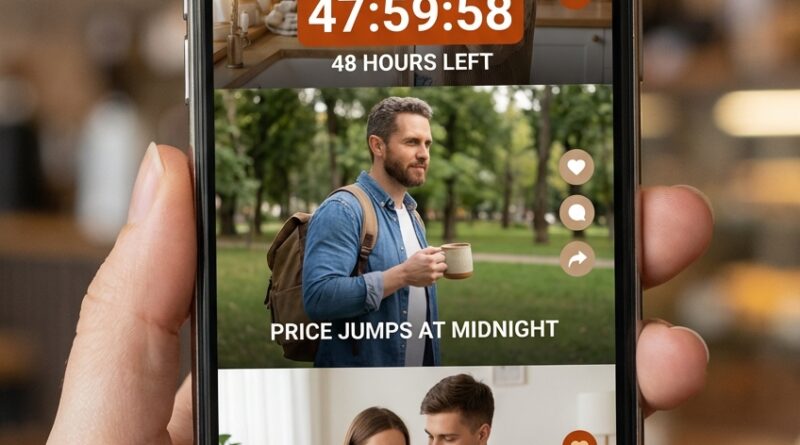
The UGC Countdown Flash Sale: Turn Raw Customer Clips Into 48-Hour Sellouts
You know the feeling. You spend half a week polishing flash sale graphics, writing clever copy, tweaking colors, and exporting six versions for every placement. Then the campaign goes live and nothing much happens. Meanwhile, some smaller brand posts a shaky customer clip with a countdown sticker, and somehow they are the ones selling out by dinner. That is frustrating because it makes all that careful work feel invisible.
Here is the shift that matters. People scrolling fast do not always stop for “perfect.” They stop for proof. A real customer holding the product, reacting to it, showing how it fits into normal life, that feels like something worth watching. Add a clear 48-hour deadline and your offer stops looking like just another sale banner. It starts feeling immediate. If you want a practical UGC flash sale strategy for ecommerce, the good news is you do not need a studio, a big ad budget, or a full rebrand. You need a tighter system, better product selection, and a simple countdown-led creative format you can ship this week.
⚡ In a Hurry? Key Takeaways
- A UGC countdown flash sale works best when you pair real customer video with a simple 24 to 48-hour deadline on products people already love.
- Start with 3 to 5 raw customer clips, add on-screen text, a timer, one clear offer, and publish across product pages, email, and paid social at the same time.
- Keep the sale safe by limiting stock, naming exact end times, and only promoting items you can actually fulfill.
Why polished flash sale ads are getting ignored
Flash sale ads used to get attention just by looking expensive. That is not enough now. Feeds are crowded, people scroll faster, and anything that looks too much like an ad can get skipped in a second.
Raw customer content works for a simple reason. It feels closer to a recommendation than a campaign. Someone says, “I bought this and here is why I like it,” and that lands differently than a giant banner screaming 30% OFF.
That is the opening. Instead of trying to out-produce everyone, you use customer proof plus urgency. That mix is what makes this format click.
What a UGC countdown flash sale actually is
Think of it as a short, controlled sale built around customer-made videos, not brand-made hero ads.
The core parts
You need four pieces.
- Real customer clips that show the product in use
- A short sale window, usually 24 to 48 hours
- Simple on-screen countdown language
- One focused offer on one small group of products
The point is not to make the video pretty. The point is to make the buyer think, “Other people already love this, and I need to decide soon.”
Why this works better than another discount code blast
Most sale emails and paid ads fail because they feel generic. Same layout. Same red badge. Same “limited time only” line people have seen a hundred times.
UGC changes the texture of the message. The sale is still there, but the first thing the shopper notices is a person. A voice. A reaction. A tiny bit of proof that the product is not just another item sitting on a white background.
It also helps small teams avoid a common trap. You do not have to guess which product to push. Start with products that already have happy buyers on camera. That gives you a built-in filter.
The easiest framework to copy this week
If you want a UGC flash sale strategy for ecommerce that is simple enough to launch fast, use this five-step setup.
1. Pick only products with clear customer love
Do not start with your slowest seller just because you want to move it. Start with items that already have:
- Good reviews
- Repeat purchases
- UGC from customers
- Low return rates
You are not trying to force demand. You are trying to concentrate it.
2. Gather 3 to 5 raw clips
Use footage from customer DMs, review requests, creator submissions, or post-purchase emails. You do not need long videos. Ten to twenty seconds is enough.
Look for clips that show one of these:
- The product being opened
- The product solving a small problem
- A quick before-and-after
- A customer saying exactly why they like it
If the clip is a little messy, that is often fine. Too polished can weaken the effect.
3. Edit lightly
Keep your edits feed-native. That means simple captions, vertical framing, and no overdone brand intro.
A useful structure looks like this:
- 0 to 2 seconds: customer reaction or product shot
- 2 to 5 seconds: what the product helps with
- 5 to 10 seconds: social proof line or quick testimonial
- Final frame: sale offer plus countdown end time
Add text like:
- 48 hours only
- Ends Thursday at midnight
- Best-sellers customers keep reposting
- Gone when this batch sells out
4. Build one landing page, not ten
Send traffic to a clean flash sale page with just the featured items, the sale deadline, and the same customer clips embedded near the products.
Keep it tight. If shoppers have to hunt around the whole store, urgency starts to fade.
5. Launch everywhere at once
Your sale should feel like one event, not scattered posts.
At minimum, publish through:
- SMS if you use it
- Instagram Stories or Reels
- TikTok or short-form paid social
- Your site banner and product page blocks
The goal is repetition. People often need to see the same offer in a few places before they act.
What to say in the videos and captions
A lot of teams overcomplicate this part. You do not need cinematic copy. You need clarity.
Simple caption formulas
- Customers kept posting this, so we made it our 48-hour flash sale.
- Real customer clips. Real favorite product. Sale ends tomorrow.
- This is the item buyers keep reordering. It is on flash sale for 2 days only.
- Our community picked the winner. Timer is on.
Simple CTA lines
- Shop before the timer ends
- Grab yours before this batch goes
- Watch it in action, then shop the sale
- 48 hours. Then back to full price
Short beats clever here.
Common mistakes that kill the sale
This format is simple, but there are still a few ways to mess it up.
Too many products
If everything is on flash sale, nothing feels urgent. Pick a narrow set.
Fake urgency
If your “48-hour sale” quietly comes back every weekend, people catch on. Be honest with timing.
Over-editing the UGC
Once the clip starts looking like a brand commercial, you lose the thing that made it believable.
Ignoring inventory reality
This is the big one. Urgency works, but only if you can actually fulfill orders. If you are running a timed push, read The Inventory‑Safe Flash Sale: How To Drive Urgency Without Overselling Or Issuing Embarrassing Refunds. It is a good reminder that nothing ruins a hot sale faster than apology emails and refund headaches.
How to know which UGC clips to trust
Not every customer video is worth promoting. Pick clips that answer buyer hesitation.
Ask yourself:
- Does this show the product clearly in real life?
- Does the customer mention a specific benefit?
- Would this help a first-time buyer picture ownership?
- Does it feel real without being confusing?
If a clip is funny but does not help someone understand the product, save it for social. Do not make it the backbone of a sale.
A sample 48-hour rollout
Here is a practical way to run it.
Day 0, prep
- Choose 1 to 3 products
- Confirm inventory
- Edit 3 to 5 customer clips
- Build one sale page
- Write email, SMS, and social captions
Day 1, launch morning
- Send launch email
- Post first short-form video
- Turn on paid spend behind top clip
- Update home page banner
Day 1, evening
- Post another customer clip
- Share social proof like “best-seller in today’s sale”
Day 2, final push
- Send reminder email with exact end time
- Post “last chance” Story or Reel
- Refresh product page with remaining stock note if true
That is enough to create momentum without dragging the sale out so long that urgency disappears.
How much production you actually need
Less than you think.
A phone editor, CapCut or a basic social editing tool, existing customer footage, and a clear offer are enough. The expensive part of old-school sale marketing was production. This format cuts that down because the value comes from proof, not polish.
That is why it is such a useful move for smaller ecommerce teams. You can start with assets you already have.
When this strategy is a bad fit
It is not magic. Skip it if:
- You have no customer proof yet
- Your product needs a long education funnel
- Your stock situation is shaky
- Your return rate is high and buyers are not happy
If buyers are not genuinely pleased, UGC will expose that fast. This works best when the product already has fans.
At a Glance: Comparison
| Feature/Aspect | Details | Verdict |
|---|---|---|
| Creative style | Raw customer clips with light captions and a clear timer usually stop scrolls better than polished sale banners. | Best for attention and trust |
| Setup effort | You can build a 48-hour campaign from existing UGC, one landing page, and a few short edits. | Faster than a traditional creative sprint |
| Risk control | Works best when inventory is checked, products are limited, and end times are specific. | Strong if you plan stock carefully |
Conclusion
The good news is you do not need to keep losing time to glossy sale creatives that blend into the feed. Attention is moving toward raw, native-looking content, and shoppers are getting better at ignoring anything that feels too manufactured. A UGC countdown flash sale gives small ecommerce teams a practical way to move with that shift. Your customers bring the proof. Their voices create trust. The timer adds urgency. And because you are featuring products that already have happy buyers on camera, you are not guessing your way into another weak discount push. Start small, keep it honest, and run one tight 48-hour test this week. It is one of the simplest ways to mix social proof, FOMO, and low-cost video into a sale people actually notice.