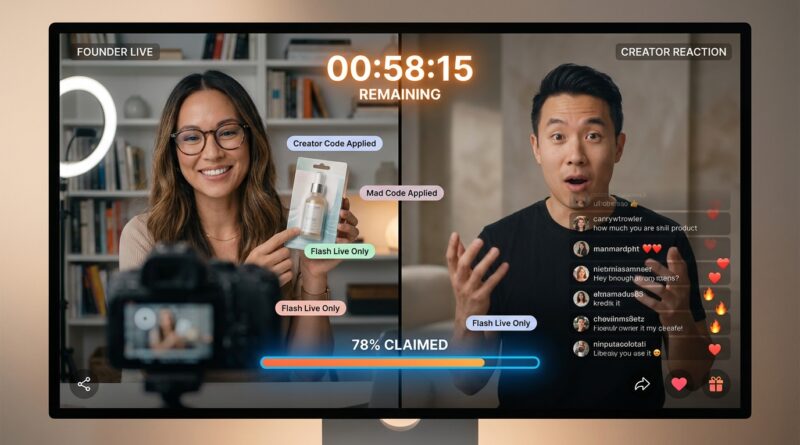
The ‘Creator Countdown Flash’ Strategy: Turn One Live Co-Hosted Drop Into Your Highest‑Margin Spike Of The Month
Flash sales can feel maddening. You line up the discount, add the countdown timer, send the emails, maybe post a few stories, and then… not much happens. Traffic trickles in. Conversion looks sleepy. By the time people notice, the sale is nearly over. That is the part that stings. The offer was not bad. The audience simply was not paying attention in the right place. That is why the ecommerce flash sale live creator strategy is getting so much traction. Instead of hoping shoppers visit your site at the perfect moment, you meet them where they already hang out: TikTok, Instagram Reels, and live shopping feeds. The smartest version is not a storewide markdown. It is a short, co-hosted live event built around one hero product, one creator, one code, and a visible reason to act now. Done well, it creates a sharp revenue spike without turning your whole brand into a discount habit.
⚡ In a Hurry? Key Takeaways
- Use one 60 to 90 minute co-hosted live around a single headliner product instead of a broad flash sale.
- Give the creator a unique code, show a live sell-through counter, and script the event in short segments to keep viewers moving toward checkout.
- This approach can protect margins better than sitewide discounts because it creates urgency through attention and proof, not just a deeper price cut.
Why regular flash sales keep falling flat
Most weak flash sales have the same problem. They depend on interruption. You are asking people to stop what they are doing, open your email, click through, and care right now.
That worked better when the homepage was the center of online shopping. It is not anymore. A lot of discovery now happens inside short video feeds and live streams. People see the product first, get sold on it there, and only then decide whether to visit the store.
So if your sale starts on your website, but shopper attention starts on social, you are beginning too late.
What the Creator Countdown Flash strategy actually is
The idea is simple. Pick one strong product. Team up with one creator whose audience already matches your customer. Run a live event for 60 to 90 minutes. Give viewers a creator-only code. Show inventory movement or sell-through in real time. Keep the event tightly paced.
You are not trying to put your whole catalog on sale. You are creating one moment around one item people can understand fast.
The winning mix
A good creator-led flash sale usually has four parts:
- One headliner product, not ten
- One creator host plus one brand co-host
- One visible countdown or stock counter
- One unique code tied to that live event
That structure matters because live shopping is noisy. Simplicity wins.
Why this works better than a generic sitewide discount
It uses behavior that already exists. Shoppers are scrolling. They are watching. They are reacting to comments, demos, and creator opinions. A co-hosted live inserts your offer into that natural flow.
It also gives people a reason to care now. A timer alone is easy to ignore. A creator saying, “Half the units are gone and my code ends when this live ends,” is harder to shrug off.
And because the event centers on one item, you can often keep the discount lighter. The urgency comes from the format, the audience, and the proof, not just from slashing price.
How to set one up without making it complicated
1. Choose the right product
Do not pick the item you are desperate to move. Pick the item that demos well live.
The best headliner products are:
- Easy to explain in under 30 seconds
- Clearly better with a demo
- Priced high enough to leave margin after creator payout and promo code
- Likely to trigger add-ons after the main purchase
If people need a five-minute explainer just to understand what it is, it is probably the wrong product for a live drop.
2. Pick a creator with buyer trust, not just reach
This is where brands often get distracted. A huge following looks exciting, but raw audience size is not the point. You want a creator whose followers listen, ask questions, and buy things that fit your category.
Look for:
- Strong comment quality, not just likes
- Past brand posts that got genuine questions
- A speaking style that feels believable on live video
- An audience that matches your actual customer
A smaller creator with loyal followers can outperform a bigger one with a passive crowd.
3. Script the live like a show, not a chat
This is a big one. The best live drops feel natural, but they are not random.
Map out the whole 60 to 90 minutes:
- First 5 minutes. Hook and promise
- Next 10 minutes. Fast demo and who it is for
- Next 10 minutes. Objection handling
- Next 10 minutes. Social proof and customer comments
- Midpoint. Inventory update and code reminder
- Final stretch. Repeat the demo, answer questions, and increase urgency
Think of it like a home shopping segment with better comments and stronger personality.
If you want to make the social proof part stronger, this pairs nicely with The ‘Peer Proof Flash’ Strategy: Turn Live Buyer Comments Into Your Highest‑Trust 60‑Minute Sale, which shows how buyer reactions can do some of the selling for you.
4. Use a visible sell-through signal
People move faster when they can see momentum. That could be:
- Units sold
- Percent claimed
- Bundles remaining
- A progress bar tied to inventory
Just be honest. Never fake scarcity. If viewers sense the numbers are made up, trust disappears fast.
5. Give the creator a unique code
This is about more than tracking. A creator code makes the event feel exclusive. It also lets you measure how much demand came from the live itself.
Keep the code easy to hear and type. Something short. Something tied to the creator name. Not a clunky string of numbers and symbols.
How to protect your margins
The nice thing about this ecommerce flash sale live creator strategy is that it does not need a giant discount to work.
Try protecting margin in a few ways:
- Discount one hero product, not the whole store
- Offer a value add instead of a deeper cut, like a bonus accessory
- Use post-purchase upsells to raise average order value
- Cap the quantity available during the live
- Negotiate creator compensation with a mix of flat fee and performance bonus
If your sale requires a huge markdown just to get attention, the format is probably doing too little of the work.
Common mistakes that kill the spike
Too many products
Choice slows people down. One hero item is easier to understand and easier to remember.
No pre-live buildup
Even a flash event needs a runway. Post teasers. Use countdown stickers. Let the creator mention the drop in advance. You do not need a month-long campaign, but you do need some anticipation.
A boring live host
Live selling is part product demo, part energy management. A creator who is great in edited posts may still be weak live. Test for that.
A clunky checkout path
If people have to hunt for the product page or manually enter too much info, you will lose them. The checkout path should be as close to frictionless as possible.
No plan for comments and questions
Comments are not background noise. They are part of the sales engine. Assign someone from your team to answer sizing, shipping, ingredients, compatibility, or return questions in real time.
What success should look like
Do not judge the event only by top-line sales. Look at the full picture:
- Revenue during the live window
- Conversion rate from live traffic
- Average order value
- New follower growth on both brand and creator channels
- Email or SMS signups collected during the event
- Cost per acquired customer
- Repeat purchase behavior after the event
A strong live drop does more than create one spike. It should also leave you with a warmer audience for the next launch.
Who this strategy is best for
This works especially well for smaller and midsize ecommerce brands that cannot outspend bigger competitors on ads but can move faster and tell a clearer story.
It is especially useful if:
- Your product shows well on camera
- You have at least one creator relationship already
- Your normal flash sales underperform
- You want bursts of revenue without constant sitewide promotions
If your brand has been treating social as just a place to post clips, this is a good next step. Social can also be where the sale itself happens.
At a Glance: Comparison
| Feature/Aspect | Details | Verdict |
|---|---|---|
| Traditional flash sale | Usually depends on email, homepage traffic, and a broad discount across many products. | Easy to launch, but often weak on urgency and margin control. |
| Creator co-hosted live drop | Built around one product, one creator code, live demo, and visible inventory movement inside social feeds. | Better for discovery, engagement, and sharper short-term revenue spikes. |
| Margin impact | Traditional sales often need deeper markdowns. Live creator drops can use smaller discounts plus exclusivity and proof. | Creator-led format usually gives you more room to protect profit. |
Conclusion
If your flash sales keep coming and going with a shrug, the problem may not be the offer. It may be the setting. Shoppers are finding products inside TikTok, Reels, and live shopping feeds long before they ever land on your homepage. Brands that win these moments are using that behavior instead of fighting it. A tightly scripted 60 to 90 minute co-hosted live, one headliner product, a visible sell-through counter, and a unique creator code can help a smaller store break into algorithmic discovery, attract warmer followers, and create a profitable spike without training customers to sit around waiting for blanket discounts. Start small. Pick one product. Pick one good creator. Run one clean live event. Then measure what really moved.