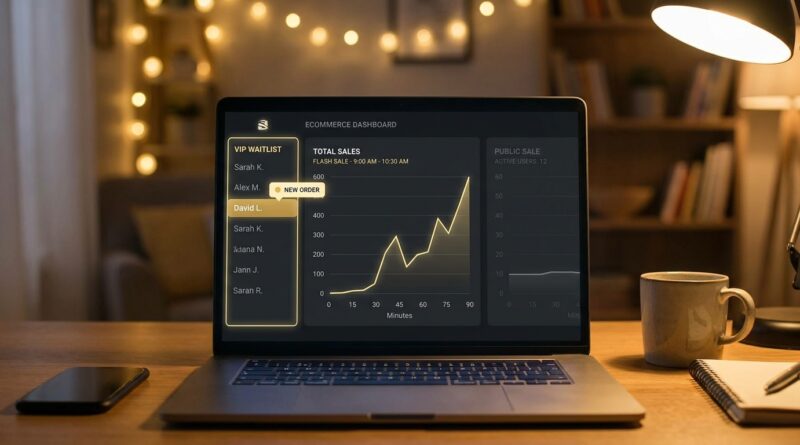
The ‘Waitlist-Only Flash’ Strategy: Turn Your Warmest Fans Into a 90‑Minute Sellout Machine
You set up a flash sale, slash the price, post it everywhere, and wait for the rush. Then nothing much happens. A few orders dribble in. Your regulars miss it until later. Random bargain hunters show up first. Worst of all, the discount feels wasted because the people most likely to buy were not first in line. If that sounds familiar, you are not doing anything “wrong.” You are just using the same public-sale playbook as everyone else, and shoppers are tired of it.
A better move is a waitlist only flash sale strategy. Instead of opening the gates to the whole internet, you give early access to the people who already raised their hand. That could be past buyers, email subscribers, SMS members, or shoppers who clicked “notify me.” The goal is simple. Pack your 90-minute window with your warmest audience first, so the sale feels busy, the product moves fast, and the discount actually does its job.
⚡ In a Hurry? Key Takeaways
- A waitlist only flash sale strategy works by giving a short sale window to your most interested shoppers before anyone else.
- Start with simple segments like past buyers, product page visitors, and SMS subscribers, then send them a 90-minute access link.
- You do not need fancy software or deeper discounts. Email, SMS, and basic tags are usually enough to make this work.
Why public flash sales keep falling flat
Most brands treat flash sales like a megaphone event. They blast social, run ads, send one email, add a countdown timer, and hope urgency does the rest.
That used to work better than it does now. Today, everyone is doing it. Shoppers have seen too many “ends tonight” banners. They scroll past them. Paid traffic gets expensive. And because the offer is public, you often attract the least loyal shoppers first.
That creates three problems at once.
Your best customers see it too late
The people most likely to buy are busy. They may check email later. They may miss your Instagram story. By the time they show up, your sale has lost momentum.
The wrong buyers soak up the discount
Public sales tend to pull in coupon chasers. Some will never buy again unless there is another markdown. That is not always bad, but it is not ideal if stock is limited.
The sale feels weaker than it should
A flash sale works best when it looks alive. Orders coming in fast create social proof. Slow trickles do the opposite. They make the event feel ordinary.
What a waitlist only flash sale strategy actually is
Think of it like a velvet rope, but without the attitude. You invite interested shoppers to join a list before the sale. Then, when the clock starts, only that group gets access for a short burst, often 60 to 90 minutes.
This changes the entire rhythm of the sale.
Instead of spending the first hour trying to find buyers, you spend it serving buyers who were already close to saying yes. That is why this approach can create a real sellout effect without needing a giant audience.
Who belongs on the waitlist
You do not need a huge list. You need the right people. Good candidates include:
- Past buyers of similar products
- Email subscribers who clicked product links
- SMS subscribers
- People who joined a back-in-stock or early access list
- Shoppers who viewed the item more than once
If you have read The ‘Warm-List Flash’ Strategy: Turn Quiet Browsers Into Buyers Before Your Sale Even Starts, this is the same core idea pushed one step further. Instead of warming browsers before the sale, you make the sale itself feel exclusive and focused.
Why this works better than a wide-open promo
It lines up intent with timing
The biggest win is simple. The people most interested in the product are the first people to see the offer. That means higher conversion in the first minutes, not the last desperate hour.
It protects your margin
Because the audience is warmer, you often do not need as steep a discount. A modest offer, paired with early access and limited time, can outperform a deeper public markdown.
It makes urgency feel real
Shoppers can smell fake urgency. But if a list gets access to a product for 90 minutes and stock is genuinely limited, that pressure feels honest. Honest urgency converts better.
It helps smaller stores punch above their weight
You do not need a giant ad budget to create momentum. You need a decent list, clean tags, and a clear time window. That is much more realistic for smaller ecommerce teams.
How to set up a 90-minute sellout machine
This sounds fancy, but the setup is pretty basic if you keep it tight.
1. Pick one product or a very small product set
Do not make people think too hard. One hero product is ideal. A tiny collection can work too, but only if the theme is obvious.
2. Build a simple waitlist
Add a landing page or pop-up that says early access is limited to waitlist members. Keep the form short. Name and email. Phone too, if SMS is part of your mix.
Your message should answer one question. Why join now? Examples:
- Get first access before the public drop
- Waitlist members get the 90-minute sale first
- Limited units. Early access only
3. Tag people by interest
This is where a lot of stores get sloppy. Do not dump everyone into one pile if you can help it. Tag by product interest, past purchase behavior, or engagement level. Even basic segmentation will improve results.
4. Prime the list before sale day
Do not wait until the last minute. Send a short heads-up the day before, or even two days before. Tell them when access opens, how long it lasts, and what to expect.
This is not the time for a novel. Clear beats clever.
5. Open with email and SMS at the same time
When the 90-minute window starts, send both channels if you have them. Email catches people at desk speed. SMS catches people at real-life speed. Together, they give you a stronger first wave.
6. Use a direct link and remove friction
Do not make people hunt. Link straight to the product or collection. Make the code obvious if one is needed. Better yet, auto-apply it.
7. Let the sale end cleanly
When the 90 minutes are up, end it. Do not quietly extend the deadline just because you got nervous. If shoppers learn your clock is soft, the next sale loses power.
What to send, and when
Pre-sale message
Send this 24 hours before:
“You are on the early-access list. Tomorrow at 1 PM, waitlist members get 90 minutes to shop the flash offer before anyone else. Stock is limited.”
Launch message
Send at the moment access opens:
“Your early-access window is live. You have 90 minutes to grab it here: [link].”
Last-call reminder
Send with 20 to 30 minutes left:
“Last call. Your waitlist-only access ends in 30 minutes. If you want it, now is the time.”
That is enough. You do not need seven reminders and a panic parade.
Common mistakes that kill the effect
Making the list too broad
If everyone gets in, it is not really a waitlist only flash sale strategy. Keep it anchored to actual interest.
Choosing the wrong product
Do not test this on something nobody cares about. Start with a product that already has clicks, repeat visits, or customer questions behind it.
Using a weak offer
You do not need your deepest discount, but the offer still has to matter. Early access alone is not magic if the price barely moves.
Failing to cap inventory expectations
If stock is limited, say so. If it is not limited, do not pretend it is. Trust matters more than one busy hour.
Not tracking the right numbers
Do not judge success only by top-line revenue. Look at open rate, click rate, conversion rate, speed of sales in the first 15 minutes, and how much of the list bought.
What success looks like
A good waitlist flash does not always mean every unit sells out in exactly 90 minutes. Sometimes the real win is cleaner.
- More of the discount goes to loyal or high-intent shoppers
- Sales happen faster after launch
- You rely less on paid traffic
- Your public sale, if you run one later, starts with momentum already built
That last point matters. You can even use the waitlist window as phase one, then open any remaining stock to the public after. That way your warm audience gets first crack, and the broader crowd sees a product that is already moving.
Who should try this first
This approach is especially useful for:
- Small ecommerce brands with limited ad budgets
- Stores with engaged email or SMS lists
- Brands launching limited stock drops
- Shops that are tired of discounting harder just to get the same result
If your current flash sales feel noisy but oddly cold, this is a strong fix.
At a Glance: Comparison
| Feature/Aspect | Details | Verdict |
|---|---|---|
| Audience quality | Waitlist members are usually past buyers, subscribers, or repeat visitors with stronger intent than general traffic. | Better fit for fast conversions |
| Discount efficiency | You can often use a smaller markdown because the offer reaches people already interested in the product. | Stronger margin protection |
| Setup difficulty | Requires basic tagging, a landing page or form, and coordinated email and SMS timing. | Very doable for small stores |
Conclusion
The waitlist only flash sale strategy works because it fixes the part most flash sales get wrong. It puts the offer in front of the right people first. Right now every brand is blasting public flash sales with the same tired countdown bars, so shoppers are numb and ad costs keep climbing. A waitlist-only flash refocuses the discount on people who actually want the product, spikes conversion without needing deeper cuts, and gives smaller stores a realistic way to engineer a real sellout using assets they already have: email, SMS and a basic tagging system, instead of bigger budgets. If your last flash sale felt loud but limp, this is the smarter next test.