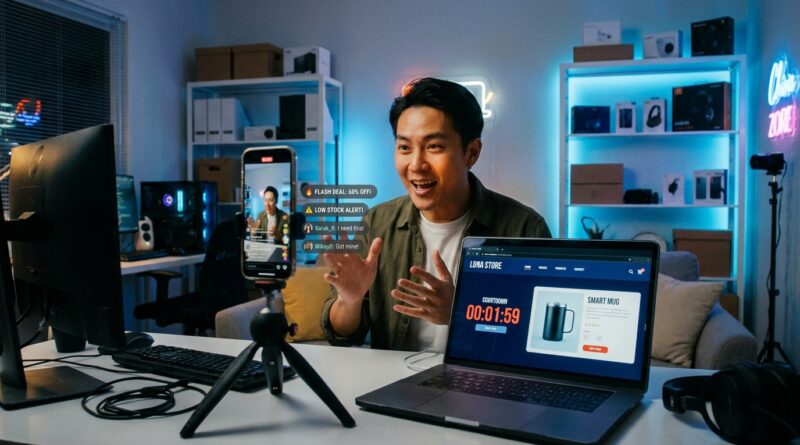
The ‘One-Stream Flash’ Strategy: Turn A Single Live Session Into Your Highest-Converting Sale Of The Month
You can feel when a flash sale has no center. The email says one thing. TikTok says another. Instagram Stories push people to a product page that looks like any other Tuesday, and your site is covered in timers, popups, coupon boxes, and “last chance” banners that nobody really believes. It is frustrating because the plan sounds smart on paper. More channels should mean more sales. But in practice, traffic gets split up, attention gets watered down, and shoppers never feel like they are part of one live moment. That is where the one-stream approach works better. Instead of trying to make every page and every platform scream at once, you pick one live session as the main event. You gather attention there, demo the product fast, open one real flash deal for a short window, then close it on time. That is the ecommerce flash sale live shopping strategy more stores should be using.
⚡ In a Hurry? Key Takeaways
- Run one clear live “main event” instead of scattering your flash sale across too many pages and platforms.
- Warm people up with short demos, then open one simple offer for a tight time window and remove it exactly when promised.
- Do not pile on endless coupons and fake urgency. Believability protects both your conversion rate and your margin.
Why most flash sales feel busy but sell poorly
A lot of stores are not lacking traffic. They are lacking focus.
They send people from email to the homepage, from social to a collection page, from paid ads to a product page, and from live posts to a link in bio. Every stop has a slightly different message. By the time a shopper lands, the supposed “flash” part feels pretty ordinary.
Urgency only works when people believe something special is happening right now, in one place, for one reason.
If everything is urgent, nothing is urgent.
What the one-stream flash strategy actually is
The one-stream flash strategy is simple. You choose one live session as the event. That could be TikTok Live, Instagram Live, a live shopping app, or a stream embedded on your own site. Then you point your traffic there.
Not to five different product pages first. Not to a generic sale banner. To the live event.
During that stream, you do three things:
1. Warm up the room
Show the product in real use. Answer obvious objections. Compare colors, sizes, or versions. Keep it quick. You are building confidence before asking for the click.
2. Open one clear flash offer
One product, one bundle, or one very easy-to-understand discount. Not a maze of promo codes. Not “20% off selected items excluding bestsellers.” Make it obvious enough that someone watching while half-distracted still gets it.
3. Shut it off on time
This part matters most. If you say the offer ends in 15 minutes, it ends in 15 minutes. That is how you train your audience to believe you next time.
Why live shopping converts better when it has a single center
Live commerce works because it combines product proof, timing, and social energy. People can see the item, hear answers in real time, and feel that others are watching too.
But that only works if the event feels like an event.
When you spread the action all over the place, you lose the shared momentum. One person is on your site. Another is on TikTok. Another is reading an email from 45 minutes ago. Nobody feels the countdown together.
A focused ecommerce flash sale live shopping strategy fixes that. It gives your shoppers one stage, one script, and one decision to make.
How to set it up without a big-brand budget
Pick a hero product or a tight product group
Do not try to feature your whole catalog. Pick the item that is easiest to demo, easiest to explain, and easiest to buy on impulse.
If you want to raise order value, a small bundle can work too. This is where a related play like The ‘Mix‑Match Flash’ Strategy: Turn One Simple Bundle Grid Into Sky‑High AOV In Your Next Sale fits nicely. It is useful when you want a simple bundle structure without turning your sale into a confusing scavenger hunt.
Choose one destination
If your audience already buys on TikTok, start there. If your best customers trust your site more, use a live tool that keeps the stream and checkout close together. The exact platform matters less than the clarity.
People should know where the main event is happening.
Build the pre-event message around the event, not the discount
Tell people when to show up and what they will see. Example: “Live at 7 PM. Quick demo, fit check, customer Q&A, then a 12-minute flash deal.”
That is more believable than shouting “massive sale” all day long.
Keep the offer mechanically simple
A pinned product. A single landing page. A visible timer. Clear stock or time rules. Fewer clicks are better. Fewer choices are usually better too.
What to say during the live
You do not need to sound like a game show host. You need structure.
A basic run-of-show could look like this:
- Minute 1 to 3: Welcome people and explain what is happening
- Minute 3 to 8: Demo the hero product in real life
- Minute 8 to 12: Answer common buying questions
- Minute 12: Open the flash offer
- Minute 12 to 24: Repeat the value, handle objections, remind viewers of the deadline
- Minute 24: Close the deal on time
Notice what is missing. No rambling. No surprise coupon stack. No “we might keep this going a little longer.”
The mistakes that quietly kill urgency
Too many offers at once
If shoppers have to compare three codes, four bundles, and seven exclusions, they slow down. Slow kills flash sales.
Weak timers
If your timer resets, or the deal lingers after the clock ends, people notice. Maybe not consciously at first, but trust drops fast.
Popups fighting the stream
Your live session should feel like the front door. Random spin-to-win popups and email capture walls can break momentum right when someone is ready to buy.
No post-live cutoff
Many brands panic and leave the offer running because “a few more orders might come in.” That short-term thinking is expensive. The next launch gets weaker because buyers stop believing your deadlines.
How to protect margin while still making the sale feel exciting
This is one of the best parts of the one-stream model. Because attention is concentrated, you often do not need a huge discount.
A short, believable window can outperform a bigger all-day markdown.
Try these instead of slashing price too deeply:
- Offer a bonus gift for the live window only
- Use a bundle instead of a straight discount
- Feature one bestseller, not the whole store
- Limit the deal by time, not by broad sitewide markdowns
The goal is not to look dramatic. It is to create a buying moment people trust.
What to measure after the stream
Do not just count views.
Look at the numbers that tell you whether the event had a real center:
- Click-through from each promo channel to the live event
- Peak live viewers and average watch time
- Conversion rate during the open offer window
- Revenue per minute while the deal was active
- Average order value
- Drop-off after the deal closed
If sales spike only during the active window and fall once it closes, that is not a bad sign. That usually means people believed the urgency.
At a Glance: Comparison
| Feature/Aspect | Details | Verdict |
|---|---|---|
| Traffic flow | One-stream flash pushes email, TikTok, Instagram, and SMS toward one live destination instead of scattering clicks across the store. | Better for focus and urgency |
| Offer structure | A single hero offer or simple bundle is easier to understand than stacked coupons, rotating banners, and sitewide exclusions. | Better for conversion speed |
| Margin protection | Short live windows and strict cutoff times let you create excitement without leaving discounts active all day. | Better for long-term profitability |
Conclusion
Live commerce tools on platforms like TikTok and native mobile shopping are getting more popular for a reason. They can sell. The problem is that many brands bury the opportunity under too many coupons, too many interruptions, and urgency that feels fake the second a shopper looks closely. A focused one-stream flash sale is cleaner and more believable. You warm people up with a fast demo, switch on one clear deal for a short window, and shut it off when you said you would. That simple structure can help small and mid-size stores get the kind of conversion lift people usually associate with much bigger brands, without burning margin or training customers to wait for endless “last chance” sales. Keep it tight, keep it honest, and make your next sale feel like a real event.