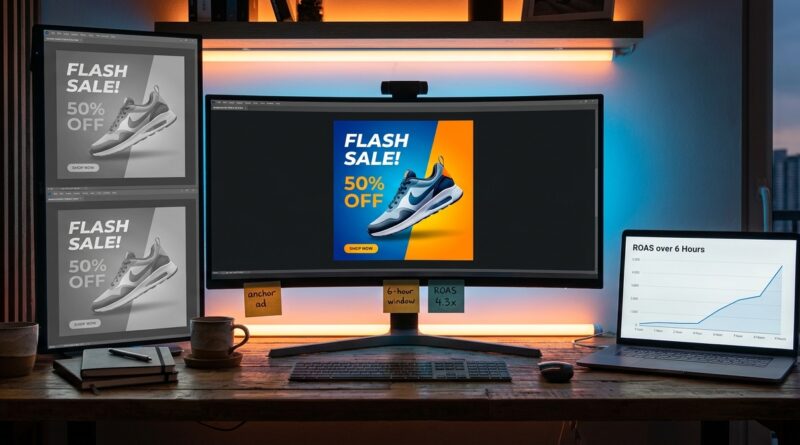
The ‘One-Ad Flash’ Strategy: Let Your Top Creative Dominate For 6 Hours And Watch ROAS Spike
You know the feeling. You finally tee up a six hour flash sale, load a few creatives into Meta, hit publish, and then watch the platform do something mildly infuriating. One ad starts getting all the love. The others barely move, still spend money, and leave you second guessing every decision. Do you step in. Duplicate the winner. Pause the losers. Restart the set. Or do nothing and hope the machine knows best?
For short promos, the answer is usually simpler than it feels. If one ad clearly wins early, stop fighting that signal. A flash sale ad strategy built around one winning creative often works better than trying to force equal testing during a tiny time window. When you only have six hours, every minute spent “learning” on weak ads is money that cannot come back. The smart move is to set things up so the platform can find one strong creative fast, feed it, and turn your promo into a cleaner, more repeatable system.
⚡ In a Hurry? Key Takeaways
- For a 6 hour sale, one strong ad often beats a messy multi-creative test.
- Start with a small pre-test, then put the flash budget behind the single winner.
- Do not keep editing campaigns mid-sale unless performance clearly breaks. Constant tinkering resets momentum.
Why one winning creative matters more during a flash sale
On a normal week, you can afford some wandering. On a six hour sale, you cannot.
Meta and other ad platforms need signals. When you give them too many creative choices in a very short window, they spend part of the sale sorting things out. That can be fine over several days. It is painful over six hours.
This is why so many buyers now quietly favor a flash sale ad strategy with one winning creative. It gives the system a clear path. Fewer distractions. Faster optimization. Less budget wasted on ads that were never going to get there.
It also matches the reality most indie brands live with right now. CPMs are not cheap. Tracking is messy. Data comes in late or incomplete. You need clean inputs if you want decent outputs.
What the “one-ad flash” strategy actually looks like
This is not about guessing one ad and praying. It is about doing the messy part before the clock starts.
Step 1: Pre-test before the sale
Run a small test before your flash event. That could be the day before, or earlier in the week. You are not trying to crown the greatest ad in brand history. You are just trying to find the one creative most likely to win this specific offer.
Look for a clear leader on the metrics that matter for your store. Usually that means click-through rate, add-to-cart rate, cost per purchase if volume allows, and just as important, whether the ad matches the sale message cleanly.
Step 2: Pick one hero creative
Once you see a winner, make it the center of the sale. One ad. One main angle. One offer presentation.
That does not mean your account can only contain one asset forever. It means your short flash campaign should not be a creative buffet. Pick the strongest horse and let it run.
Step 3: Build the sale around that ad
Your landing page, headline, discount framing, and email push should match the ad that won. Consistency helps conversion. If the ad says “Ends tonight. Best seller is 25% off,” the page should feel like a continuation, not a detour.
If you need help creating a simple hero asset in the first place, The ‘AI Video Flash’ Strategy: Turn One 30‑Second Clip Into A Weekend Sellout is a useful companion read. It fits nicely with this one-ad setup because both ideas focus on clarity over clutter.
When Meta picks a winner early, should you intervene?
Usually, not right away.
If one creative starts dominating spend and results in the first hour or two, that is often the platform doing exactly what you hoped it would do. The mistake many advertisers make is getting emotional about “fairness.” They want every creative to get a proper audition.
The algorithm does not care about fairness. Your sale should not either.
Leave it alone if:
The winning ad has better clicks, better conversion signals, and stable delivery. In that case, let it keep going. A clean winner is a gift during a short sale.
Intervene if:
The winner is getting spend but not sales, frequency is spiking too fast, or delivery suddenly falls apart. If that happens, you may need to swap in your second-best pre-tested ad or cut back budget to steady things.
Do not duplicate just because you are nervous
This is a big one. Duplicating a winning ad mid-sale can split learning, create weird delivery swings, and muddy the signal. Sometimes it works. Often it just creates more moving parts during the worst possible moment.
If the original ad is serving well, keep your hands off.
The best campaign structure for a 6 hour flash
There is no single perfect setup for every account, but simple usually wins.
Option 1: One campaign, one ad set, one ad
This is the cleanest version. It works well when you already know your audience and have enough confidence in the creative.
Option 2: One campaign, one ad set, one winner plus one backup paused
This is a nice safety net. Keep the runner-up ready, but paused. If the top ad fails hard, you can switch fast without rebuilding anything.
Option 3: Warm audience and broad audience, same winning creative
If your store has enough traffic and customer data, this can work well. Just do not turn it into five ad sets and eight versions of the same idea. Keep the structure tight.
How to choose the winner before the flash starts
Do not get too cute here. The winning creative usually has a few obvious traits.
It makes the offer instantly clear
People should know what is on sale, why it matters, and how long they have. Confused ads rarely become miracle converters in a flash sale.
It gets to the product fast
A six hour sale is not the time for a slow brand film. Show the item. Show the discount. Show the urgency.
It has one angle, not four
The best flash ad often does one job really well. Maybe it sells scarcity. Maybe it sells best-seller status. Maybe it sells a problem-solution hook. Pick one.
It already has proof
If a creative has converted before, that matters. Proven beats novel when the clock is running.
Common mistakes that quietly kill ROAS
Launching too many creatives at once
This is the big one. Testing six to twelve ads in a six hour window sounds data-driven. In practice, it often just spreads budget too thin.
Editing the campaign every 20 minutes
I get it. Sales promos make people twitchy. But constant changes can interrupt delivery and make results harder to read.
Judging by clicks only
A clicky ad is not always a sales ad. If possible, use past conversion data, not just attention metrics.
Changing the offer and the ad at the same time
If performance tanks, you want to know why. If you change everything at once, you learn nothing.
What to do after the sale ends
This part is where the strategy really pays off.
A one-ad flash structure gives you a cleaner result set. You can actually learn from it. Which opening hook worked. Which audience responded fastest. What time sales peaked. Whether urgency messaging beat discount-led messaging.
That turns each promo into a live test bed instead of a stressful blur.
Write down:
- Which creative won before launch
- How fast it took over spend
- ROAS by hour
- Whether frequency became a problem
- What backup creative you would use next time
After two or three flash sales, patterns start to show up. That is when this stops feeling like guesswork and starts feeling like a system.
When this strategy is not the best fit
There are exceptions.
If your account has huge spend, massive audience pools, or enough conversion volume to test multiple ads without starving them, you may have more room to experiment. The same goes for longer promos. A weekend sale gives the platform more time than a six hour sprint.
But for most smaller ecommerce brands, especially those running fast, high-pressure offers, a one winner setup is usually the safer bet.
At a Glance: Comparison
| Feature/Aspect | Details | Verdict |
|---|---|---|
| Multiple creatives during a 6 hour sale | Gives the platform more options, but often burns time and budget on weak ads while learning | Useful for longer promos, risky for short flash windows |
| One winning creative | Clear signal, faster optimization, simpler reporting, fewer mid-sale decisions | Best choice for most small brands running a fast sale |
| Duplicating the winner mid-sale | Can increase complexity and split momentum unless there is a very specific delivery problem | Usually skip it and let the original ad run |
Conclusion
If your flash sale ad strategy keeps turning into a frantic debate over whether to pause, duplicate, or rescue underperforming ads, that is your clue to simplify. Right now, media buyers are quietly agreeing on one thing. In short flash windows, algorithmic ad platforms perform best when they can quickly lock onto a single clear winner instead of juggling a dozen variants. That matters today because CPMs are high, tracking is noisy, and most indie stores cannot afford to waste an hour of learning during a 6 hour sale. By leaning into a one-ad flash structure instead of fighting it, small ecommerce brands can squeeze more revenue out of the same ad budget, avoid painful delivery swings mid-sale, and turn each flash into a live lab that feeds the next one. That is how scattered, stressful promos become a repeatable playbook that gets better every time you use it.