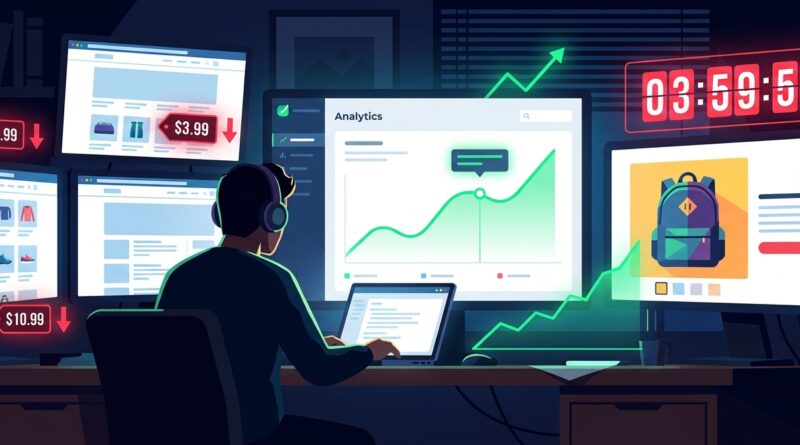
The ‘Competitor Watch Flash’ Strategy: Turn Rival Discounts Into Your Most Profitable 4‑Hour Sale
You plan a flash sale for weeks, line up the emails, prep the ad spend, and then wake up to find Amazon, Walmart, or a hungry Shopify rival cutting prices on the same products. That is maddening. Worse, it can make your carefully planned promo look late before it even starts. The fix is not bigger discounts. It is faster, smarter timing. A good ecommerce flash sale competitor monitoring strategy helps you spot when a rival drops price, launches a coupon, or pushes a short promo, then answer with a tight 4-hour sale that protects margin instead of blowing it up. Think of it like a weather alert for promos. You are not trying to win every price war. You are waiting for the right opening, then moving fast with the right product, the right audience, and a clear cutoff. That is how small stores can stop reacting late and start selling like they saw it coming.
⚡ In a Hurry? Key Takeaways
- A competitor watch flash strategy means tracking rival discounts in real time and launching a short 4-hour counter-sale only when the numbers make sense.
- Start with a simple promo radar: watch 5 to 10 competitors, flag key SKUs, set alerts for price drops, and prepare ready-to-send sale assets in advance.
- The goal is not to be the cheapest. It is to respond fast enough to keep clicks and orders while protecting profit per order.
Why flash sales feel broken now
Because the old playbook assumed your sale had room to breathe.
That is not how 2026 works. Prices change hourly. Coupons appear at lunchtime. Marketplace sellers test discounts like they are changing shirts. If you only check competitor pricing the night before your event, you are already behind.
That is why an ecommerce flash sale competitor monitoring strategy matters. You need a way to see changes while they are happening, not after the traffic is gone.
What the “Competitor Watch Flash” strategy actually is
At its core, this is simple.
You monitor a short list of rivals and products that overlap with your best sellers. When one of them launches a meaningful discount, you do not panic and slash everything. You trigger a narrow, pre-planned 4-hour sale on the products, bundles, or customer segments most likely to win back attention.
The strategy works because it is surgical.
Short window. Tight product list. Clear margin floor. Fast message.
What you are watching for
Your promo radar should track things like:
- Price drops on matching or near-matching SKUs
- Sitewide coupon codes
- Marketplace badges such as limited-time deals
- Free shipping changes
- Bundle offers that quietly lower effective price
- Email or SMS promo pushes from key rivals
What you are not doing
You are not matching every move.
You are not cutting price on your whole catalog.
You are not starting a sale with no margin guardrails.
Why a 4-hour sale works better than an all-day panic promo
A short sale gives you three advantages.
1. It creates urgency without training shoppers to wait
If your sales run all day, all weekend, or every other week, customers catch on. A 4-hour window feels real. It pushes action now.
2. It limits margin damage
If your response is wrong, you are wrong for four hours, not four days. That matters a lot.
3. It lets you target traffic spikes
You can line the sale up with the hours your rival is getting the most attention. That is often enough to pull back clicks that would have gone elsewhere.
How to build a promo radar in one afternoon
You do not need an enterprise budget to do this. You need a repeatable system.
Step 1: Pick your real competitors
Choose 5 to 10 brands or sellers that overlap with your products and customers. Be honest here. The giant marketplace is one competitor. The niche brand stealing your branded search traffic is another. The local favorite with aggressive SMS offers might be even more important.
Step 2: Make a watch list of key SKUs
Do not monitor everything.
Start with:
- Your top 20 revenue-driving products
- Your price-sensitive products
- Your ad-heavy products
- Your products most likely to be comparison shopped
Step 3: Set alert rules
Create simple triggers such as:
- Alert me if competitor price drops by 10 percent or more
- Alert me if a product gets a “deal” tag
- Alert me if shipping terms improve
- Alert me if two or more competitors discount the same item on the same day
Step 4: Prepare your response kit
This is the part most stores skip, and it is why they react too slowly.
Have these ready before you need them:
- Three sale email templates
- Two SMS versions
- Paid social creative in common sizes
- Landing page blocks you can publish fast
- A list of approved discount levels by SKU
- A stop-loss rule if conversion does not hit target
Step 5: Decide your margin floor
This is non-negotiable. If a competitor goes wild and prices below what works for your business, let them. A smart response can be a bundle, gift-with-purchase, loyalty-only code, or free expedited shipping instead of a deeper cut.
If pricing has been a guessing game for you, it is worth reading Stop Guessing Your Flash Sale Price: How To Use Live Competitor Tracking To Set Discounts That Actually Win. It does a good job of showing how to set discounts based on what is happening live, not what felt reasonable yesterday.
How to choose the right response when a rival blinks first
Not every competitor move deserves the same answer.
When to match
Match when the SKU is a known traffic magnet, your audience comparison-shops hard, and your margin can handle it for a short burst.
When to go narrower
If the competitor is discounting sitewide, consider a 4-hour sale only for your VIP list, cart abandoners, or returning customers. That protects profit and keeps your offer focused.
When to avoid a price cut completely
Sometimes the right move is not cheaper. It is better.
Try:
- A bundle with higher average order value
- Free gift over a threshold
- Fast shipping upgrade
- Loyalty points multiplier
- Buy more, save more on related items
A simple example
Let’s say you sell premium kitchen gear. At 9:10 a.m., a rival drops a hero product by 15 percent and pushes the offer by email. Your promo radar catches it.
Instead of cutting your whole cookware line, you launch a 4-hour lunch-hour sale on that hero item plus two high-margin accessories. Your email goes to recent product viewers. Your SMS goes to VIP customers. Your ad creative says “Ends at 2 PM.”
You keep the core discount modest, but the bundle lifts average order value. The short window creates urgency. You protect margin, keep some clicks, and avoid a full-day race to the bottom.
Metrics that tell you if the strategy is working
Do not judge this only by revenue.
Watch these numbers:
- Profit per order
- Conversion rate during the 4-hour window
- Average order value
- Email click rate and SMS conversion
- Return on ad spend during counter-sale windows
- Share of traffic on monitored SKUs
If the sale brings in orders but kills margin, it is not a win. If a targeted 4-hour sale holds conversion and keeps profit healthy, that is the model to repeat.
Common mistakes that make this backfire
Watching too many competitors
If your radar tracks everyone, you will drown in noise. Start small.
Reacting to tiny price changes
A 2 percent dip is often not worth your attention. Set meaningful thresholds.
Ignoring non-price offers
Customers care about shipping, bundles, and convenience too. Watch the full offer, not just the sticker price.
Having no pre-approved assets
If design, copy, and discount approval still need a meeting, your “flash” sale is not flash.
Discounting your best customers too often
If every alert becomes a sale, your list learns to wait. Use this for real moments, not every twitch in the market.
Who should use this strategy first
This approach is especially useful for:
- Small and mid-size ecommerce stores
- Brands with a few hero SKUs
- Stores competing against marketplace sellers
- Teams that can move fast but cannot afford constant discounting
If your catalog is huge and your pricing changes constantly, you may need more automation. But even then, the principle is the same. Watch the right rivals. Set triggers. Respond with discipline.
At a Glance: Comparison
| Feature/Aspect | Details | Verdict |
|---|---|---|
| Traditional flash sale planning | Built weeks ahead, often based on old competitor pricing and fixed discount assumptions | Too slow when rivals change offers the same day |
| Competitor Watch Flash strategy | Monitors live competitor promos, uses pre-built assets, and triggers a narrow 4-hour response sale | Best mix of speed, control, and profit protection |
| Full catalog price matching | Drops prices broadly to keep up with aggressive rivals across many products | Easy to start, expensive to sustain |
Conclusion
If your flash sales keep getting blindsided, the answer is not always a bigger markdown. It is better timing and better visibility. Flash sales in 2026 live and die on timing, not just discount size. With pricing and promos shifting in real time across marketplaces, brands that quietly monitor competitor drops and respond with short, surgical counter-sales are making more per order while everyone else races to the bottom. The good news is you do not need a giant team to do this. You can build a practical promo radar in one afternoon, watch for the moment a rival blinks first, and launch a lean 4-hour sale while the window is still open. That is how even small stores can stop feeling outgunned and start selling with a plan.