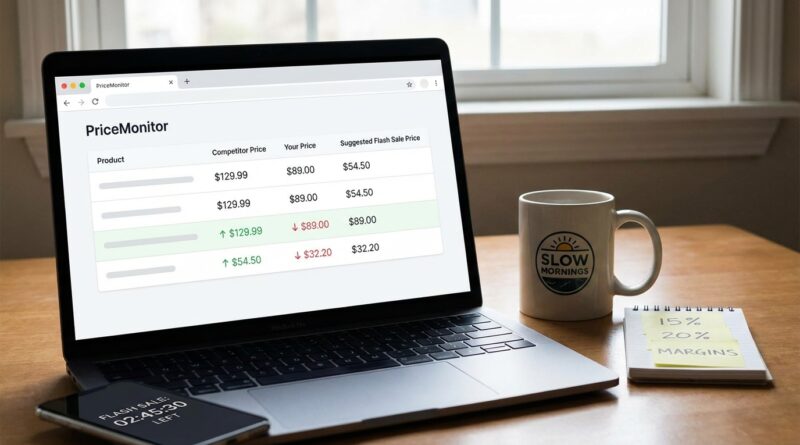
Stop Guessing Your Flash Sale Price: How To Use Live Competitor Tracking To Set Discounts That Actually Win
You know the feeling. You finally green-light a flash sale, trim prices fast, send the email, post the social promo, and then a competitor quietly drops their price even lower. Suddenly your big push looks average. Or maybe you go too far the other way, cut deeper than you needed to, and spend the rest of the week wondering why your margins took the hit. That frustration is real, especially for small ecommerce teams that do not have time to babysit rival sites all day. The good news is you do not need a giant pricing department to fix this. A simple ecommerce flash sale competitor pricing strategy can help you set discounts based on what is happening right now, not what happened last month. The goal is not to always be cheapest. It is to be competitive enough to win clicks, protect profit, and stop running sales based on guesswork.
⚡ In a Hurry? Key Takeaways
- Stop using flat discounts for every flash sale. Check live competitor prices first and price with a clear floor and target.
- Start with a one-screen routine: track 3 to 5 direct rivals, compare same-day prices, then adjust only your key sale items.
- Being the cheapest is not always the best move. Protect your margin, watch shipping and bundle tricks, and avoid panic price wars.
Why flash sale pricing goes wrong so often
Most stores are not bad at sales. They are just working with old information.
A team picks a familiar number like 15 percent off or 20 percent off because it is easy, fast, and feels safe. But flash sales are not static anymore. Competitors can change prices before breakfast, add a coupon by lunch, and push free shipping by dinner.
If you are setting your sale price from memory, last week’s spreadsheet, or a quick manual check, you are probably reacting too slowly.
That is why a smart ecommerce flash sale competitor pricing strategy matters. It gives you a live view of the market before you touch your own pricing.
What “live competitor tracking” really means
This sounds more technical than it is.
At the small business level, live competitor tracking usually means using a price monitoring tool, or even a clean daily dashboard, to watch the current selling prices of a few direct competitors on the exact products you care about most.
You are not trying to monitor the whole internet. You are watching the handful of stores that actually steal your customers.
Track the products that matter most
Start with:
- Your top 10 revenue-driving products
- Your most price-sensitive items
- Your flash sale “hero” products used in ads and email subject lines
If one of those items is off by even a few dollars compared with a rival, it can change click-through rates and conversions fast.
Watch the full offer, not just the listed price
A competitor may look more expensive at first glance, but then they add:
- A checkout coupon
- Free shipping
- Buy one, get one pricing
- A free gift
- Loyalty points or store credit
That means your decision should be based on effective selling price, not just the product page number.
The one-screen routine small stores can actually use
If your team is lean, you need a routine that takes minutes, not hours.
Step 1: Build a short competitor list
Pick 3 to 5 real competitors. Not giant marketplaces unless they truly overlap with your buyers. Focus on stores that sell the same or very similar products to the same audience.
Step 2: Set your guardrails before the sale starts
For each flash sale product, define:
- Your normal selling price
- Your lowest acceptable margin
- Your ideal sale price
- The lowest emergency price you will allow
This is important because competitor tracking is useful only if you know when to stop. Without a floor, it turns into a race to the bottom.
Step 3: Check live prices the morning the sale goes live
This is the key move. Do not rely on what competitors charged yesterday. Look at the market that morning.
If your top rival just launched a surprise flash sale, your old discount plan may already be stale.
Step 4: Adjust only the products that need it
You do not have to reprice everything.
Maybe only 3 of your 10 sale items need sharper pricing. Maybe 2 can stay higher because your shipping is faster or your product bundle is better. Be selective.
Step 5: Recheck at midday if the sale is important
For a short, high-stakes flash sale, one more quick scan can save the day. Competitors often react once your ads start running.
How to choose a winning discount without guessing
Here is the practical part most stores need.
Let’s say your regular price is $50.
- Your ideal margin says you would like to sell at $44
- Your absolute floor is $41
- Competitor A is at $46
- Competitor B is at $43 with free shipping
In that case, a lazy 20 percent discount to $40 may be unnecessary. You might win just fine at $42 or $43, especially if your product page, reviews, or delivery promise are stronger.
The right flash sale price is usually the one that is competitive enough to look compelling in the feed, while still keeping you above your pain threshold.
That is a better rule than “everything gets 20 percent off.”
When not to undercut a competitor
This part saves margins.
You do not always need to beat the lowest price. Sometimes you should hold your price and improve the offer instead.
Keep your price if your value is clearly better
You may not need to match a cheaper rival if you offer:
- Faster shipping
- Better reviews
- Stronger return terms
- A trusted brand
- A useful bundle
If shoppers trust you more, a small price gap is often survivable. That is especially true if discount fatigue is setting in. If you want help with that side of the sale, The ‘Verified Deal’ Flash Sale: How To Win Shoppers Who No Longer Trust Discounts is worth a read. It gets into the trust problem that shows up when every store screams “deal” at the same time.
Do not chase loss-making prices
If a competitor goes irrationally low, let them. Some stores are clearing stock, making a cash flow move, or simply making a mistake.
You do not need to follow them off a cliff.
What to automate first
You do not need an enterprise setup. Start small.
The first things worth automating are:
- Daily or hourly price checks on key competitor products
- Alerts when a rival drops below your target threshold
- A simple summary view for your top sale items
That alone cuts down the worst kind of pricing mistake, the one where you launch a flash sale already behind the market.
A good starter rule
If a competitor drops price on one of your top five sale products by more than 5 percent, your team gets an alert. Then someone decides whether to match, beat, or hold.
Notice that last part. A person still decides. Automation should inform your pricing, not blindly control it.
Common mistakes that make competitor-aware pricing backfire
Watching too many competitors
If you monitor 20 stores, you will drown in noise. Track the few that matter.
Comparing unlike-for-like products
A similar item is not always the same item. Different sizing, shipping times, included accessories, and warranty terms matter.
Ignoring fees and fulfillment costs
A sale price that looks smart can still hurt if shipping, payment fees, or ad costs eat the margin underneath it.
Only checking once before the sale
Flash sales move quickly. If the sale matters, do a second check later in the day.
Using discounts as the only weapon
Sometimes better creative, stronger urgency, or a cleaner product page beats another 3 percent off.
A simple weekly habit for lean teams
If this all sounds like a lot, keep it boring and repeatable.
Try this routine:
- Monday: review top products and key competitors
- Day before sale: confirm margin floors and sale targets
- Sale morning: check live competitor pricing and adjust hero products
- Midday: review alerts and make only necessary changes
- Day after: note which price points actually converted best
That last point matters. Over time, your own data gets smarter. You begin to learn where you truly need to be aggressive and where you can hold price.
At a Glance: Comparison
| Feature/Aspect | Details | Verdict |
|---|---|---|
| Flat discount pricing | Easy to run, but ignores same-day competitor moves and often cuts too deep or not deep enough. | Fast, but risky. |
| Live competitor tracking | Uses current rival pricing, alerts, and margin floors to shape flash sale discounts in real time. | Best for smarter, controlled sales. |
| Always being the cheapest | Can win some clicks, but often damages profit and trains shoppers to wait for deeper cuts. | Use with caution. |
Conclusion
Competitor-aware flash sales are growing for a simple reason. Margins are tighter, shoppers are comparing everything, and stores cannot afford to price by gut feel anymore. In the last few weeks, plenty of sellers have shared the same painful lesson: missing one competitor flash sale can cost hundreds in lost revenue, while overreacting can burn profit just as fast. The fix does not have to be fancy. A small, practical routine with live competitor checks, clear margin floors, and a few automated alerts can turn flash sale pricing from a panic move into a planned one. That is the real value of a strong ecommerce flash sale competitor pricing strategy. You stop flying blind. You stop copying old 20 percent-off habits. And you start making discounts that fit the market you are in that morning, not the one you remember from last month.