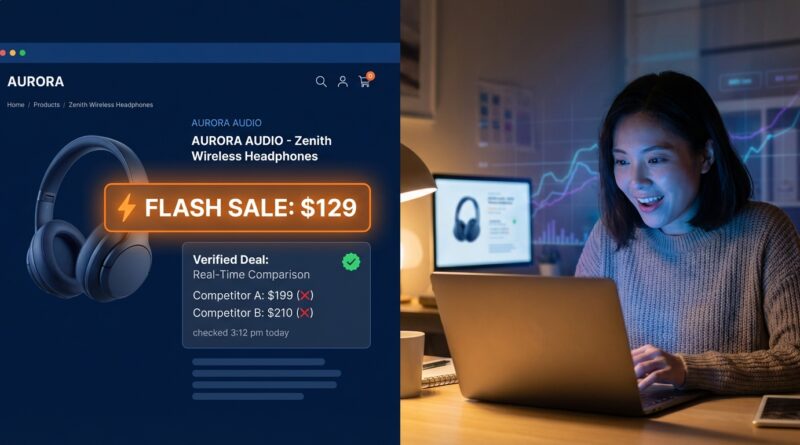
The ‘Verified Deal’ Flash Sale: How To Win Shoppers Who No Longer Trust Discounts
You can feel the trust problem the moment a flash sale goes live. The email opens are fine, the traffic shows up, and then people hesitate. They compare tabs, leave items in the cart, and wait. That is not because your offer is weak. It is because shoppers have seen too many made-up “was” prices, too many countdown timers that reset, and too many prices that seem to change depending on the hour, device, or mood of the internet. People have learned to doubt the discount first and ask questions later. A Verified Deal flash sale fixes that by replacing vague savings claims with proof. Instead of just saying “20% off today,” you show a live, plain-English note such as “$18 lower than Amazon right now, verified at 3:12 pm.” That small bit of evidence can do what a bigger discount often cannot. It makes the deal believable, and believable deals get clicked.
⚡ In a Hurry? Key Takeaways
- A Verified Deal flash sale works best when you prove your price beats key competitors in real time, not when you just shout “limited-time discount.”
- Start with a few top products, use simple price-checking tools, and add a time-stamped message directly in emails, product pages, and checkout.
- This approach builds trust and protects margins because you are selling proof, not just panic or fake urgency.
Why shoppers stopped believing your flash sales
Most buyers are not cynical by nature. They are trained.
They have watched products jump in price the week before a sale. They have seen “only 2 left” messages on items that somehow stay in stock for days. They have clicked on discounts that were not really discounts at all. So now they do what smart shoppers do. They pause.
That pause is expensive. It lowers click-through rates, weakens conversion, and turns what should be a quick win into a maybe-later moment.
This is the real issue behind the search for an ecommerce flash sale verified deal pricing strategy. The problem is not just pricing. It is trust. If the buyer does not believe the savings are real, your urgency message can actually hurt you. It starts to sound like pressure instead of value.
What a Verified Deal flash sale actually is
Think of it as a flash sale with a receipt attached.
You use lightweight price-checking tools, or even a simple manual check for a smaller catalog, to compare your sale price against a short list of meaningful competitors. Then you show that proof right where the buying decision happens.
The core idea
Instead of saying:
“Flash Sale. Save 25% today only.”
You say:
“Verified Deal. $18 lower than Amazon right now, checked at 3:12 pm.”
That wording matters because it answers the question already sitting in the shopper’s head. “Is this really a good price, or should I wait?”
Why this works better than a bigger discount
A bigger discount can attract attention. Proof closes doubt.
When shoppers see a clear comparison and a time stamp, the deal feels grounded in reality. It looks less like marketing copy and more like useful information. That changes the emotional tone of the whole sale.
How dynamic pricing created this mess
Dynamic pricing is not evil. Airlines use it. Hotels use it. Big retailers use it every minute of the day. The problem is that shoppers know this now.
They assume prices move around constantly. They suspect the “best deal” may show up tomorrow, or in another browser, or after they abandon the cart. So they hold off.
That behavior makes perfect sense from their side. But for brands, especially smaller ones, it creates a hard problem. You are not only competing on price. You are competing against the fear of buying at the wrong moment.
A Verified Deal flash sale cuts through that by saying, in effect, “You do not need to guess. Here is the comparison. Here is when we checked.”
What to include in your Verified Deal message
This does not need to be fancy. In fact, simpler is better.
1. The competitor name
Use a recognizable benchmark. Amazon is the obvious example for many products, but it could also be Walmart, Best Buy, Target, Chewy, or a niche competitor in your category.
2. The price difference
Use a dollar amount when possible. It feels more concrete than a percentage.
Example: “$18 lower than Amazon right now.”
3. The verification time
Add a time stamp so the customer knows this is current.
Example: “Verified at 3:12 pm.”
4. Plain language
Do not bury the message in legal or promotional fluff. Put it in normal human words. Clear beats clever here.
5. Placement where it matters
Put it in your flash sale email subject line or preview text, on the product page near the price, and close to the checkout button. If the proof only appears in small print, it loses most of its value.
A practical setup for small and mid-sized ecommerce teams
You do not need an enterprise pricing team to start this. Keep it light.
Step 1: Pick your “proof products”
Start with 5 to 20 items that meet three conditions:
- Customers know the market price well.
- You can monitor the competition easily.
- The margin still works if you win the click.
These are your trust builders. They do not have to be your cheapest items. They have to be the ones where proof will matter most.
Step 2: Track a short competitor list
Do not compare against everyone. Compare against the two or three sellers your audience actually checks.
Too many comparisons get messy fast. A small, relevant list is more believable.
Step 3: Verify close to send time
If your flash sale email goes out at 3 pm, check prices as close to that time as possible. Real-time or near-real-time verification is the point.
Step 4: Build reusable message blocks
Create a simple template your team can drop into sale pages and emails:
“Verified Deal: Our price is $79. That is $18 lower than Amazon as of 3:12 pm.”
That gives you a repeatable system instead of a one-off campaign.
Step 5: Save screenshots or logs internally
This is important. Keep a record of the checks. If a customer asks, your support team can answer with confidence. It also keeps your marketing honest.
Where to show the proof for the biggest impact
Good proof in the wrong place still gets missed.
Email subject lines
Try lines like:
- Verified Deal: $18 lower than Amazon right now
- Flash Sale, price checked against top retailers
- Today’s verified deal ends tonight
This can raise curiosity without sounding gimmicky.
Hero banner copy
Your sale page banner should not just scream “Hurry.” It should explain why this offer is worth acting on.
Example: “Verified Deal Flash Sale. Lower than top competitors, checked today.”
Product page pricing area
This is where the proof earns its keep. Add the note right under the sale price, not hidden in a tab or footnote.
Cart and checkout
Buyers often second-guess themselves at the last second. A short reminder there can stop abandonment.
Example: “Still a verified deal. $18 below Amazon at last check.”
How this protects margins instead of starting a race to the bottom
Here is the part many brands miss. Verified Deal pricing is not about being the cheapest store on earth. It is about proving that this specific offer is strong enough to trust.
If you can show your sale price is better than the places shoppers already compare against, you may not need to cut deeper. The proof does some of the work that discounting used to do.
That matters because endless markdowns train people to wait for bigger markdowns. Proof-backed pricing trains them to act when the value is clear.
Use guardrails
Set rules before the sale starts:
- Minimum margin per SKU
- Maximum markdown allowed
- Approved competitor list
- How often prices are rechecked during the sale
That keeps the sale disciplined. You are not improvising under pressure.
Common mistakes that can ruin trust again
This strategy works only if it stays clean.
Using outdated checks
If you verified at 9 am and the email goes out at 5 pm, your proof may already be stale.
Comparing against weak or irrelevant sellers
Shoppers know when you are cherry-picking. Use competitors they recognize and care about.
Hiding fees
If your item is cheaper but shipping wipes out the savings, the trust boost disappears. Be honest about total value.
Overdoing the claim
Not every product needs a dramatic badge. Use verified proof where it is real and meaningful. If you stretch the format too far, it starts to feel like another trick.
Metrics to watch after launch
You do not need a giant analytics project. Watch the basics first.
Email click-through rate
Does proof in the subject line or preview text get more people into the sale?
Product page conversion rate
Do verified products convert better than non-verified products?
Cart abandonment
Does the time-stamped proof reduce hesitation at checkout?
Average discount depth
Are you getting similar or better performance without cutting prices as deeply?
Repeat sale response
This is the long game. If shoppers learn that your flash sales are usually real, future campaigns get easier.
Why this is a smart move for smaller brands
Big retailers have pricing engines, huge ad budgets, and brand recognition. Smaller brands often cannot win that fight head-on.
But smaller brands can be clearer. Faster. More human.
That is where the Verified Deal approach shines. You are not trying to out-tech the giants. You are helping the customer make a confident decision right now, with proof they can understand in two seconds.
That makes this a very practical ecommerce flash sale verified deal pricing strategy for brands that need trust as much as traffic.
At a Glance: Comparison
| Feature/Aspect | Details | Verdict |
|---|---|---|
| Traditional flash sale | Relies on countdowns, percentage-off language, and urgency with little proof the deal is truly competitive. | Good for attention, weak on trust. |
| Verified Deal flash sale | Shows a live or near-live competitor comparison with a time stamp in plain language. | Best choice for rebuilding confidence and improving conversion quality. |
| Deep discount race | Cuts prices harder and harder to force action, often hurting margins and training customers to wait for the next sale. | Short-term spike, long-term pain. |
Conclusion
Shoppers are not ignoring your flash sales because they hate deals. They are ignoring them because too many deals stopped feeling real. Dynamic pricing has trained customers to assume every discount is fake and to stall at checkout while they wait for a better offer. A Verified Deal flash sale flips that script. You use lightweight price-checking tools to compare your flash sale price against key competitors in real time, then surface a clear, human explanation like “$18 lower than Amazon right now, verified at 3:12 pm” directly in your sale messaging. That instantly restores trust, boosts click-through on your flash sale emails, and gives smaller brands a credible way to compete in a market where AI pricing engines usually favor the giants. Best of all, it protects margins and turns future sales into repeatable, proof-backed events instead of another sprint to the bottom. Start with a handful of products, keep the message honest, and let proof do the heavy lifting.