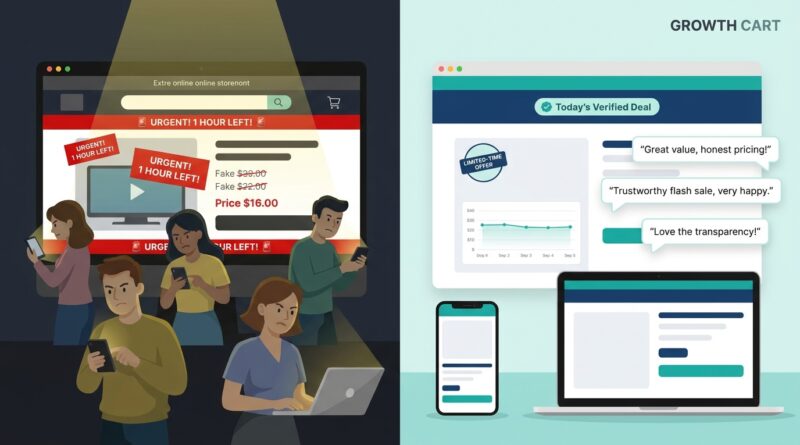
The ‘Trust-First Flash’ Strategy: Turn Skeptical Shoppers Into Same‑Session Buyers
Shoppers are not naive, and honestly, they are tired. They have seen too many fake countdowns, too many crossed-out “was” prices that were never real, and too many mystery discounts that somehow come back every weekend. If your flash sales feel weaker than they did a year or two ago, that is probably why. People are still willing to buy fast. They just do not want to feel tricked while doing it.
The good news is that smaller ecommerce brands have a real opening here. You do not need louder timers or more dramatic red banners. You need proof. A smart ecommerce flash sale trust strategy shows shoppers, quickly and clearly, that this deal is actually rare, actually better than your normal price, and actually worth acting on right now. When someone can verify that in 10 seconds, hesitation drops. You feel safer than the bigger seller using old urgency tricks, and that trust can turn a skeptical browser into a same-session buyer.
⚡ In a Hurry? Key Takeaways
- Trust-first flash sales work best when shoppers can verify the discount fast, instead of being pushed by vague urgency.
- Show real price history, add 1 to 3 authentic customer receipts or reviews, and explain why this offer is genuinely rare.
- This approach protects list trust, improves conversion quality, and helps smaller brands stand out during noisy Q4 promotions.
Why old-school urgency is starting to backfire
A flash sale is supposed to create momentum. But a lot of brands have trained shoppers to doubt everything first.
Think about what people see all week. “Sale ends in 2 hours.” Then the same sale is back tomorrow. “Originally $199.” Then a quick search shows it was $129 last month. “Secret deal inside.” Then the discount is 10 percent off something nobody planned to buy.
That is not just annoying. It changes behavior. People stop clicking. Or worse, they click, get suspicious, and leave. Some learn to wait because they assume a better offer is coming.
That is the real cost. Not just a lost sale today, but a trained audience that no longer believes you.
What a trust-first flash offer actually looks like
A trust-first flash offer still creates urgency. It just earns it.
The core idea is simple. Instead of asking the shopper to believe your sale is good, you show enough proof that they can decide for themselves in a few seconds.
For a practical ecommerce flash sale trust strategy, focus on three things:
- Proof that the price is genuinely better than your normal price
- Proof that real people bought and liked the product
- Proof that the deal is rare for a specific reason
That is it. No smoke machine needed.
The 10-second verification test
Before you launch any flash promotion, ask one blunt question: can a skeptical shopper verify this deal in 10 seconds?
If the answer is no, your sale is probably asking for too much trust.
Here is what usually passes the test:
1. Real price history
Show the normal price. Show the flash price. If possible, show a screenshot or simple timeline of recent pricing. You are trying to remove doubt, not create suspense.
For example:
- Regular price: $68 for the last 90 days
- Last sale price: $59 during Labor Day
- Today only: $49
Now the shopper understands the offer without doing detective work.
2. Authentic proof from actual buyers
Add one to three pieces of believable customer proof near the offer. Not a giant wall of testimonials. Just enough to reassure.
This could be:
- A photo review
- A short UGC clip
- A screenshot of a customer saying they bought it at full price and would do it again
The best proof is specific. “Bought this before our trip and it held up for 6 days in rain” works better than “Love it!!!”
3. One clear reason the deal is rare
Do not stack five reasons. Pick one real one.
Examples:
- End-of-season color clearance
- Supplier gave a one-time cost break
- Anniversary weekend offer
- Limited stock left in one SKU
A shopper does not need a novel. They need a reason that sounds normal and true.
How to build the offer without a huge team
This is the part many smaller brands will like. You do not need a full redesign.
You can build a trust-first flash sale with assets you likely already have.
Step 1: Save price proof before the promo starts
Take screenshots of your product page before changing the price. Keep a simple log of standard price, last sale price, and current flash price. This helps marketing, customer service, and paid social stay aligned.
It also keeps you honest, which matters more than people think.
Step 2: Pull your best “receipts”
Grab 1 to 3 reviews, social comments, or UGC clips that feel real. Prioritize content with details, dates, and images. If a customer mentions paying full price and still loving the product, even better.
That kind of proof tells shoppers the item has value beyond the sale.
Step 3: Write one sentence that explains the rarity
This sentence should be clear enough to use everywhere.
For example: “Lowest price we have run since spring because we are clearing our summer packaging before the holiday relaunch.”
Now you have a consistent message for email, TikTok LIVE, SMS, and your site banner.
Step 4: Put proof next to the buy moment
Do not hide all the trust signals on a separate page. Put them where people hesitate.
Good placement includes:
- Under the price on the product page
- Inside the email hero section
- Pinned comment during TikTok LIVE
- Cart drawer note or promo banner
If someone has to go searching for reassurance, you waited too long.
What to say instead of the usual hype
A lot of weak flash sale copy sounds interchangeable. That is part of the problem.
Try language that sounds grounded:
- “Usually $72. Last sale was $64. Today it is $54 until midnight.”
- “We only discount this style a few times a year. This is the lowest price since July.”
- “Three recent customer photos below, so you can see the fit before you buy.”
- “This batch is discounted because the outer box is changing next month. Product is the same.”
Notice what these lines do. They reduce suspicion. They do not try to overpower it.
Where this works best
The nice thing about this strategy is that it travels well.
Lead with proof, not drama. Put the real price comparison near the top, followed by one buyer quote and your one-sentence rarity reason.
TikTok LIVE
Say the normal price out loud. Say the sale price out loud. Pin a comment that explains why the offer is rare, and show one piece of customer proof on screen if you can.
Onsite banners
Skip vague lines like “Huge savings now live.” Try something concrete like “Lowest price since August. Usually $48, today $36.”
SMS
Keep it short. “Today only: our tote drops from $59 to $44. Last sale was $49. Ends midnight.”
That is far more believable than “FLASH SALE OMG RUN.”
Common mistakes that quietly kill trust
Even good brands fall into these traps.
Using inflated compare-at pricing
If the crossed-out number is not your true recent selling price, do not use it. Shoppers notice. So do regulators.
Adding fake countdown pressure
If the timer resets tomorrow, people remember. Better to run a clean end time with no timer than a flashy one nobody believes.
Overloading the page with proof
Too much can look staged. You are not building a courtroom case. You are easing doubt.
Making “rare” claims that happen every week
If every sale is “once a year,” none of them are.
Trust-first does not mean soft
Some brands hear “trust-first” and worry it means less urgency. It does not.
It means your urgency has a backbone.
You can still run a 24-hour flash sale. You can still limit stock. You can still create a strong call to action. The difference is that your offer feels solid instead of slippery.
And if you are planning a high-demand drop, pair this approach with operational protection too. For example, The ‘Anti-Bot Flash’ Strategy: Stop Resellers From Hijacking Your Next Big Sale is a useful companion read if you want to keep real customers from losing inventory to bots and resellers.
A simple framework you can repeat
If you want a reusable playbook, use this formula:
Best verified price + authentic buyer proof + one real reason for rarity
That is the whole engine.
Here is how it might look in the wild:
- Hero line: “Today only: $39. Usually $54. Lower than our Labor Day price.”
- Trust block: “See price history” plus a screenshot or simple graphic
- Proof block: Two customer photos and one short review
- Rarity line: “We are closing out this label design before the holiday version arrives”
- CTA: “Shop the flash price before midnight”
Fast. Clear. Believable.
At a Glance: Comparison
| Feature/Aspect | Details | Verdict |
|---|---|---|
| Old urgency-first flash sale | Heavy timers, vague scarcity, inflated compare-at prices, little proof | Can get clicks short term, but often hurts trust and trains shoppers to wait |
| Trust-first flash sale | Real price history, authentic UGC or reviews, one clear rarity reason | Stronger credibility, better same-session buying confidence, safer for long-term brand health |
| Best use for smaller brands | Use simple proof elements across email, onsite banners, SMS, and LIVE selling | High upside because it helps independents look more honest than bigger competitors |
Conclusion
Right now, almost every major year-end and Q4 playbook is pushing urgency harder than trust, even though this is exactly when shoppers are fact-checking discounts and calling out fake deals in public comments. That creates a huge opening for smaller ecommerce brands. If you can show that your flash price is genuinely better than your normal price, better than your last sale, and better than “the rest of the web” in a way the shopper can verify in 10 seconds, you immediately feel safer to buy from than the giant marketplace they already know.
The smart move is not to shout louder. It is to prove more, faster. Screenshot and surface real price history. Pair the deal with 1 to 3 authentic UGC receipts or reviews instead of generic urgency widgets. Use one clear “why this is actually rare” proof point in every promo. That is a practical ecommerce flash sale trust strategy that still converts fast without burning list trust. It works across email, TikTok LIVE, and onsite banners, and it gives independent brands a real chance to win while bigger players keep racing to the bottom on fake scarcity.