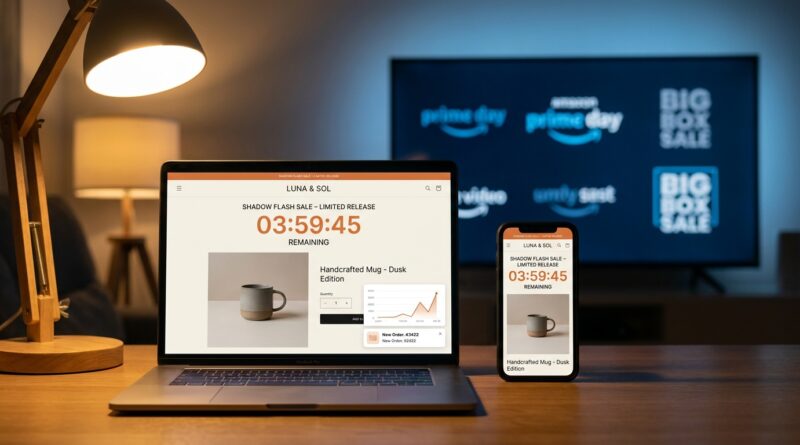
The ‘Prime Shadow Flash’ Strategy: Turn Big-Box Mega Events Into Your Highest-Converting 4-Hour Sale
Your customers are tired, distracted, and still weirdly ready to buy. That is the frustrating part. During overlapping Prime Day-style events and Walmart Deals, shoppers are flooded with banners, countdowns, and “lowest price ever” claims. If you run a smaller store, it can feel like your sale has no chance unless you slash prices so hard it hurts. You do not need to play that game. A smart ecommerce flash sale strategy during prime day is not about yelling louder. It is about showing up at the right moment, with a tighter offer, for people who are already in buying mode but fed up with the noise. That is where the Prime Shadow Flash comes in. Instead of competing head-on with giant retailers during their busiest hours, you let them warm up the market, then step in with a short 4-hour sale that feels cleaner, simpler, and easier to trust. Think less chaos, more precision.
⚡ In a Hurry? Key Takeaways
- A Prime Shadow Flash works best when it starts just after big-box peak promo hours, not during them.
- Keep the sale to 4 hours, feature a few clear hero products, and compare your value against public mega-event deals.
- Do not chase giant discounts you cannot afford. Use timing, focus, and smart channels to protect margin.
What a Prime Shadow Flash Actually Is
A Prime Shadow Flash is a short, tightly timed sale that runs right after a major retailer’s loudest promo window. You are not trying to steal Amazon’s spotlight at noon. You are trying to catch shoppers at 4 p.m. or 8 p.m., after they have spent hours browsing, comparing, and getting a little numb from all the noise.
That shopper is still in deal mode. They are just more selective now. This is your opening.
The big players did the expensive part for you. They trained customers to hunt deals, check prices, and act fast. Your job is to offer a simpler choice at the moment people are most likely to say, “Finally, something I can understand.”
Why This Works Better Than a Multi-Day Discount
Small brands often copy the big sale format. Three days. Sitewide. Endless reminders. That usually creates two problems.
First, you stretch your budget thin. Second, you teach customers to wait, because the offer feels like it will be around forever.
A 4-hour window does the opposite. It is short enough to create urgency and small enough to manage. You can put your best inventory forward, cap your risk, and make the whole thing feel intentional instead of desperate.
Urgency feels more believable
When you say “ends in 4 hours,” people believe you. When you say “summer sale all week,” it starts to sound like background noise.
Your message is easier to understand
One time window. A few products. A clean reason to buy now. That is much easier to absorb than 200 marked-down items and five coupon codes.
You protect your margins
You do not need to discount every SKU. Pick products with room to move, bundles with strong perceived value, or items you want to clear before back-to-school and early fall planning begins.
How to Time It
Timing is the whole trick here. You want the shadow of the big event, not the collision.
Best timing rule
Start your flash sale just after the biggest retailer promo spikes. In plain English, that usually means after the morning rush, after lunchtime browsing, or in the evening when people are back on their phones.
Good examples:
- 2 p.m. to 6 p.m. local time after the morning deal frenzy cools off
- 6 p.m. to 10 p.m. when shoppers revisit carts and comparison-shop
- The day after a major event ends, when inboxes are quieter but deal interest is still high
Today, June 28, 2026, is a perfect example of this setup. Shoppers are at the tail end of overlapping mega-event fatigue. They still want a deal. They just do not want another circus.
How to Structure the Offer Without Over-Discounting
This is where many founders get into trouble. They assume the only way to compete is by going lower on price. Usually, that is the wrong move.
Use public price anchors
If a giant retailer is pushing 20 percent off a common category, use that as the frame. You do not always need to beat it. Sometimes you just need to be easier, faster, or more relevant.
For example:
- “Our 4-hour kit deal beats buying these pieces separately.”
- “Same-day bonus gift, no membership required.”
- “Limited run bundle. Better value than mass-market single-item discounts.”
Pick 3 to 5 hero offers
Do not make customers think too hard. A focused set of offers converts better than a giant sale page full of random markdowns.
Use bundles, gifts, or thresholds
If straight discounts feel too expensive, try:
- Buy more, save more tiers
- Free gift with purchase
- Free shipping threshold
- Limited bundle pricing
These often preserve margin better than a blunt 30 percent off coupon.
Promote It Where the Giants Barely Bother
You are not going to outspend Amazon on paid traffic. Good news. You do not need to.
Email is still one of the best channels for a Prime Shadow Flash. Send one teaser, one launch email, and one last-call reminder. Keep each one short and specific.
SMS
If you have permission-based text marketing, this is a strong fit for a 4-hour sale. Text is perfect for urgency.
Instagram Stories and close community spaces
Stories, private groups, loyalty segments, and post-purchase audiences often work better than broad top-of-funnel ads during mega-event weeks. These are people who already know you.
Retargeting, but very narrowly
Do not spray money everywhere. Retarget recent product viewers, cart abandoners, and recent email clickers. They are already warm.
The Message That Usually Wins
Keep the copy calm. Clear beats clever here.
Try this basic formula:
- What it is: 4-hour flash sale
- Why now: after the big deal chaos, here is a simpler offer
- What is included: 3 to 5 products or bundles
- When it ends: exact time, with timezone
Example:
“Missed the mega-deal madness? Our 4-hour Shadow Flash is live now. 3 best-selling bundles, bonus gift included, ends tonight at 10 p.m. ET.”
What to Do Right After the Sale
The sale is not the finish line. It is the start of a customer relationship, if you handle the follow-up well.
This is where many brands leave money on the table. If you want to turn one burst of traffic into repeat sales, it is worth reading The ‘Behavior Loop Flash’ Strategy: Turn 24 Hours of Clicks Into Your Next 90 Days of Sales. The idea is simple. Use what people clicked, bought, or ignored during the flash to shape the next 30, 60, and 90 days of email, retargeting, and product pushes.
Do these 3 things within 24 hours
- Tag buyers by product or bundle purchased
- Build a segment of clickers who did not buy
- Send a thank-you or “you missed it” follow-up with a softer next step
Common Mistakes to Avoid
Running too long
If it lasts all day, it stops feeling special. Four hours is enough to drive action without dragging.
Discounting everything
This makes your store look messy and can train customers to wait for broad markdowns.
Starting during the loudest retail hours
You will get buried. Let the giants spend their money first.
Forgetting checkout friction
Make sure mobile load speed, cart flow, coupon logic, and shipping details are clean before launch. A 4-hour sale leaves no room for technical drama.
A Simple Prime Shadow Flash Playbook
- Pick one 4-hour window just after a major deal spike.
- Choose 3 to 5 hero products, bundles, or clearance winners.
- Set an offer that protects margin, not just a dramatic discount.
- Write one clear message with an exact end time.
- Promote first to email, SMS, and warm audiences.
- Retarget recent site visitors only.
- Follow up fast with buyers and non-buyers.
At a Glance: Comparison
| Feature/Aspect | Details | Verdict |
|---|---|---|
| Timing | Launch just after the biggest retailer traffic surges, not during them. | Best way to catch shoppers without getting drowned out. |
| Offer Design | Use 3 to 5 hero offers, bundles, gifts, or thresholds instead of sitewide deep cuts. | Stronger conversion with better margin control. |
| Promotion Channels | Focus on email, SMS, retargeting, and community channels the big-box players do not dominate. | Most practical path for smaller brands with limited ad budgets. |
Conclusion
You do not need to win the whole internet for three days. You just need one clean window where your offer makes sense. Right now, on June 28, 2026, shoppers are coming off overlapping Prime Day-style pushes and Walmart Deals that have trained them to expect aggressive discounts while also wearing them out. That is exactly why a Prime Shadow Flash can work so well. It lets smaller e-commerce brands capture deal-hungry traffic without fighting for the same hours, placements, or budgets as the giants. By starting just after their peak windows, anchoring your pricing against public offers, and promoting in channels they barely touch, you borrow the urgency they created without paying for all that awareness yourself. For founders who cannot afford a multi-day sale or massive ad spend, this is the practical move. Done right, it helps you move inventory, grow your list, and pick up new customers while the whole web is still in buying mode.