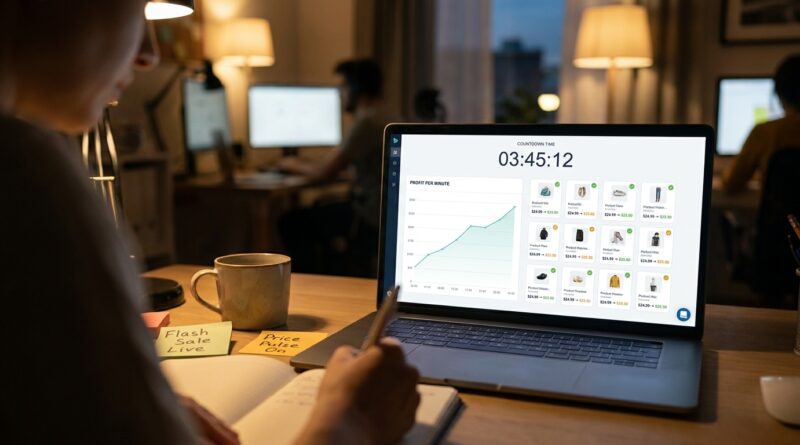
The ‘Live Price Pulse Flash’ Strategy: Turn Real‑Time Demand Spikes Into Automatic Extra Profit
It is frustrating to run a 24-hour flash sale and still feel like you are losing from both sides. Cut prices too early, and you give away margin you did not need to lose. Hold steady, and a competitor or marketplace seller slips in with a lower price before your customer checks out. That is the new reality. A flash sale is no longer one discount for one day. It is a moving contest that can change by the hour. The good news is you do not need a giant retail tech stack to keep up. A smart dynamic pricing flash sale strategy for ecommerce can be surprisingly simple. Think of it as adding short, controlled price pulses during your sale based on live demand, stock levels and competitor movement. Done right, you earn more on products that are already hot, move the slower items faster, and stop teaching shoppers to wait around for a bigger blanket markdown.
⚡ In a Hurry? Key Takeaways
- Use short live price changes during a flash sale, not one fixed discount all day.
- Start with a few SKUs, clear floor prices and 2 to 4 scheduled check-ins based on demand and competitor moves.
- Protect trust by setting guardrails so prices never swing wildly or drop below your minimum margin.
What the “Live Price Pulse Flash” strategy actually means
This is not about changing every price every five minutes like a chaotic airline site.
It is about using small, planned price adjustments inside a flash sale window. You watch what is happening in real time, then respond with rules.
For example, if one SKU is selling faster than expected and inventory is getting tight, you trim the discount. If another product is getting clicks but no conversions, you deepen the discount for two hours. If a rival undercuts your hero item, you either match for a short burst or shift your offer to a bundle, free shipping or bonus gift.
That is the pulse. Short. Intentional. Measured.
Why static flash sales are struggling now
Shoppers are seeing more price changes than they used to. Marketplaces update prices constantly. Competitor tools track your SKUs. Some brands are reacting to ad costs, stock pressure and conversion rates in near real time.
If your sale price is frozen for 24 hours, you are basically posting your playbook in the window and walking away.
That creates three common problems.
You discount too much, too early
If demand was strong at 15% off, a 30% blanket discount just burns margin.
You miss the weak spots
Not every product needs the same push. A slow-moving item may need a stronger offer, while a fast seller may need none.
You train customers to wait
If shoppers know your big sale means broad markdowns on everything, they learn to hold off. That is a hard habit to undo.
How to build a simple dynamic pricing flash sale strategy for ecommerce
You do not need to start with your whole catalog. In fact, please do not. Start small.
1. Pick 5 to 20 products, not 500
Choose products that fit into three buckets.
- Fast movers with healthy traffic
- Margin-rich items with room to flex
- Slow movers you genuinely want to clear
This gives you enough variety to learn without creating a mess.
2. Set a floor price before the sale starts
This is your safety rail. Decide the lowest price you will allow for each SKU after fees, shipping, returns and ad spend.
If your software, team or agency cannot explain the floor clearly, stop there and fix that first. Dynamic pricing without a floor is just fast guessing.
3. Create 3 pricing bands
Keep it simple.
- Band A, light discount
- Band B, standard flash discount
- Band C, deeper rescue discount
Now your team is not inventing prices on the fly. They are moving products between pre-approved ranges.
4. Check a few live signals, not everything under the sun
The best signals for most smaller brands are:
- Conversion rate
- Units sold per hour
- Inventory left
- Competitor or marketplace price shifts
- Cart abandonment on key SKUs
That is enough to make good calls.
5. Change prices on a schedule
Do not update constantly. That gets messy and can look shady to shoppers.
A better pattern is every 3, 4 or 6 hours during the sale. That keeps the pulse alive without turning your storefront into a slot machine.
A practical example
Let’s say you sell skincare.
Your vitamin C serum starts the sale at 20% off. By 10 a.m., traffic is strong, conversion is high and stock is moving faster than planned. Instead of leaving money on the table all day, you reduce the discount to 15% for the next pulse window.
Meanwhile, your night cream is getting plenty of product page views but weak conversion. You drop it from 15% off to 25% off for a two-hour push. If that still does not work, you might switch tactics and offer a bundle instead.
Your cleanser gets undercut on a marketplace. Rather than racing to the bottom for the full day, you match the lower price only from noon to 3 p.m., then return to your normal band if the market settles.
That is how a dynamic pricing flash sale strategy for ecommerce protects margin and improves sell-through at the same time.
What to automate and what to keep human
Automation is useful. Blind automation is not.
Good things to automate
- Price alerts when competitors change
- Scheduled pulse windows
- Rules tied to stock levels or conversion thresholds
- Notifications when a product hits its price floor
Things a human should still review
- Brand-sensitive hero products
- Products with messy shipping costs
- Items that are often bought together
- Any surprise swing that looks too aggressive
If you already run timed promotions during quieter parts of the day, you may also like The ‘AI Happy Hour Flash’ Strategy: Turn 3 Quiet Hours Into Your Store’s Daily Profit Spike. It pairs well with live price pulses because both ideas are really about being more precise instead of just being louder.
Guardrails that keep this from backfiring
This strategy works best when it feels smart, not sneaky.
Do not make huge swings
A product that is $49 at 9 a.m., $39 at 11 a.m. and $52 by lunch can annoy people. Keep changes modest and purposeful.
Use messaging that explains the event
Phrases like “limited-time live deal,” “inventory-based offer,” or “price updates throughout the sale” help set expectations.
Protect your best customers
If someone buys at 10 a.m. and the item drops slightly at noon, consider a short price-protection window or store credit rule. That keeps trust intact.
Watch your channels
If you sell on your own site, Amazon, Walmart or Google Shopping, make sure your price moves do not create feed issues, policy problems or margin surprises after fees.
When live price pulses work best
- Short flash events, like 12 to 48 hours
- Categories with active comparison shopping
- Products with visible competitor overlap
- Inventory situations where some items are tight and others are overstocked
They are less useful when every item has razor-thin margin or when your catalog is too custom to compare easily.
Easy first test for your next sale
If you want a low-stress way to begin, try this.
- Choose 10 SKUs.
- Set a price floor and 3 discount bands for each.
- Run a 24-hour sale with 4 pulse checkpoints.
- At each checkpoint, review conversion, units sold, stock and competitor prices.
- Change only the products that clearly need a push or a pullback.
After the event, compare margin, revenue per visitor and sell-through against your last static sale.
That one test will tell you a lot.
Common mistakes to avoid
- Applying dynamic pricing to your entire catalog on day one
- Ignoring fees and using fake floor prices
- Chasing every competitor move instantly
- Dropping prices when the real problem is a weak product page or bad shipping terms
- Forgetting to measure whether margin improved, not just revenue
At a Glance: Comparison
| Feature/Aspect | Details | Verdict |
|---|---|---|
| Static 24-hour sale | One price all day, simple to run, but slow to react to demand spikes or competitor cuts. | Easy, but often leaves margin behind. |
| Live price pulse sale | Small timed price changes based on stock, conversions and market movement. | Best balance of agility and control. |
| Full always-on dynamic pricing | Constant algorithm-driven price updates across many SKUs and channels. | Powerful, but usually too complex for a first step. |
Conclusion
Flash sales have quietly changed. They are not one-price events anymore. They are mini price wars that play out hour by hour, often with competitors and marketplaces watching your products in real time. That is why a simple dynamic pricing flash sale strategy for ecommerce matters right now. It helps you protect margin on items already selling well, move slower stock without blanket discounts, and avoid teaching loyal shoppers to sit tight until the deepest markdown appears. You do not need to turn your store into a science project. Start with a handful of products, clear guardrails and a few pulse windows. If you do that well, you give your brand something every small seller needs in 2026, a way to compete with smarter pricing instead of just cheaper pricing.