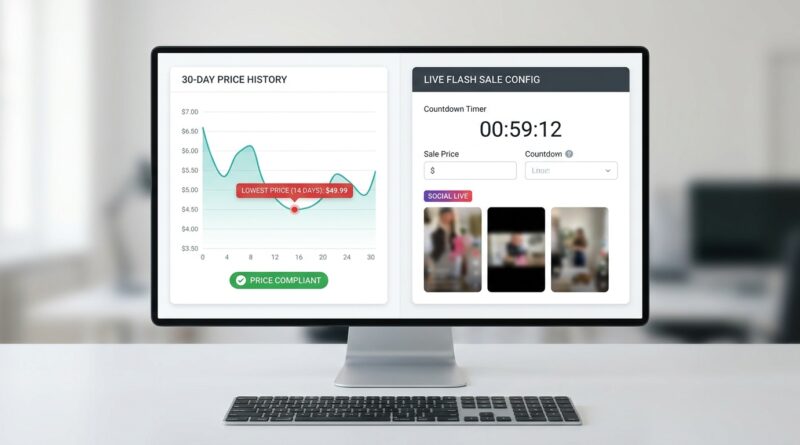
The ‘Price-Proof Flash’ Strategy: Turn Transparent Discounts Into Click‑Safe, High‑Trust Sales
You can feel the trap here. You need a flash sale to move stock, wake up the algorithm, and give shoppers a reason to buy now. But one bad “was” price, one promo that quietly expires while a video keeps running, or one discount that is not backed by real price history can turn a good sales day into refunds, angry comments, and platform headaches. Shoppers are sharper now. Regulators are sharper too. They are checking whether your discount is real, whether your urgency is honest, and whether your “lowest price” claims can be proved. That is why a flash sale pricing strategy compliant lowest price rules is no longer just a legal box to tick. It is a trust tool. The smart move is to build every flash promo so you can prove the before-price, control the floor price, and shut the promo off cleanly when the timer ends.
⚡ In a Hurry? Key Takeaways
- Use a price-proof flash framework. Every “save X%” claim should match a real, documented prior price and a controlled promo end time.
- Set three numbers before launch: your reference price, your true lowest allowed sale price, and your margin floor after fees, coupons, and returns.
- Clean promo shutoff matters as much as the launch. Old videos, pinned comments, and storefront banners can still trigger flags after the sale ends.
The problem is not discounts. It is sloppy discount math.
Most sellers do not get in trouble because they offered a big deal. They get in trouble because their systems, creatives, and product feeds stop agreeing with each other.
Maybe your Shopify store shows 30% off, your TikTok Shop product card shows a different strike-through price, and an older creator video still says “today only” two days later. To a customer, that looks shady. To a platform, it can look like fake urgency or a misleading price claim.
This is why a flash sale pricing strategy compliant lowest price rules has to be built like a checklist, not a vibe.
What “price-proof flash” actually means
Think of it like keeping receipts for your promotion. Before you hit publish, you should be able to answer three simple questions.
1. What price are you comparing against?
Your “before” price needs to be a real selling price, not a fantasy list price you barely used. In many markets and on many platforms, the comparison price must reflect a genuine previous selling period or the lowest recent price within a set time window.
2. How low can you safely go?
This is your floor. Not the number you hope works. The number that still protects your margin after platform fees, payment fees, shipping subsidies, affiliate cuts, coupons, and likely returns.
3. When does the claim stop being true?
If your promo ends at 9 p.m., then your product page, ad copy, live talking points, auto-applied coupons, and pinned comments all need to stop saying the sale is active at 9:01 p.m.
The three-price rule every seller should use
Here is the simplest framework I know for staying aggressive without getting reckless.
Reference price
This is the price you are allowed to compare against. It should be supported by your actual sales history and local rules. Save screenshots, exports, and timestamps.
Promo price
This is the public flash-sale price shoppers see.
Margin floor
This is the private number your team never crosses, even if a coupon stacks, an affiliate pushes volume, or ad costs jump.
If the promo price gets too close to the margin floor, you do not have a promotion. You have a panic discount.
How to build a compliant flash sale without killing conversions
Start with real price history
Pull the last 30 to 90 days of actual sold prices by SKU. Not what the catalog said. What customers really paid. Include bundles, auto-discounts, creator codes, and marketplace vouchers if those affect the final public price.
This step matters because “lowest price” rules often care about the actual lowest recent price, not the neat number in your planning sheet.
Use one source of truth for the sale
Your store, marketplace listing, ad creative, live script, and support macros should all read from the same promo plan. One SKU. One start time. One end time. One approved comparison price.
If you are also testing checkout incentives, pair this with a cleaner payment setup. Our piece on The ‘Payment Power Flash’ Strategy: Turn One Checkout Choice Into A High‑Margin Stampede fits well here, because payment offers can quietly distort the real final price if you do not map them in advance.
Pre-write the shutoff plan
This is where many sellers slip. They plan the launch and forget the ending.
Make a shutdown list that includes:
- Product page strike-through price
- Storefront banners
- TikTok Shop flash deal settings
- Auto-applied coupons
- Live shopping scripts and overlays
- Pinned comments and link-in-bio tools
- Creator briefs still promoting the expired price
If a platform crawler or a customer sees yesterday’s price claim still hanging around, your intent may not matter much.
Why shoppers now spot fake urgency faster than many sellers expect
People have learned the tricks. They screenshot prices. They compare tabs. They check comment sections. If someone notices that your “flash” price appears every weekend, or that the “was” price was only live for a few hours, they will say it out loud.
That hurts twice. First, it cuts conversion because trust falls apart in public. Second, it raises your risk of chargebacks, refund requests, and reports to the platform.
A real flash sale should feel urgent, not suspicious.
A simple operating model for TikTok Shop, Shopify, and marketplaces
For TikTok Shop
Short-form video has a memory problem. A clip can keep getting views after the offer ends. So avoid hard-coded lines like “ends tonight” unless you know the content will be pulled or updated immediately.
Safer approach. Use wording tied to the active product card or on-screen timestamp, and keep a team member responsible for deactivating old sale creatives. Also check whether creator affiliates are still using expired hooks.
For Shopify
Shopify gives you control, but that means the cleanup is on you. Theme badges, compare-at prices, apps, bundles, cart discounts, and popups can drift out of sync. Test the full buyer path before launch and again right after the sale ends.
For marketplaces
Marketplaces often have stricter automated enforcement because they have to police millions of listings at once. Read the current promo and pricing policy, then assume the robot will judge what is visible, not what you meant.
The margin-safe part that sellers skip
Compliance is only half the job. You also need the sale to make money.
Build your all-in cost view
Include:
- Cost of goods
- Platform commission
- Payment processing
- Shipping and packaging
- Affiliate or creator payout
- Expected refund rate
- Customer support cost on high-volume days
Then work backward from a minimum acceptable contribution margin. If the price needed to win the click drops under that line, change the offer shape instead of forcing the price lower.
Use offer design, not just deeper cuts
You can keep the promo strong by changing the structure:
- Limited bundle instead of solo-SKU discount
- Free gift with guardrails instead of another 10% off
- Checkout-specific incentive
- Spend threshold that lifts average order value
That often protects both trust and margin better than pushing a dramatic but fragile headline discount.
The comments section is now part of your compliance system
This sounds strange, but it is true. If multiple shoppers are asking, “Wasn’t this the same price last week?” or “Why does the video say 50% off but the page says 20%?” that is not just customer service noise. It is early-warning data.
Treat those comments like smoke from under the door. Check the listing, check the timestamps, and check every linked promo asset right away.
A quick “price-proof flash” checklist
- Document the valid reference price with dates and screenshots.
- Confirm the recent lowest public price by SKU.
- Set the promo price above your true margin floor.
- Check stackable discounts, coupons, and payment offers.
- Align product pages, ads, live scripts, and creator briefs.
- Assign one person to end the sale everywhere.
- Audit old videos, pinned posts, and banners after expiry.
- Keep records in case a platform or customer questions the claim.
At a Glance: Comparison
| Feature/Aspect | Details | Verdict |
|---|---|---|
| Reference price setup | Use actual recent selling data, not an inflated list price or old catalog number. | Best for trust and rule compliance |
| Promo execution | One approved sale plan across storefront, marketplace, ads, creators, and coupons. | Cuts customer confusion and platform risk |
| Promo shutdown | Remove expired claims from videos, banners, comments, and auto-discounts as soon as the timer ends. | Critical for avoiding flags and refund storms |
Conclusion
Flash sales still work. They just have to be cleaner now. Regulators, platforms, and shoppers are all paying closer attention to fake urgency and inflated “before” prices, and sellers are already seeing videos flagged or removed after promos expire because the cleanup did not happen fast enough. A price-proof flash framework gives you a practical way to keep running bold, margin-safe campaigns on TikTok Shop, Shopify, and beyond. You move inventory, protect trust, and sleep better because your pricing story holds up the next morning. That is the real win. Not just more clicks, but safer clicks.