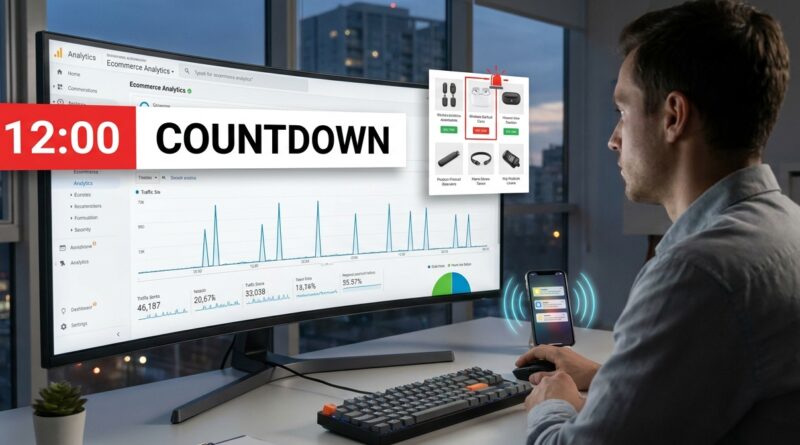
The ‘Micro-Burst Flash’ Strategy: Run 12-Minute Sales That Don’t Train Shoppers To Wait For Discounts
You know the pattern. You call it a flash sale, but it runs half the day, maybe a full day. Sales come in, sure, but margins get thinner, your team gets jumpy, and your customers quietly learn a bad habit. Wait long enough and the discount will show up. That is the part that stings.
A micro burst flash sale strategy for ecommerce fixes that by shrinking the offer window to something much tighter, often 12 minutes. Not 12 hours. Not “today only.” Just a short, deliberate burst tied to a real spike in attention. Maybe TikTok sends a wave. Maybe an email gets opened fast. Maybe a creator mention lands better than expected. Instead of dragging a promotion across the whole day, you catch the moment, use a small offer, and get out. Done right, it feels exciting to shoppers, useful to your revenue, and rare enough that you are not training people to sit on their hands until the next markdown.
⚡ In a Hurry? Key Takeaways
- A micro burst flash sale strategy for ecommerce means running a very short sale, often 12 minutes, during a real traffic spike instead of discounting for hours.
- Start with one product, one clear message, a countdown bar, and a simple trigger based on live traffic or referral spikes.
- Keep these sales rare and brief so they feel special, protect margins better, and do not teach shoppers to always wait for discounts.
What a micro-burst flash actually is
Think of it as a pressure valve, not a season-long pricing habit.
A micro-burst flash is a short sale window, usually around 12 minutes, launched when attention is already high. The point is not to create demand from nothing. The point is to capture demand that is already knocking at the door.
That is why it works better than the old “24-hour flash sale” label. A 24-hour sale is not really a flash. It is a regular promotion wearing a leather jacket.
A true micro-burst has three parts.
1. A real trigger
This could be a spike in live visitors, a sudden jump from Instagram stories, a creator shout-out, or a sharp rise in add-to-carts.
2. A narrow offer
One hero product. One bundle. One gift-with-purchase. Keep it focused.
3. A hard stop
When the 12 minutes end, the offer is gone. No extensions. No “we heard you” email ten minutes later.
Why 12 minutes makes more sense than 12 hours
People do not shop in long, calm sessions the way they used to. They bounce. A little scrolling on TikTok. A quick peek at Instagram. Two minutes on your site. Then they are gone.
If attention now comes in short bursts, your promotion should match that behavior.
Long sales create two problems. First, they eat margin because too many buyers who would have paid full price also get the discount. Second, they train your audience to wait. If every offer lasts all day, there is no reason to act now.
A 12-minute burst changes the psychology. It feels like a moment, not a pattern.
When to use a micro burst flash sale strategy ecommerce brands can trust
This works best when you have a sudden pocket of attention and a decent reason to move fast.
Good moments to trigger one
Use it when:
- A creator mentions your product and traffic jumps
- An email campaign gets unusually strong open and click activity in the first few minutes
- A reel, short, or TikTok starts sending visitors right now, not later
- A product restock creates a buzz spike
- You want to test urgency messaging without running a full-blown discount event
If you are already working with creators, this pairs nicely with The ‘Micro-Influencer Flash’ Strategy: Turn One Live Collab Into A 30‑Minute Sellout. The logic is similar. Catch the live energy while it is still hot.
What to offer without wrecking your margins
The best micro-bursts are not always the deepest discounts. They are the cleanest offers.
Safer offers to start with
- 10% off one hero SKU
- Free shipping for 12 minutes
- Free gift for the next 25 orders
- A limited bundle price
- Early access to a product variation or restock
You do not need to slash prices to create urgency. In many cases, a small perk plus a short timer does more good than a big discount stretched across hours.
If your margins are already tight, test free shipping or a gift first. Customers often read those as high value, while your math stays more controlled.
How to set one up this week
You do not need fancy software. Most brands can do this with tools they already have.
Step 1. Pick your trigger
Set a simple rule. For example:
- Launch when live traffic is 30% above your normal hourly average
- Launch when a social post sends 100 visitors in 10 minutes
- Launch when your email campaign drives an unusually high click rate in the first 15 minutes
Keep it plain. You are looking for a visible surge, not a perfect model.
Step 2. Choose one product
Do not spread the offer storewide. That is how “small test” turns into “there goes the margin.” Pick one item with healthy stock, decent margin, and broad appeal.
Step 3. Build a tiny promo kit
You need:
- A countdown bar
- An on-site announcement
- One cart or checkout code, if needed
- One story post, SMS, or email draft ready to go
That is enough to start.
Step 4. Write urgency copy that sounds human
Skip the fake drama. Try simple lines like:
- 12 minutes only. Ends at 2:24 PM.
- Traffic spiked, so we opened a quick thank-you offer.
- Live for 12 minutes. One product. Then it is gone.
Specific beats loud.
Step 5. End it cleanly
When the timer ends, take it down. No last-second extensions. If you keep reviving the sale, shoppers will notice. They always do.
How often is too often
This is where brands get themselves into trouble.
If you run a micro-burst every other day, it stops being special. It becomes your new pricing system with a countdown clock attached.
A good rule is to keep them irregular and tied to genuine moments. If shoppers cannot predict them, they stay interesting. If they can predict them, they become a waiting game.
Rare beats frequent here.
What to measure after each burst
You are not just looking for a nice spike in orders. You are checking whether the burst was worth the trade.
Watch these numbers
- Revenue during the 12-minute window
- Conversion rate versus your normal baseline
- Average order value
- Margin on the featured item or bundle
- How many sales likely would have happened anyway
- New customer share versus repeat customer share
If conversions jump but margin gets ugly, tighten the offer next time. If traffic surges but nobody buys, the issue may be the product, not the format.
Common mistakes that make micro-bursts backfire
Running them too long
If the sale lasts an hour or more, you are drifting back into standard promo territory.
Discounting the whole store
That is the fast lane to margin damage.
Using weak triggers
Do not force a burst because you feel like posting one. Tie it to actual attention.
Being vague
“Limited time” is mush. “12 minutes only” is clear.
Ignoring inventory
Do not trigger a burst on a product with shaky stock or fulfillment issues. Nothing ruins urgency faster than overselling.
Who should try this first
This works especially well for brands that already get uneven but intense pockets of traffic.
- DTC brands with active social channels
- Shops using creator mentions or live collabs
- Brands with one or two clear hero products
- Stores that want to test urgency without committing to constant discounting
If your traffic is flat and predictable, a micro-burst can still work, but you may need to pair it with a stronger trigger source first.
At a Glance: Comparison
| Feature/Aspect | Details | Verdict |
|---|---|---|
| Sale length | Micro-burst runs about 12 minutes. Traditional flash sales often run 12 to 24 hours. | Shorter is better for real urgency and less discount dependency. |
| Margin impact | A narrow product offer limits how much full-price demand gets pulled into the discount window. | Better protection than broad, day-long promos. |
| Customer behavior | Rare, brief offers feel like lucky timing. Frequent long sales teach shoppers to wait. | Micro-bursts are safer if you keep them uncommon and honest. |
Conclusion
Right now traffic and attention are all over the place. Shoppers hop between TikTok, Instagram, and your site in little bursts, not long sessions. That makes old-school multi-hour flash sales feel clumsy and expensive. A micro-burst flash gives The Deal community a practical way to squeeze revenue out of those sudden spikes, test urgency copy without a huge risk, and keep offers short enough that they feel like a win, not a standing invitation to wait for markdowns. Best of all, you can start this week with simple tools you probably already have. A basic analytics view, a countdown bar, and a plain on-site announcement are enough. Keep it tight. Keep it rare. Then let the moment do the work.