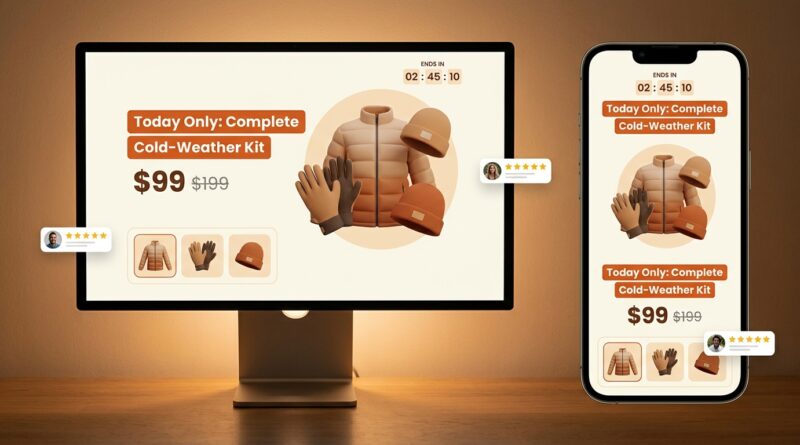
The ‘Cluster-Flash’ Strategy: Turn One Smart Bundle Into A Higher AOV Stampede
Flash sales can feel like a sugar rush for your store. Orders jump for a day, your team gets excited, then you look at the numbers and the buzz wears off fast. Margins are thinner. Customers bought the cheapest thing. And worst of all, you may have trained regular shoppers to wait for the next code instead of buying at full price. If that sounds familiar, you are not doing anything “wrong.” You are just using a promo format that often rewards volume more than value. A smarter move is a flash sale bundle strategy for higher average order value. Instead of discounting one popular item and hoping shoppers add more, you build one tight bundle around a specific problem your customer wants solved right now. Then you make that bundle the star of a short, focused flash window. It is simpler than it sounds, and for many smaller ecommerce teams, it is much healthier for the business.
⚡ In a Hurry? Key Takeaways
- A cluster-flash bundle works best when you group 3 to 5 products around one urgent customer need and make that bundle the only flash offer.
- Start with items that naturally belong together, keep the discount modest, and write the offer around the problem solved, not just the percent off.
- This approach can lift average order value while protecting margin better than broad coupon blasts or single-SKU promos.
Why single-item flash sales stop helping after a while
Single-SKU promos feel safe because they are easy to set up. Pick a bestseller, trim the price, send an email, watch traffic come in.
But there is a catch. The customer learns the pattern. They stop thinking, “I need this brand.” They start thinking, “I will wait for a deal.”
That creates three headaches at once. Your margin shrinks. Your average order value stays flat. And your best item starts doing all the heavy lifting while the rest of your catalog sits there.
This is why a flash sale bundle strategy for higher average order value is worth a serious look. It changes the question from “How do we discount one thing?” to “How do we help the shopper solve something completely in one click?”
What a cluster-flash bundle actually is
Think of it as a mini solution kit with a timer on it.
You choose one clear customer problem. Then you group 3 to 5 products that solve that problem better together than alone. That bundle becomes the only flash offer for a short, intense window.
Examples help.
Simple bundle ideas
A skincare brand could run a “48-hour breakout reset” bundle with cleanser, treatment serum, spot patches, and a lightweight moisturizer.
A coffee brand could offer a “better home brew this week” bundle with beans, filters, a grinder cleaner, and a mug.
A pet store could build a “new puppy first-week calm kit” with training treats, poop bags, a toy, and a stain remover.
The point is not to cram random products together. The point is to remove decisions. The shopper sees one problem, one package, one time limit.
Why this lifts AOV without the usual damage
Bundles work because they change buying behavior in a quiet but important way.
1. You raise basket size naturally
Instead of trying to upsell after the customer adds one item, you start with a bigger offer. The order value rises at the front door.
2. You protect margin better
You do not need a huge discount on every item. Often the customer values the convenience and curation enough that a modest bundle deal feels strong.
3. You reduce decision fatigue
Too many choices can freeze people. A good cluster-flash bundle says, “If this is your problem, here is the answer.” That simplicity sells.
4. You move more than one product line
Your bestseller can still be in the bundle, but now it helps pull slower items along with it. That makes your catalog work harder.
How to build a cluster-flash bundle in a day
You do not need fancy personalization tools or a major development sprint. Most teams can do this with what they already have.
Step 1: Pick one urgent customer job
Do not start with products. Start with the thing the customer wants solved today.
Good examples include “sleep better tonight,” “refresh your desk setup,” “pack for a weekend trip,” or “recover after a hard workout.”
If the theme sounds vague, keep refining it until a shopper can understand it in two seconds.
Step 2: Choose 3 to 5 products that fit cleanly
This part matters a lot. Every item should make the bundle better. If one item feels like filler, remove it.
A good test is simple. If a customer asked, “Why is this in here?” would your answer feel obvious?
Step 3: Keep the discount focused, not reckless
You are not trying to shock people with a giant markdown. You are trying to make the combined offer feel smart and time-sensitive.
For many stores, that means a bundle savings that is noticeable but controlled. Enough to create action. Not so much that it wrecks profit.
Step 4: Make it the only flash deal
This is where many brands mess up. They build a nice bundle, then also run sitewide codes, category discounts, and pop-ups for first-time buyers.
That muddies the message. If everything is on sale, nothing feels special.
A cluster-flash works best when it gets the stage to itself.
Step 5: Write the sales copy around the outcome
Do not lead with “Save 15%.” Lead with the problem solved.
For example, “Your three-step rainy-season skin rescue, live for 12 hours only” is stronger than “Bundle sale now on.”
How long should the flash window be?
Shorter is usually better. You want energy, not confusion.
For most stores, 6 to 24 hours is a useful range. Long enough for email, SMS, and social to do their job. Short enough that people feel they need to act.
If you want another angle on urgency that does not rely on deep discounts, see The ‘Shipping-Speed Flash’ Strategy: Turn One 24‑Hour Delivery Window Into Higher Prices And Faster Sellouts. It is a good reminder that urgency can come from the offer structure, not just the markdown.
Common mistakes to avoid
Making the bundle too big
More products do not always mean more value. Past five items, many bundles start to feel messy.
Using unrelated products
Customers can spot a warehouse cleanout in seconds. If the bundle looks like you are just trying to dump inventory, trust drops.
Discounting too hard
A flash sale should bring in profitable orders, not applause on social media and regret in your finance sheet.
Running it too often
If the bundle appears every weekend, shoppers will wait. Keep it special.
Ignoring post-sale data
Track bundle conversion rate, average order value, gross margin, and repeat purchase behavior. The goal is not just one busy day. The goal is healthier buying patterns over time.
What to measure after the campaign
You do not need a giant dashboard. Just watch the numbers that tell the real story.
- Average order value versus your normal flash sale days
- Gross margin per order
- Bundle take rate, meaning how many visitors chose it
- Attach rate for products inside the bundle afterward
- Repeat purchase rate from bundle buyers
If AOV rises and margin stays healthier than your usual promo days, you are onto something.
Who should try this first?
This works especially well for smaller ecommerce teams that cannot spend months building advanced personalization systems.
If you have a decent product mix, a basic email or SMS setup, and enough control over your storefront to feature one bundle clearly, you can test this fast.
That is the beauty of it. It is practical. You can ship the idea in a day, learn from it, and improve the next one.
At a Glance: Comparison
| Feature/Aspect | Details | Verdict |
|---|---|---|
| Single-SKU flash sale | Easy to launch, but often keeps order size small and teaches shoppers to wait for discounts. | Fast, but weak for long-term AOV growth. |
| Cluster-flash bundle | Groups 3 to 5 products around one clear need, with one short flash window and one focused message. | Best balance of urgency, margin protection, and higher basket value. |
| Sitewide coupon blast | Broad reach, but usually cuts too deep, confuses the message, and makes the sale feel ordinary. | Useful sparingly, but risky as a habit. |
Conclusion
Right now, plenty of brands are chasing personalization and urgency by piling generic coupon codes on top of the same tired bestsellers. That is easy to copy, and it usually gets expensive. A cluster-flash bundle is different. You pick one clear problem your customer wants solved today, group 3 to 5 products that solve it better together, and make that bundle the only flash offer for a short, intense window. Done well, this flash sale bundle strategy for higher average order value can protect margin, raise order size, and make shopping feel simpler instead of noisier. Best of all, smaller ecommerce teams can actually do it without fancy AI or heavy development work. Start with one bundle, one problem, and one short window. You do not need a quarter to test it. You can start this week.