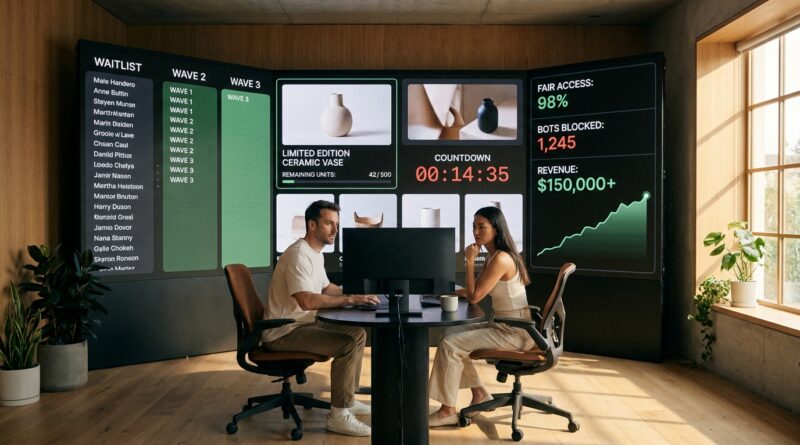
The ‘Drop Queue Flash’ Strategy: Turn Waitlists Into Guaranteed Sell‑Outs
You can spend weeks setting up a flash sale and still end up with the worst of both worlds. One item vanishes in minutes, another sits there awkwardly, and your inbox fills with messages about bots, unfair checkouts, and “why did I even bother?” That frustration is real. It is not just about revenue. It is about trust. Customers want a fair shot, and you want clean signals about actual demand, not chaos caused by speed-clicking and panic buying.
⚡ In a Hurry? Key Takeaways
- A flash sale waitlist strategy turns one messy launch into staged buying windows that feel fairer and sell more predictably.
- Start by collecting interest before launch, then invite shoppers in waves based on segment, loyalty, or signup order.
- This cuts bot drama, protects your site from traffic spikes, and gives you better data to adjust bundles or pricing between waves.
Why regular flash sales keep going sideways
A standard flash sale assumes everyone should show up at once, click at once, and somehow have a good experience. That works in theory. In real life, it creates a traffic jam.
The fastest buyers win. Everyone else feels cheated. Your store may slow down. Your support team gets slammed. And the sales data you collect is messy because it reflects urgency and confusion, not clean buying intent.
That is why the drop-queue model is getting attention. It borrows the good part of hype drops while removing some of the pain.
What the “Drop Queue Flash” strategy actually is
The flash sale waitlist strategy is simple. Before the sale opens, you ask interested shoppers to join a waitlist. Then, instead of opening the gates to everyone at once, you release access in timed waves.
Think of it like boarding a plane by groups instead of telling 180 people to rush the aisle together.
How it works in plain English
First, customers raise their hand by joining the waitlist. That gives you a pool of pre-qualified demand.
Next, you sort that pool into segments. That might mean VIP customers first, email subscribers second, general public third. Or you might use signup time, location, product interest, or past purchase behavior.
Then each group gets a buying window. Maybe Wave 1 gets 20 minutes. Wave 2 gets access to remaining stock plus a different bundle. Wave 3 gets a fallback offer if the hero SKU is nearly gone.
Now you are not guessing demand all at once. You are learning as you go.
Why this works better in 2026
Shoppers are tired. They have seen too many fake countdowns, too many “limited” drops that smell rigged, and too many checkouts that look like bot playgrounds. FOMO still works, but blind FOMO is wearing thin.
A queue and waitlist feel more honest. Customers can see there is a process. Even if they do not get first access, they understand the rules.
For smaller brands, that matters. You probably do not have Supreme-level infrastructure or a giant engineering team. But you can still create that drop energy without inviting total checkout mayhem.
The biggest benefits of a flash sale waitlist strategy
1. Fairer access
Customers are less likely to feel tricked when they join a known line and receive a clear access window. It is not perfect fairness, but it is much better than “fastest thumbs win.”
2. Better inventory control
If Wave 1 burns through 70 percent of stock in ten minutes, you can change what happens next. You can cap quantities, change bundles, or hold some units for Wave 2. You are steering the sale instead of watching it spin out.
3. Cleaner demand data
A waitlist tells you who wanted in before the frenzy started. That is useful. It helps you see true interest by product, segment, source, and timing.
4. Higher revenue per SKU
This is the sneaky advantage. Between waves, you can test different price breaks, bonus offers, or bundles based on what is actually happening. That beats guessing all your pricing upfront and hoping you nailed it.
5. Less infrastructure stress
Staggered access smooths traffic spikes. That means fewer site crashes, fewer cart errors, and fewer angry social posts with screenshots of broken checkout pages.
How to set one up without making it complicated
Step 1: Build a clean waitlist page
Keep it short. Tell people what the product is, why stock is limited, when invites start, and how access works. Ask only for the details you need, usually email and maybe SMS.
If you can, let shoppers indicate which product or variant they want. That gives you sharper demand signals.
Step 2: Be very clear about the rules
Say whether access is first-come, loyalty-based, randomized, or segmented another way. Explain time windows. Explain cart holds. Explain quantity limits.
People handle bad news better when the rules were clear from the start.
Step 3: Create sensible waves
You do not need ten waves. Start with three.
Wave 1 could be VIPs or top customers.
Wave 2 could be active subscribers.
Wave 3 could be everyone else on the list.
Keep each window long enough for normal humans with jobs, kids, and meetings. Ten to thirty minutes often works better than a two-minute scramble.
Step 4: Add anti-bot friction where it matters
Use account login, CAPTCHA, one-time access links, and purchase limits. You do not need to turn checkout into airport security. Just make abuse annoying enough that real customers have a fair shot.
Step 5: Decide your between-wave options in advance
This part is important. Before launch, plan your “if this, then that” moves.
If stock runs hotter than expected, maybe later waves see a smaller quantity cap.
If one color underperforms, maybe it gets paired in a bundle.
If the top SKU is nearly gone, maybe you promote a backup product with a small bonus.
That way you are adjusting calmly, not improvising under pressure.
Common mistakes that ruin the model
Making the queue feel fake
If shoppers suspect the line is just theater, trust disappears fast. Do not overstate scarcity. Do not send “you are next” emails to everyone at once. Make the sequence real.
Giving no fallback to later waves
If most people wait only to find a sold-out page, the strategy starts feeling like a tease. Offer alternatives. That could be a restock waitlist, a second-choice product, a bundle, or a future access code.
Ignoring post-sale communication
After the event, tell people what happened. Thank them. If they missed out, give them a next step. Silence after a high-hype drop is how brands collect resentment.
Who should use this approach
This works especially well for limited-edition products, collectible items, small-batch launches, beauty drops, fashion capsules, and products with obvious social buzz.
It is also a smart move if your last sale taught you that demand is lumpy. One SKU explodes. Another stalls. A queue gives you room to react instead of freezing the whole sale plan upfront.
If your product is being pushed by social buzz, you may also like The ‘TikTok Trend-Surf Flash Sale’ Strategy: Turn 1 Viral Product Spike Into A Controlled Cash Surge. It is another good example of controlling demand instead of letting demand control you.
What success looks like
A good drop-queue sale does not just sell out. It feels organized. Customers understand what happened. Your team is not firefighting all day. Your data tells a story you can actually use next time.
You know how many people wanted the product before launch. You know which segment converted best. You know whether price, bundle, or timing changed results. That is the kind of information that makes the next sale better.
At a Glance: Comparison
| Feature/Aspect | Details | Verdict |
|---|---|---|
| Demand capture | Waitlist collects intent before launch, so you see who wants what before stock starts moving. | Much better than guessing from live traffic alone. |
| Customer fairness | Staggered access windows and clear rules reduce the feeling that bots or speed alone decide everything. | Stronger trust and fewer complaints. |
| Revenue optimization | You can adjust bundles, quantity limits, or price breaks between waves as real demand becomes clearer. | Higher upside per SKU with less blind risk. |
Conclusion
If your flash sales keep feeling like a street fight at checkout, the answer is not always “get more traffic” or “hype it harder.” Often, the fix is structure. A drop-queue style flash sale solves two 2026 pain points at once. It restores trust in limited offers in a world of bots and FOMO fatigue, and it lets smaller brands mimic Supreme-style product drops without wrecking their infrastructure. By pre-qualifying demand into a waitlist, then staggering access windows by segment, merchants get cleaner data, fairer distribution, fewer angry DMs and higher overall revenue per SKU because they can adjust price breaks or bundles between waves instead of guessing blindly upfront.