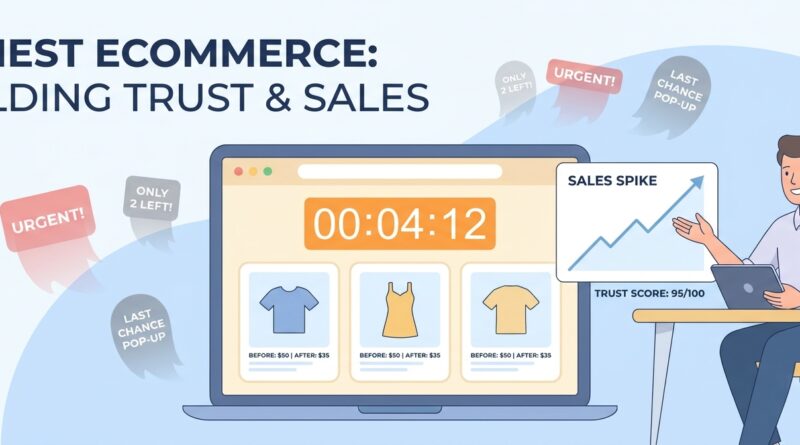
The ‘Clean Countdown’ Flash Strategy: Run High‑Urgency Sales Without Shady Tactics Or Fines
Your customers can smell a fake countdown now. So can regulators. That old playbook, with the timer that magically resets, the “only 2 left” message on every product, and the “sale ends tonight” email that somehow comes back tomorrow, is wearing thin fast. If you run a small ecommerce brand, that’s awkward. You want the lift a flash sale can bring, but you do not want to look sketchy, train your list to ignore you, or create legal trouble you never meant to invite. The good news is you do not need shady tactics to create urgency. A clean, honest flash sale can still work very well. The trick is simple. One real deadline. One real offer. Clear pricing. Real stock info. And messaging that matches from ad to landing page to checkout. That is the heart of an ethical flash sale strategy, and it is much easier to run than the messy alternative.
⚡ In a Hurry? Key Takeaways
- Use one genuine countdown with a real end time, and make sure it matches everywhere customers see the offer.
- Replace vague pressure tactics with clear proof, such as before-and-after pricing and honest stock brackets.
- A clean countdown can still drive a strong sales spike while protecting trust, email performance, and compliance.
Why fake urgency is backfiring
People are tired of being pushed. You can see it in comment sections, Trustpilot reviews, Reddit threads, and watchdog updates. Shoppers are calling out brands that use endless countdowns, fuzzy “trending now” labels, and low-stock warnings that feel made up.
That matters because urgency still works. It helps people decide. It gives a reason to act now instead of later. But when urgency feels fake, it stops being helpful and starts looking manipulative.
And there is another problem. If your ad says one thing, your product page says another, and the checkout total changes again, you are not just annoying people. You are creating the kind of mismatch that can trigger complaints, chargebacks, or scrutiny.
What a “Clean Countdown” actually means
A Clean Countdown is a simple flash-sale setup built around facts, not theatre.
It has four rules
First, the timer is real. It starts once and ends once.
Second, the deal is clear. Customers can see exactly what they save.
Third, stock signals are based on actual inventory data, not generic scare prompts.
Fourth, every customer touchpoint matches. Ads, emails, landing pages, product pages, cart, and checkout all tell the same story.
That is the whole idea. You still create urgency. You just do it honestly.
The step-by-step ethical flash sale strategy
1. Pick one deadline and stick to it
Start here. Choose a sale window you can defend. Six hours. Twelve hours. Twenty-four hours. Maybe a weekend. The right length depends on your traffic and audience, but the key is this: once the sale ends, it ends.
Do not quietly restart the same timer for the same audience. Do not send “last chance” three days in a row. If you extend a sale for a real reason, say so plainly. For example, “We are extending this by 12 hours because our checkout was down this morning.” That is honest. People can tell the difference.
2. Show the same timing everywhere
Your homepage banner, paid ad copy, email subject line, product page message, and checkout reminder all need the same end time. If one says midnight and another says 2 a.m., trust starts leaking out immediately.
Use one source of truth for the countdown if your ecommerce stack allows it. Even a shared sale note in your team chat helps. Someone should own the exact wording and time zone.
This sounds small. It is not. A sale that feels coordinated looks professional. A sale with conflicting clocks looks sloppy at best.
3. Match the discount from click to checkout
This is where many brands get into trouble without meaning to. An ad promises 25% off. The collection page shows selected items only. The product page shows a crossed-out price. Then checkout applies a different code, or excludes a popular variant.
Customers hate that. Regulators do too.
Run a quick discount audit before launch:
- Does the ad match the landing page?
- Does the product page match the cart?
- Do excluded products clearly say they are excluded?
- Are taxes, shipping thresholds, and code requirements stated clearly?
If you want a short, intense follow-up campaign after the main sale, it can pair well with The ‘Abandoned Cart Flash’ Strategy: Turn Stalled Checkouts Into Your Highest‑ROI 60‑Minute Sale. That approach works best when the original sale terms were already clear and consistent.
4. Replace “only 2 left” with honest stock brackets
You do not need dramatic scarcity copy on every item. Use real inventory ranges instead.
Good examples:
- “In stock”
- “Low stock: fewer than 10 left”
- “Only a few sizes left”
- “Restock expected next week”
These messages still help customers make decisions, but they do not feel like a cheap magic trick. They are also easier for your support team to stand behind when someone asks, “Was that actually true?”
5. Use real before-and-after pricing
If you show a product was $80 and is now $59, make sure that comparison is real and recent. Customers are increasingly alert to inflated “was” prices. If your store software pulls compare-at pricing automatically, check that it is accurate for the products in the sale.
Transparent pricing builds confidence. It also reduces one of the biggest sources of friction during flash sales, which is the customer wondering whether they are actually getting a deal.
6. Write urgency copy that helps, not pressures
There is a big difference between clarity and coercion.
Helpful urgency sounds like this:
- “Ends tonight at 11:59 p.m. ET”
- “Our winter stock is being cleared before the new drop”
- “Best value ends when this timer ends”
Manipulative urgency sounds like this:
- “Everyone is buying this right now”
- “You will miss out forever”
- “Only 2 left” on every product, all month
The first type respects the customer. The second type tries to corner them. One builds a brand. The other burns it.
7. Keep your list healthy during the sale
Flash sales can wreck email performance if you overdo them. If every message is “last chance,” subscribers start tuning out. Worse, they may mark you as spam.
A cleaner structure works better:
- Announcement email
- Mid-sale reminder, only if the sale runs long enough to justify it
- Final-hours note with the real deadline
That is usually enough. Shorter, smarter, and less exhausting for everyone.
A practical launch checklist for your next sale
If you want this to be easy, set it up like a pre-flight check.
Before the sale
- Choose one start time and one end time
- Confirm time zone wording
- Check all product exclusions
- Test discount application in cart and checkout
- Review compare-at prices
- Set stock messages using real inventory rules
- Update customer support with the exact terms
During the sale
- Watch for broken codes or pricing mismatches
- Monitor out-of-stock items quickly
- Pause ads if the featured product sells out
- Keep support replies short and specific
After the sale
- Remove the timer promptly
- End discount logic on time
- Do not keep “sale” labels lingering on product pages
- Review conversion lift, refund rate, and complaint volume
What smaller brands often get wrong
Most small teams do not set out to mislead anyone. They copy what they see bigger brands doing. The problem is that the bigger brand may have a legal team, custom systems, and a much higher tolerance for reputational mess.
Lean teams need simpler rules. Fewer moving parts. Less room for contradiction.
That is why an ethical flash sale strategy is not just about being nice. It is practical. It reduces errors. It makes support easier. It gives your ads and email a better chance of landing well because customers do not feel tricked.
When urgency is still fine to use
Urgency is not the villain. Fake urgency is.
If your sale really ends tonight, say it. If your stock really is running low in certain sizes, show it. If you only do four flash sales a year, that scarcity can be powerful because it is true.
The basic test is simple. If a reasonable customer asked you to prove the message, could you?
If the answer is yes, you are on much safer ground.
At a Glance: Comparison
| Feature/Aspect | Details | Verdict |
|---|---|---|
| Countdown timer | One real start and end time shown consistently across ads, site, email, and checkout. | Best practice. Clear, simple, trustworthy. |
| Stock messaging | Use actual inventory signals like “low stock” brackets instead of dramatic universal warnings. | Safer and more credible than generic scarcity prompts. |
| Pricing display | Before-and-after pricing, discount terms, and checkout totals all match what was advertised. | Essential for conversion, trust, and lower compliance risk. |
Conclusion
There has been a real shift in the last few weeks. Shoppers are speaking up more loudly about pressure-selling tricks, and watchdogs are paying closer attention to fake urgency, vague popularity claims, and misleading stock alerts. Smaller brands should take that seriously, especially if they have been copying big-retail tactics without much thought. The smarter move is not to stop running flash sales. It is to clean them up. A practical Clean Countdown framework gives you something useful for your very next campaign: one honest timer, pricing that stays consistent from ad to checkout, and real data in place of manipulative nudges. You still get the short-term revenue bump. But you also protect list health, brand trust, and legal peace of mind. Going into a busy promotional season, that is the kind of win a lean ecommerce team actually needs.