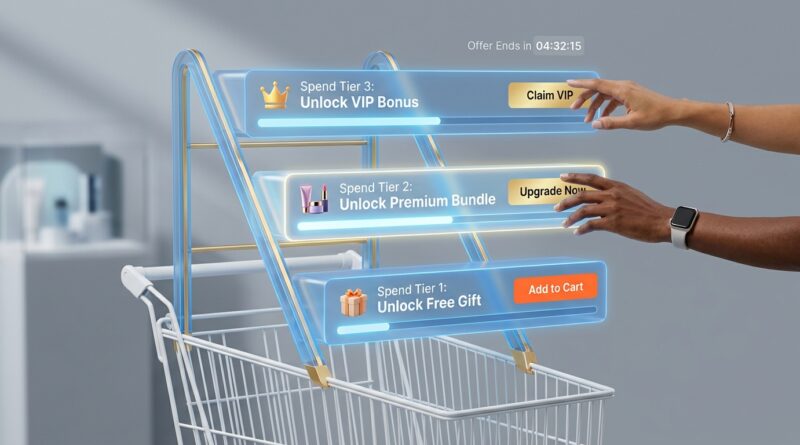
The ‘Cart-Ladder Flash’ Strategy: Turn One-Time Buyers Into Big Spenders Without Killing Your Margins
You know the feeling. You run a flash sale, orders jump for a day, and then you look at the numbers and feel a little sick. Margin is down, customers loaded up only on discounted items, and average order value barely moved. Worse, you may have trained people to wait for the next sitewide markdown. That is the trap with the usual “everything 20% off” move. It feels exciting on the front end and expensive on the back end. A better ecommerce flash sale strategy to increase average order value is what I call a cart-ladder flash. Instead of cutting prices across the whole store, you set clear spend tiers that unlock better perks as the cart grows. Customers feel like they are winning. You keep more control over what gets discounted, how much gets discounted, and when the offer stops making sense for your margins.
⚡ In a Hurry? Key Takeaways
- A cart-ladder flash raises average order value by rewarding bigger carts with tiered perks instead of discounting everything.
- Start with 2 to 4 spend thresholds, such as free shipping at one level, a gift at the next, and a limited discount only at the top tier.
- This approach protects hero product pricing and usually keeps margins healthier than a blanket sitewide sale.
What a cart-ladder flash actually is
A cart-ladder flash is a short sale built around cart value, not blanket discounts.
Think of it like stairs.
Spend $50 and get free shipping. Spend $80 and unlock a gift. Spend $110 and get 10% off your full cart, or access to a bundle that only appears at that level. Each step gives shoppers a reason to add one more item.
That is the key difference. You are not begging people to buy because things are cheaper. You are giving them a reason to build a bigger basket.
Why it works better than a basic flash sale
Most flash sales lower the price floor. A cart-ladder flash raises the cart goal.
Customers do simple math in their head. If they are $12 away from a better reward, many will add something small to “make the deal worth it.” That is where average order value starts to move in a real way.
And because not every perk has to be a straight discount, you have options. Free shipping, samples, low-cost gifts, early access, and bundles can all feel valuable without wrecking your margins.
Why blanket discounts usually disappoint
When you cut prices across the board, three things often happen.
1. People buy the minimum they were already going to buy
If someone wanted one product, a 20% off sitewide sale does not always push them to buy two or three. It just gives them a cheaper version of the order they were already planning.
2. Your best products lose pricing credibility
Hero products should feel worth full price. If they are always part of every sale, shoppers start to see the “real” price as the discounted one.
3. You give away margin to customers who did not need the push
This one hurts the most. You pay for traffic, finally get someone to convert, and then hand out a discount they may not have needed anyway.
If this pattern sounds familiar, you may also like The ‘Drop-Shift Flash’ Strategy: Mirror Prime‑Style Deal Waves Without Killing Your Margins, which tackles another smart way to create urgency without turning your whole store into a discount bin.
How to build a cart-ladder flash
You do not need fancy tech to start. You do need clean math.
Step 1: Pick your target AOV
Start with your current average order value. Let’s say it is $62.
Your spend tiers should nudge people above that, not below it. A simple setup might be:
- $75 unlocks free shipping
- $95 unlocks a free gift
- $120 unlocks 10% off or a premium bonus
The gaps should feel reachable. If the next reward is too far away, shoppers give up.
Step 2: Use perks with different margin impact
Not all rewards cost you the same amount. That is good news.
Free shipping can be cheaper than a sitewide discount. A gift with a high perceived value but low landed cost can work even better. Digital extras, samples, accessories, or overstock items are often perfect here.
Save the strongest reward for the highest tier only.
Step 3: Exclude hero products if needed
You do not have to put every product into the deal.
In fact, many stores do better when hero items stay full price and the ladder encourages add-ons around them. That keeps your star products credible while still growing the cart.
Step 4: Show progress in the cart
This matters more than most stores think.
If a shopper has $68 in the cart and your next threshold is $75, tell them clearly: “You’re $7 away from free shipping.” That small nudge can do a lot of work.
Good cart-ladder messaging feels like a game. People like finishing games.
Step 5: Keep the sale short and specific
Call it a flash for a reason.
Run it for a tight window. Twelve hours. Twenty-four hours. Maybe a weekend if your audience needs more time. The offer should feel special, not permanent.
A simple example
Let’s say you run a skincare store.
Your normal AOV is $54. Instead of offering 20% off sitewide, you try this:
- Spend $65 for free shipping
- Spend $85 for a travel-size serum
- Spend $110 for a full routine pouch plus 10% off
Now the customer who came in for one cleanser starts looking for a toner, a mask, or a lip treatment to hit the next level. You did not slash the price of everything. You gave them a reason to build a routine.
That is a much better ecommerce flash sale strategy to increase average order value than a broad markdown that treats every cart the same.
Best practices that keep margins intact
Use gifts customers actually want
A random leftover item is not a reward. It is clutter.
Pick gifts that fit naturally with your main products. Samples that lead to future purchases are even better.
Do not stack too many offers
If you combine sitewide discounts, free shipping, gifts, points multipliers, and coupon codes all at once, the sale gets confusing and expensive fast.
Keep it simple. One ladder. Clear rewards.
Watch contribution margin, not just revenue
A bigger top line is nice. A profitable top line is better.
Check the real cost of each tier, including shipping, packaging, gift cost, and discount rate. Sometimes a lower-looking perk makes more money than a flashy one.
Merchandise the “bridge” products
These are the items that help people move from one tier to the next.
If your next threshold is $15 away, show products in the $12 to $20 range. Accessories, refills, travel sizes, and impulse buys are great for this.
Common mistakes
Setting thresholds too low
If your first reward kicks in below your normal AOV, you are not nudging behavior. You are just giving away perks.
Making every tier a discount
That defeats the point. Mix in rewards that feel valuable but cost less than a straight price cut.
Ignoring mobile shoppers
Most people will see this on a phone. If your progress bar, cart messages, or reward details are buried, the ladder loses power.
Forgetting inventory reality
Do not offer a gift tier built around a product you only have 50 units of if the sale could generate 500 qualifying orders. Nothing kills trust faster than a swapped reward after checkout.
Who should use this strategy
This works especially well for stores with:
- Good attach products or add-ons
- Consumables that naturally bundle together
- Giftable items
- Strong repeat traffic from email, SMS, or retargeting
If your catalog has only one expensive item and very few complementary products, a cart-ladder flash may be harder to pull off. But for most ecommerce brands with a decent range, it is a smart tool.
At a Glance: Comparison
| Feature/Aspect | Details | Verdict |
|---|---|---|
| Blanket sitewide discount | Easy to launch, but often lowers margin on every order whether the customer needed an incentive or not. | Good for quick volume. Weak for profit and brand value. |
| Cart-ladder flash | Uses spend thresholds and tiered rewards to push shoppers toward larger baskets. | Best all-around option for boosting AOV without over-discounting. |
| Hero product protection | You can keep core products at full price and use add-ons, gifts, or bundles to drive cart growth. | Strong move for healthier margins and long-term pricing credibility. |
Conclusion
If your flash sales keep creating noise but not enough profit, the problem may not be traffic. It may be the structure of the offer. Right now ad costs are brutal and everyone is yelling about AOV, but the default move is still blanket discounts that erode brand value and profitability. A cart-ladder flash gives you a practical way to squeeze more revenue out of the traffic you already have by nudging shoppers up clearly defined spend tiers instead of racing to the bottom on price. You keep your hero products credible, your margins healthier, and your flash sales feel like a game customers actually want to win. That is a lot better than crossing your fingers and taking 20% off everything again.