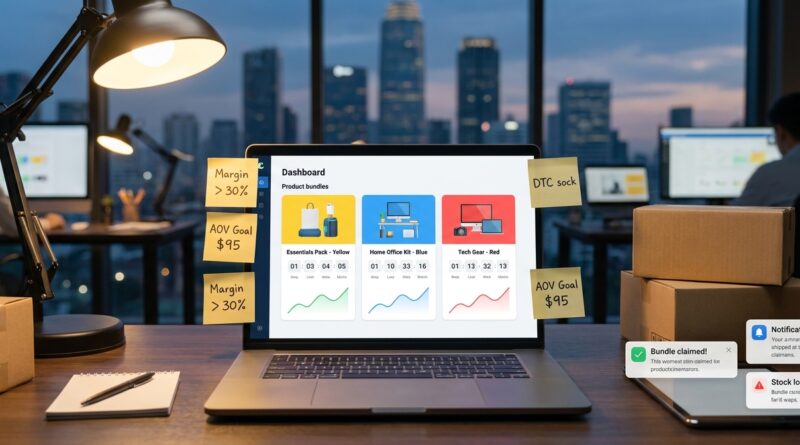
The ‘Bundle-Flash Carousel’ Strategy: Turn One 20‑Minute Window Into Three Rising AOV Spikes
You fight to get people into a flash sale, then watch them grab the cheapest item and disappear. That stings. Traffic was the hard part, but the order value never shows up, and suddenly your “big promotion” looks more like a margin haircut. The good news is you do not need a fancy funnel rebuild to fix it. A simple ecommerce flash sale bundle strategy can turn that same 20-minute rush into a guided buying path. Instead of one lonely discounted product, you offer three bundles in sequence. Small first, then better, then best. Customers are not asked to think too hard in the middle of the chaos. They just pick the version that fits their budget and urgency. Done right, this creates three waves of higher cart values inside one short sale window, while keeping inventory cleaner and messaging far easier to manage than a giant sitewide discount.
⚡ In a Hurry? Key Takeaways
- Use one 20-minute flash event to sell three timed bundles, not one deeply discounted single SKU.
- Start with an easy-entry bundle, move to a value bundle, then finish with a premium bundle to lift average order value step by step.
- Keep bundles tight and inventory simple, or the sale gets confusing fast and customers fall back to the cheapest option.
What the Bundle-Flash Carousel Actually Is
Think of it like a short sale with chapters.
Instead of opening one discount and hoping shoppers add extras on their own, you guide them through three bundle offers over 20 minutes. Each bundle is built around the same hero product, but the value goes up each round.
The pattern looks like this:
Window 1. Entry Bundle
Minutes 0 to 6. Offer the hero product plus one obvious add-on. This is your low-friction choice. It should feel like the smart minimum buy, not the expensive one.
Window 2. Value Bundle
Minutes 7 to 13. Now you switch to the most practical package. Same hero item, plus two or three extras people commonly buy together. This is usually the real workhorse for profit.
Window 3. Premium Bundle
Minutes 14 to 20. End with the best deal in terms of total savings, even if the price is highest. Add exclusivity here. Limited quantity, bonus item, or early access to a new variation.
You are not trying to trick people. You are reducing decision fatigue during a fast event.
Why This Works Better Than One Flat Discount
Flat flash sales invite bargain hunting. People scan for the cheapest ticket in, buy that, and leave. Bundles change the question from “What is the cheapest thing here?” to “Which option fits me best?”
That is a big shift.
It works because short sales create urgency, but urgency alone does not raise average order value. Structure does. If shoppers can see a clear ladder of options, many will move up one step. Some will jump straight to the top.
If you have been following the rush around live selling, this idea pairs nicely with it. In fact, the logic is similar to The ‘Live Ladder Flash’ Strategy: Turn One TikTok Stream Into Three Surging Price Tiers. The principle is simple. Do not throw one offer at everyone. Give people a guided path with rising value.
How to Build the Three Bundles Without Making a Mess
The biggest mistake is building bundles that are too clever. Keep them boring in the best way. Easy to understand. Easy to pack. Easy to track.
Pick one hero SKU
Start with the product already pulling traffic. This is the item customers came for. Do not fight that. Use it.
Add only natural companions
Good bundle items are things customers already buy together, such as:
- Core product plus refill
- Core product plus accessory
- Core product plus travel or mini version
- Core product plus protection, storage, or care item
If you need to explain why products belong together, the bundle is probably too weak.
Make each step feel clearly better
The three bundles should not blur together. Each one needs a clean reason to exist.
- Bundle 1: Best for first-time buyers
- Bundle 2: Best everyday value
- Bundle 3: Best savings or most complete setup
Keep inventory overlap simple
If all three bundles use wildly different parts, fulfillment gets ugly fast. Try to use the same hero product across all three and rotate only one or two add-ons.
A Simple 20-Minute Sale Map
Here is a format most stores can use right away.
Minutes 0 to 6: Open with the easy yes
Lead with the lowest-priced bundle, not the single item. This matters. If you leave the cheap single SKU sitting next to it, many shoppers will still choose that. Your entry bundle should become the default deal.
Example: “Flash Starter Set. Hero product + mini add-on. 12% off for 6 minutes.”
Minutes 7 to 13: Switch to the practical winner
This is where you push the strongest AOV jump. The bundle should feel like the sensible choice, not the luxury one.
Example: “Daily Use Set. Hero product + refill + accessory. 18% combined savings for 7 minutes.”
Minutes 14 to 20: Finish with the high-value closer
Now bring out the premium package. Some buyers waited. Some already trust the deal because they watched the earlier windows sell. This is your best chance to capture top spenders.
Example: “Complete Kit. Hero product + refill + accessory + bonus item. 22% savings. Limited to 40 bundles.”
Pricing Rules That Keep Margins Alive
A bundle strategy only works if the math works.
Do not over-discount the first bundle
The entry offer should convert hesitant buyers, but it should not become your cheapest margin point. Keep enough room so the second and third bundles look stronger.
Show total savings, not just percent off
Some shoppers respond better to “Save $18” than “Save 15%.” If your average price points are modest, dollar savings often land better.
Protect your premium bundle
The last bundle should have the highest order value and solid contribution margin. Add perceived value with a bonus item that costs you little but feels useful to the customer.
Skip coupon stacking if possible
Flash events are chaotic enough. Extra codes create confusion, support headaches, and accidental margin damage. Keep pricing built into the bundle offer.
How to Present It So Shoppers Actually Follow Along
You are not just building bundles. You are directing attention.
Use one message per window
Do not show all three bundles with equal weight from the start. That turns your sale into a menu. The whole point is the carousel. One focus at a time.
Name the bundles like a human
Avoid internal labels like Bundle A, Bundle B, and Bundle C. Use names that instantly explain the use case:
- Starter Set
- Best Value Set
- Complete Kit
Repeat the decision shortcut
Good sale copy tells people who each bundle is for.
- “Best for trying it out”
- “Best for repeat buyers”
- “Best savings tonight”
That tiny bit of guidance can move people up without feeling pushy.
What to Track After the Sale
You do not need a new analytics stack for this. Just watch a few numbers closely.
Bundle take rate
What percent of orders came from each bundle? If Bundle 1 dominates and Bundle 2 barely moves, your middle offer may not feel distinct enough.
Average order value by window
Did AOV rise as the sale progressed? That is the whole point of the format.
Attach rate of add-ons
Which companion products kept showing up in converting bundles? Those are your future building blocks.
Sell-through stress
Did one component run out too early and kill the later bundles? If yes, rebalance stock or reduce overlap next time.
Common Mistakes That Break the Strategy
Most problems come from making the sale too complicated.
Too many choices
Three bundles is enough. Four or five starts to feel like homework.
Weak differences between offers
If Bundle 2 looks only slightly better than Bundle 1, shoppers will save money and stay low.
Bad timing
If each window is too short, people miss it. Too long, and urgency fades. For a 20-minute event, roughly 6, 7, and 7 minutes works well.
Messy fulfillment
If your team cannot pack it cleanly, do not run it. Fast sales expose operational cracks fast.
Who This Strategy Is Best For
This works especially well for stores that already have:
- One reliable hero product
- A few natural accessories or refills
- Flash-sale traffic from email, SMS, social, or live sessions
- Basic inventory visibility
It is less useful if your catalog is highly custom, hard to bundle, or prone to stock mismatches. In that case, simplify first.
At a Glance: Comparison
| Feature/Aspect | Details | Verdict |
|---|---|---|
| Single-SKU flash sale | Easy to launch, but shoppers often pick the cheapest item and stop there. | Good for volume, weak for AOV. |
| Three-step bundle carousel | Uses timed bundle windows to steer customers from entry offer to higher-value packages. | Best mix of urgency, clarity, and margin protection. |
| Complex app-heavy bundle setup | Can be powerful, but often adds friction, tracking issues, and more moving parts than a short sale needs. | Use only if your store already runs it smoothly. |
Conclusion
Right now, a lot of ecommerce chatter is stuck on live shopping and blunt discounting. The smarter move is quieter and more practical. Pair the flash with tight bundles that guide spending upward instead of just cutting prices downward. That is what makes this ecommerce flash sale bundle strategy useful. You can use the same flash-sale tools you already have, but redirect demand into three clear bundles that are easy for shoppers to understand and easy for your team to manage. No influencers. No new apps. No full funnel rebuild. Just a cleaner format that gives customers a path and gives your average order value a much better shot at rising when the clock is ticking.