The ‘Fan-Pulse Flash’ Strategy: Turn Real-Time Hype Spikes Into One Hour Of Profitable Orders
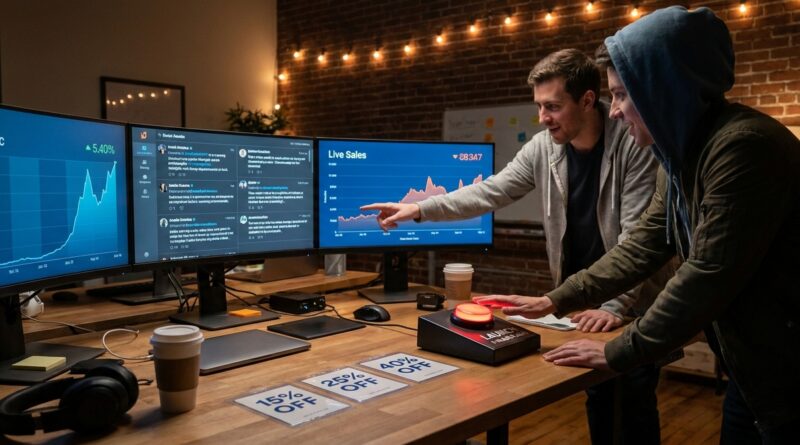
You know the feeling. You set up a flash sale, pick a discount, queue the emails, and hope the rush lands during office hours. Then the real spike happens at 9:40 p.m. because a creator mentions your product, a customer post takes off, or your community suddenly starts buzzing. By the time you see it the next morning, the moment is gone. Worse, the offer you had running was probably wrong for that level of excitement. Too small, and people hesitate. Too deep, and you give away margin you did not need to lose. A real time ecommerce flash sale strategy fixes that by treating fan excitement like a live signal. Instead of forcing every rush into the same tired countdown template, you watch for short bursts of attention, trigger a one-hour offer that fits the moment, and close it before the energy fades. That is the basic idea behind the Fan-Pulse Flash.
⚡ In a Hurry? Key Takeaways
- Use short, one-hour offers triggered by real audience spikes, not a fixed promo calendar.
- Set clear rules now for when to launch, how much to discount, and who gets alerted.
- Keep the offer measured. The goal is profitable momentum, not panic discounts that train shoppers to wait.
What the Fan-Pulse Flash strategy actually is
The Fan-Pulse Flash strategy is simple. When your audience shows a sudden jump in attention, clicks, mentions, add-to-carts, or product page views, you launch a short sale for about an hour while interest is still hot.
This is not the same as a planned weekend flash sale. It is a response to live demand. Think of it like a shop owner seeing a line form outside and deciding to open a second register right away instead of waiting until tomorrow.
The big shift is this. You stop asking, “What promotion did we schedule?” and start asking, “What is the audience telling us right now?”
Why fixed flash sales keep underperforming
Most stores still run urgency campaigns like they are printing flyers in 1998. Pick a date. Pick a discount. Add a timer. Hope for the best.
That can still work sometimes. But shoppers have seen too many fake deadlines and recycled “today only” banners. They can smell autopilot. If the promotion does not feel tied to a real moment, it blends into the wallpaper.
There are also two expensive mistakes that come with static flash sales.
You miss the actual peak
Attention online comes in waves. A post gets shared. A niche influencer talks about your product. A review video gets picked up. The rush might last 40 minutes, not 24 hours.
If your sale is locked to a neat calendar slot, you often miss the part that mattered most.
You discount blindly
When the offer is planned in advance, the discount is often disconnected from demand. Strong hype gets a discount that is bigger than necessary. Weak hype gets an offer too soft to move people.
If you want to dig deeper into matching offer strength to demand, this piece on The ‘Dynamic-Price Flash’ Strategy: Turn Real‑Time Discounts Into A Sellout Without Killing Your Margin pairs nicely with the Fan-Pulse Flash approach.
How to spot a “fan pulse” before it fades
You do not need a giant data science team for this. You just need a short list of signals that tell you attention is spiking right now.
Watch these live signals
Start with the numbers you already have:
- Product page traffic jumping above normal in a 15 to 30 minute window
- Add-to-cart rate rising faster than usual
- Direct traffic surging after a social mention
- Email click-through spikes on a product link
- Customer comments asking “Is there a code?” or “When does this drop?”
- Shop app or SMS traffic moving suddenly on one item or collection
You are not looking for perfect certainty. You are looking for a noticeable burst that is strong enough to justify a short, controlled offer.
Set a simple trigger rule
Do this before the next campaign. Pick 2 or 3 triggers like:
- Traffic to a product page is 2x the hourly average
- Add-to-cart rate is up 30 percent or more
- Social referral traffic crosses a set threshold in 20 minutes
Once two triggers fire, your team gets an alert and the one-hour promo is approved automatically or reviewed by the on-call marketer.
How to match the offer to the strength of the spike
This is where smaller brands can get smarter than bigger ones. You do not need to offer 25 percent off every time people get excited.
Instead, build a simple response ladder.
Low-intensity spike
If traffic is up but carts are only moving a little, use a light nudge.
- Free shipping
- Small bundle bonus
- 10 percent off for one hour
Medium-intensity spike
If visits and carts are both moving well, make the offer a little stronger.
- 10 to 15 percent off
- Gift with purchase
- Buy more, save more on a tight product set
High-intensity spike
If attention is roaring and conversion intent is obvious, use a stronger offer, but keep it short and targeted.
- 15 to 20 percent off on selected products
- Exclusive early access window
- Limited quantity bonus for the first set number of orders
The key is restraint. Strong fan energy often needs less discount than you think. People already want the item. Your job is to remove hesitation, not throw cash off the roof.
Build the one-hour playbook before you need it
The worst time to invent a real time ecommerce flash sale strategy is during the spike itself. You need a playbook ready to go.
Decide who is on call
If your biggest bursts happen after hours, assign someone to receive alerts during evenings or weekends on a rotating basis. It does not have to be dramatic. It just has to be clear.
Prepare promo assets in advance
Create templates now for:
- SMS alerts
- Email subject lines
- Site banners
- Social story graphics
- Checkout notes
Then all you change is the product, the offer, and the expiration time.
Use plain language
Do not pretend the sale appeared by magic. Tie it to the moment.
For example:
- “You all blew this up tonight, so here is a 1-hour thank-you deal.”
- “Traffic on this drop is wild right now. Free shipping for the next 60 minutes.”
- “Because this launch is popping off, the first 100 orders in the next hour get a bonus.”
That feels more believable than a generic “24 hours only” badge people have seen fifty times.
How to avoid turning this into chaos
Live-response selling can work beautifully. It can also become messy fast if every spike triggers a random discount.
Set guardrails
Write down the rules.
- Maximum discount by product category
- Minimum margin allowed
- Which products are excluded
- How often you can run a pulse sale in a week
- Who approves exceptions
This keeps your team from overreacting and trains customers to respect the offer instead of expecting one every day.
Protect your best inventory
If a product is already selling out naturally, you may not need a discount at all. A timed bonus, waitlist priority, or bundle add-on may be enough.
That matters because the Fan-Pulse Flash is supposed to create cleaner profit spikes, not just louder revenue.
What smaller stores get right here
Big retailers can be slow. Their promo calendars are packed with approvals, brand rules, and layers of sign-off. Smaller stores can move much faster.
That is a real advantage.
If your team can detect a community spike and push a one-hour response while the conversation is still happening, you can act more like a nimble event seller than a lumbering chain store.
That speed often matters more than discount size.
Measure success the right way
Do not judge these flash windows on raw sales alone. Look at:
- Profit per hour
- Conversion rate lift during the pulse
- Average order value
- New customer share
- Discount cost as a percent of incremental revenue
- How quickly demand dropped after the window closed
You want proof that the sale captured existing excitement efficiently. If every pulse sale needs a steep cut to perform, your trigger or your creative may be off.
A simple starter version for non-technical teams
If you are not running fancy automation yet, start small.
- Pick 5 products or one collection that often gets social attention.
- Set a traffic or add-to-cart threshold in your analytics tool.
- Prepare 3 pre-approved one-hour offers.
- Set up a Slack, email, or text alert when the threshold is hit.
- Launch the offer manually with a banner, SMS, and social story.
- Review margin and conversion the next day.
That is enough to test the idea without rebuilding your whole stack.
At a Glance: Comparison
| Feature/Aspect | Details | Verdict |
|---|---|---|
| Timing | Fixed flash sales run on a preset schedule. Fan-Pulse Flash launches when live attention spikes. | Live timing usually captures demand better. |
| Discount control | Static promos use one offer for everyone. Fan-Pulse Flash matches offer strength to spike intensity. | Better for protecting margin. |
| Operational effort | Requires alerts, templates, and a clear after-hours playbook, but not necessarily advanced software. | A little setup pays off fast. |
Conclusion
The stores winning with flash sales right now are not just shouting louder. They are listening better. They treat urgency like a living signal, not a fixed timer buried in a campaign doc. The pattern from recent case studies is pretty clear. Scarcity and deadlines still push people to buy, but only when they feel connected to a real moment of attention, not another recycled “24 hour only” graphic. That is why the Fan-Pulse Flash strategy matters. It helps you catch those short bursts of fan energy while they are still alive, match the offer to the heat of the moment, and drive profitable orders without defaulting to over-discounting. For smaller brands especially, that is a practical way to take back control from cookie-cutter countdown tactics your customers have already learned to ignore.