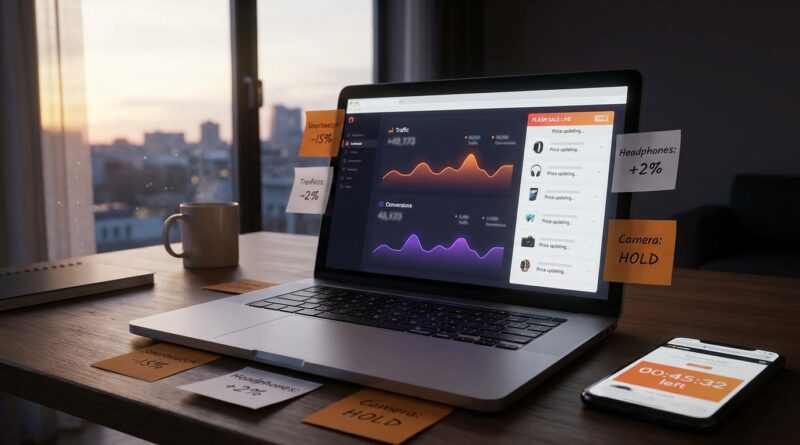
The ‘AI-Surge Flash’ Strategy: Turn 24 Hours Of Smart Discounts Into Your Highest-Converting Sale Of The Month
You can feel the waste when a flash sale misses. Pick the discount too low, and shoppers shrug and keep scrolling. Push it too high, and orders come in, but your margin disappears so fast it barely feels like a win. That is the trap with the usual “20% off everything” approach. It is easy, familiar, and often wrong. A better ai dynamic pricing flash sale strategy does not mean hiring a data scientist or building some scary Wall Street pricing engine. It can be as simple as setting smart rules that raise or lower discounts during a 24-hour sale based on live demand, stock levels, conversion rate, and traffic quality. The goal is not to change prices every five minutes just because you can. The goal is to stop guessing. When your offer reacts to what customers are actually doing, hot products keep more profit, slow products get the push they need, and the whole sale starts working harder.
⚡ In a Hurry? Key Takeaways
- AI dynamic pricing for flash sales works best when it adjusts discounts by clear rules, not gut feeling.
- Start small. Use discount floors, ceilings, and triggers based on conversion, inventory, and traffic spikes.
- Protect your brand and margin by limiting how far prices can swing during a 24-hour sale.
Why flat flash sale discounts so often fail
A flat discount assumes every product, every visitor, and every hour of your sale behave the same way. They do not.
Your best seller at 9 a.m. may not need much help at all. A slow-moving item at 4 p.m. might need a bigger push. Mobile traffic from Instagram may convert very differently from email traffic coming from loyal past buyers.
Yet many stores still lock in one discount days ahead of time and hope for the best.
That is why an ai dynamic pricing flash sale strategy is getting attention. It replaces blanket discounting with a simple system that reacts to what is happening right now.
What “AI” really means here
For most smaller e-commerce teams, this does not need to mean a complex machine learning setup.
Think of it as software that watches a few signals and follows pricing rules faster than a human can. The signals might include:
- Current conversion rate
- Inventory left
- Sales pace versus forecast
- Product page traffic
- Cart abandonment rate
- Time remaining in the sale
Then the system makes controlled changes. For example, if a product is getting lots of clicks but not enough checkouts, the discount can increase from 15% to 20%. If a product is selling quickly and inventory is getting tight, the system can hold or even reduce the discount to protect margin.
That is the practical version. Less guesswork. More response.
The core idea behind the AI-Surge Flash
The AI-Surge Flash strategy is built around one simple idea. Not every product deserves the same discount at the same moment.
Instead of setting one promo and walking away, you create a 24-hour sale with guardrails. Inside those guardrails, discounts can move up or down based on demand signals.
What changes during the sale
- Discount depth by product or collection
- Timing of discount increases
- Urgency messaging tied to stock or sales pace
- Channel-specific offers if your tools support it
What stays fixed
- Your minimum margin floor
- Your maximum discount ceiling
- Your sale end time
- Your excluded products or protected categories
That second list matters. Smart pricing without boundaries turns into chaos fast.
How to set one up without making it complicated
You do not need 50 rules. Start with three product buckets.
1. Hot products
These are items that already get strong traffic and convert well.
Set a smaller starting discount. Something like 10% to 15%. If conversion is above target and inventory is moving on pace, leave it alone. If it slows, allow a modest bump.
2. Middle-of-the-pack products
These are decent performers that benefit from a nudge.
Start around 15% to 20%. If traffic is high but conversion is weak after a few hours, increase within your limit.
3. Slow movers
These are the products you actually need to clear.
Start more aggressively, maybe 20% to 30%, but only if margin allows it. If they still do not move, bundle them, feature them in email, or pair them with a stronger product.
This is where many merchants get pricing wrong. They over-discount what would have sold anyway and under-support what actually needs help.
The four signals that matter most
If you track too much, you freeze. Track too little, and your system is blind. These four signals are usually enough for a small team.
Conversion rate
If lots of people are viewing a product and not buying, your offer may be too weak, or the traffic may be a poor match. A discount change can help, but only if the product is getting enough visits to make the signal meaningful.
Inventory pressure
If stock is moving faster than expected, you may not need a deeper discount. If stock is barely moving and the clock is ticking, you probably do.
Traffic quality
Not all traffic is equal. An email click from a repeat customer is usually warmer than a cold social click. If your tools break this out, use it. If not, at least watch the channels manually.
Time left in the sale
The final hours are not the same as the opening hours. Early on, you can be patient. Near the end, sell-through matters more.
A simple rules-based playbook
Here is a clean example of an ai dynamic pricing flash sale strategy for a 24-hour promotion:
- Start discounts at 12%, 18%, and 25% for hot, mid, and slow products.
- Check performance every 2 to 4 hours.
- If a product gets strong traffic but conversion is 20% below target, increase discount by 3% to 5%.
- If a product is selling 30% faster than forecast and stock is getting low, freeze discount or reduce by 2% to protect margin.
- If a slow mover still does not respond after one increase, stop cutting price and change the merchandising instead.
That last point is important. Price is powerful, but it is not magic. Sometimes the product needs better placement, stronger photos, clearer value, or a bundle offer.
Do not train your customers to wait for huge discounts
This is the long game problem.
If every flash sale ends with 40% off by evening, shoppers notice. They learn to ignore your first offer and wait. Over time, your “urgent” sale becomes a scheduled markdown event in their heads.
Dynamic pricing done well avoids that habit. Your best products may never need a deep cut. Some products may move just fine at 12% off. Others may earn a bigger discount because they need it.
That keeps your sale feeling responsive, not predictable.
How this connects with real-time traffic spikes
Pricing works even better when it is paired with real-time traffic behavior. If you suddenly get a burst of visitors from an email send, influencer mention, or social post, that is a chance to react while attention is high.
If you want to build around that kind of momentum too, read The ‘Live-Trigger Flash’ Strategy: Turn Real‑Time Viewer Spikes Into Instant Sell‑Outs. It fits naturally with dynamic flash pricing because both approaches depend on paying attention to what shoppers are doing now, not what you hoped they would do yesterday.
Common mistakes to avoid
Changing prices too often
If prices swing constantly, customers get confused and trust drops. Set review windows. Every few hours is usually enough for a 24-hour sale.
Ignoring margin floors
This is the big one. Never let automation discount below a number you have pre-approved.
Using tiny data samples
Ten visits and one sale do not tell you much. Wait until a product gets enough traffic before reacting.
Applying the same rules to every product
A limited-edition best seller and an overstock basic should not follow the same discount logic.
Forgetting merchandising
If a product is buried on the site, a bigger discount may not save it. Visibility still matters.
What tools do you actually need?
You need less than you think.
- An e-commerce platform that supports scheduled discounts or app-based pricing rules
- Basic analytics for traffic, conversion, and inventory
- A way to review performance during the sale, even if that is just a dashboard and a spreadsheet
Some stores will use dedicated pricing or promotion apps. Others can do a lightweight version with platform automations and manual check-ins. The key is not the fanciest tool. It is having clear rules before the sale starts.
Who should use this strategy first?
This approach is especially useful if you:
- Run frequent 24-hour or weekend flash sales
- Have a mix of hero products and stale inventory
- Get uneven traffic bursts from email, SMS, or creators
- Want to improve conversion without cutting everything too deeply
If your catalog is tiny and every product already sells at full price, you may not need much of this yet. But if sales performance changes a lot from product to product, this is where smarter discounting starts to pay off.
At a Glance: Comparison
| Feature/Aspect | Details | Verdict |
|---|---|---|
| Flat discount sale | One discount across all products for the full 24 hours, regardless of demand or stock. | Easy to run, but often wastes margin or misses conversions. |
| Rules-based AI pricing | Discounts adjust within set limits based on conversion, inventory, traffic, and time left. | Best balance of control, profit protection, and performance. |
| Fully aggressive dynamic pricing | Frequent price changes with wide swings and minimal guardrails. | Risky for smaller brands. Can confuse shoppers and damage trust. |
Conclusion
You do not need to guess your next flash sale discount and hope it works out. That old method leaves money on the table in both directions. It cuts too hard on products that would have sold anyway and stays too timid on products that need a push. The good news is that AI-driven pricing is no longer just for giant retailers with big teams and custom systems. Even smaller e-commerce brands can now run a practical, rules-based ai dynamic pricing flash sale strategy without a data science squad. Start simple. Set a floor, set a ceiling, split products into performance buckets, and let real demand guide the discount during the day. Done right, you get higher conversion on hot products, cleaner sell-through on slow movers, and fewer customers trained to only buy when you slash everything by 40%. That is a smarter flash sale, and a healthier business.