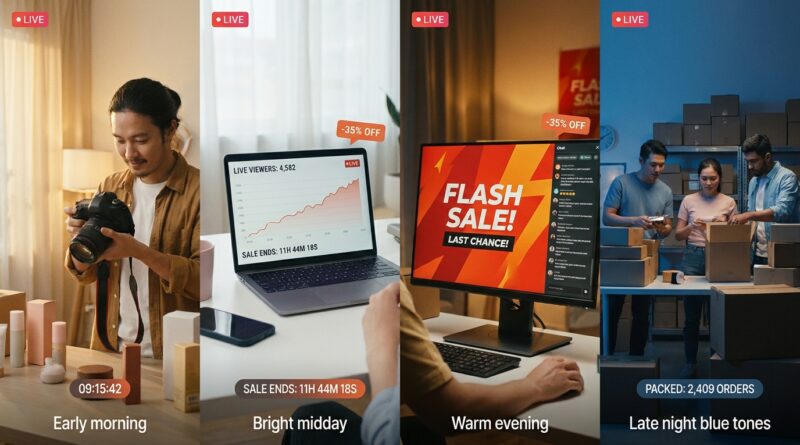
The ‘4‑Cycle Live Flash’ Strategy: Turn Four Short Streams Into One Relentless Sales Day
Flash sales sound exciting until you are the one running them. Then it is a blur of support tickets, stock panic, checkout glitches, and a sales graph that spikes hard for an hour and then goes quiet. That is why a smart live shopping flash sale strategy matters. You do not need one giant all-day stream that burns out your team and your audience. A better option is to split the day into four short live cycles, each with its own offer, stock plan, and reason to show up. Think of it like running four mini-events instead of one messy marathon. This keeps energy high, gives late buyers more than one chance to join, and makes inventory easier to control. Better still, it turns live selling from a random hustle into a repeatable system you can schedule, test, and improve every time you run it.
⚡ In a Hurry? Key Takeaways
- A four-cycle live shopping flash sale strategy breaks one stressful sale day into four short, focused live sessions that usually convert better than one long stream.
- Give each cycle its own product theme, stock cap, time limit, and call to action so buyers always have a fresh reason to return.
- Protect trust by setting inventory limits upfront, testing checkout before each cycle, and never promising stock your team cannot ship fast.
Why one big live sale often fails
A single long flash sale looks simple on paper. Go live, cut prices, post a few reminders, and let the orders roll in.
Real life is not that tidy.
The first problem is attention. Most people do not stay glued to a live stream all day. They dip in and out. If your best offer lands while they are making lunch, picking up the kids, or stuck in a meeting, you miss them.
The second problem is operations. One giant blast puts pressure on your site, your support team, your fulfillment queue, and your inventory tracking all at once. If anything breaks, the whole sale feels broken.
The third problem is momentum. After the first rush, many sales flatten. There is no new hook. No reset. No second wind.
That is exactly what the four-cycle model fixes.
What the 4-cycle live flash strategy actually is
The idea is simple. Instead of one long event, you run four short live sessions across a 24-hour period. Each one lasts roughly 20 to 45 minutes. Each one has a specific focus.
You are not repeating the same stream four times. You are creating four reasons to buy.
A simple cycle layout
Cycle 1: Kickoff drop. Lead with your strongest hook and your easiest-to-understand offer.
Cycle 2: Demo and proof. Show how the product works, answer objections, and add a smaller timed bonus.
Cycle 3: Midday or evening restock moment. Bring back top interest items in limited numbers.
Cycle 4: Final call. Last-chance bundle, countdown, and clean close.
This structure works because each block feels urgent, but not exhausting. Buyers get multiple entry points. Your team gets breathing room between sessions. Your systems get a chance to recover.
Why this live shopping flash sale strategy works so well in 2026
Shoppers are used to quick, high-energy moments now. They have been trained by TikTok, Whatnot, Instagram, and every app that rewards short bursts of attention. A static coupon code sitting on a homepage just does not create the same pull.
Short live sessions fit how people actually buy. They like countdowns. They like demos. They like limited drops. They like feeling like they caught something at the right moment.
Platforms like frequent activity too. Four separate sessions can create more engagement signals than one long, slow stream. That means more chances to get surfaced, clipped, shared, and rediscovered.
How to build each of the four cycles
Cycle 1: Start with the easiest win
Your first session should be simple and sharp. Open with the product or offer most likely to convert cold viewers fast. This is not the time for your most complicated bundle.
Good opening hooks include:
- Your best-selling item at a limited price
- A bundle that solves one clear problem
- A timed free gift for the first set number of buyers
State the rules early. Say how many units are available, how long the price lasts, and when the next live cycle happens. That last part matters. You are not only selling the current block. You are also planting the idea that buyers should come back.
Cycle 2: Turn interest into trust
This is the proof session. Fewer fireworks. More clarity.
Use this block to answer the questions buyers always ask after the first rush. Does it fit? How big is it? How fast does it ship? What is the difference between option A and B? What does it look like in real use?
If you sell beauty, show application. If you sell kitchen gear, cook something. If you sell clothing, do quick size callouts. If you sell tech accessories, show setup and compatibility.
This block is where conversions often improve because hesitation drops.
Cycle 3: Re-open the window without causing chaos
This is your smart restock or second-chance moment. Not a full reset. A controlled one.
You can bring back the top item from cycle 1, but with a tighter stock cap or slightly different bonus. This gives people who missed the first session another shot without making early buyers feel tricked.
Be careful here. If you say “sold out forever” in cycle 1 and then magically produce 500 more units in cycle 3, trust takes a hit. Better wording is “We have held a small second release for later viewers.” That is honest and easier to manage.
Cycle 4: Finish strong, not sloppy
Your last session should feel like a close, not a panic.
Keep the offer clean. One final bundle. One deadline. One clear call to action. Recap the day, show customer comments, highlight what is nearly gone, and make checkout instructions painfully obvious.
This is also the right moment for a cart-complete nudge. Many buyers watch all day and only purchase at the end.
Inventory planning is what makes this repeatable
The secret sauce is not only the live stream energy. It is the stock planning behind it.
Split your inventory by cycle before the sale starts. Do not treat the whole day as one giant pool unless your stock system is rock solid.
For example:
- 30 percent of hero stock for cycle 1
- 20 percent for cycle 2 add-ons or bundles
- 30 percent held for cycle 3 second release
- 20 percent reserved for the final call
That does two useful things. First, it stops your first session from eating the entire event. Second, it protects the later sessions so you still have something meaningful to sell.
If your catalog is wide and messy, start smaller. In fact, many brands should pair this model with a hero-product approach like The ‘One-SKU Flash’ Strategy: Turn A Single Hero Product Into Your Highest‑Margin 24‑Hour Sale. It is a good way to reduce moving parts while you learn what your audience responds to.
How to script the lives without sounding robotic
You do not need a teleprompter voice. You do need a structure.
For each cycle, prepare:
- A 15-second opening hook
- Three talking points
- Two FAQs
- One urgency line
- One next-step instruction
That is enough.
Here is a simple flow:
Hook: “For the next 30 minutes, this bundle is live at the lowest price today.”
Proof: “Here is what is inside, who it is for, and why people buy it.”
Urgency: “We only set aside 120 units for this round.”
Action: “Tap the pinned product now. When this block ends, the bonus ends too.”
That keeps the energy up without turning the whole thing into noise.
Site performance matters more than your camera quality
People will forgive a less-than-perfect backdrop. They will not forgive a broken checkout.
Before sale day, test these basics:
- Mobile checkout speed
- Payment processing under load
- Inventory sync across channels
- Coupon or auto-discount rules
- Pinned product links inside the live platform
Also assign someone to watch the site in real time during every cycle. If page load times start climbing or items show the wrong stock count, that person needs authority to pause, swap links, or adjust stock caps quickly.
How to promote all four cycles without confusing people
The trick is to make the day feel organized, not crowded.
Create one simple event graphic or landing page with all four times listed. Then give each cycle a short label:
- Morning Drop
- Proof Session
- Second Chance Restock
- Final Call
Use the same language everywhere. Email, SMS, social posts, product page banners, and live reminders should match.
Do not ask customers to decode your marketing.
Best practice for reminders
Send reminders before each cycle, not just before the first one. Many buyers will only catch one session. Treat every block as a fresh conversion opportunity.
A good rhythm is:
- The day before: full schedule
- One hour before each cycle: reminder
- Five minutes before going live: last call
- Right after each cycle: highlight what is next
How small brands can beat bigger competitors with this
Large retailers often run flash sales like giant warehouse clear-outs. There is plenty of discounting, but not much personality. The experience feels blunt.
Small brands can win by being faster, warmer, and more focused.
You can answer comments live. You can show the product in use. You can give each cycle a real theme. You can build a sense that something is happening right now, not just that prices have been chopped in a spreadsheet.
That is the heart of a strong live shopping flash sale strategy. It feels active. Human. Timed. And worth showing up for.
Common mistakes to avoid
1. Making every cycle the same
If all four sessions feel identical, returns drop fast. Give each one a distinct purpose.
2. Overselling stock
Nothing ruins a good sale like cancellation emails the next day. Cap inventory carefully and update counts honestly.
3. Talking too long before showing the offer
Live shoppers are impatient. Get to the point fast.
4. Running too many products at once
Too much choice can kill speed. Keep each cycle tight.
5. Forgetting fulfillment capacity
A 24-hour revenue spike is only good news if your team can pack and ship it without chaos.
At a Glance: Comparison
| Feature/Aspect | Details | Verdict |
|---|---|---|
| One long live sale | Big early spike, higher fatigue, harder stock control, more risk if checkout or stream quality slips. | Works for large teams, but often too messy for small brands. |
| Four-cycle live flash | Four short sessions with separate offers, inventory blocks, and reminders spread across the day. | Best balance of urgency, repeat traffic, and operational control. |
| Static coupon-only sale | Easy to set up, but less excitement, lower engagement, and fewer reasons for buyers to return during the day. | Fine as a backup, but weak if you want a memorable revenue spike. |
Conclusion
The four-cycle model works because it matches how people shop now. Buyers in 2026 respond to short live moments far better than they respond to a lonely coupon code sitting on a page. Platforms reward frequent, active sessions, and shoppers react to tight drops, clear deadlines, and focused offers. That gives smaller brands a real opening. You do not need a TV studio, a massive team, or an all-day marathon stream. You need a plan. Split the day into four clean blocks. Assign stock to each one. Script a few energetic demos. Keep the offers small, sharp, and easy to act on. Do that well, and you can turn live selling from a chaotic scramble into a repeatable machine that drives a serious 24-hour revenue jump. Better yet, you can do it with more control than bigger competitors who still bet everything on one clunky sale window.