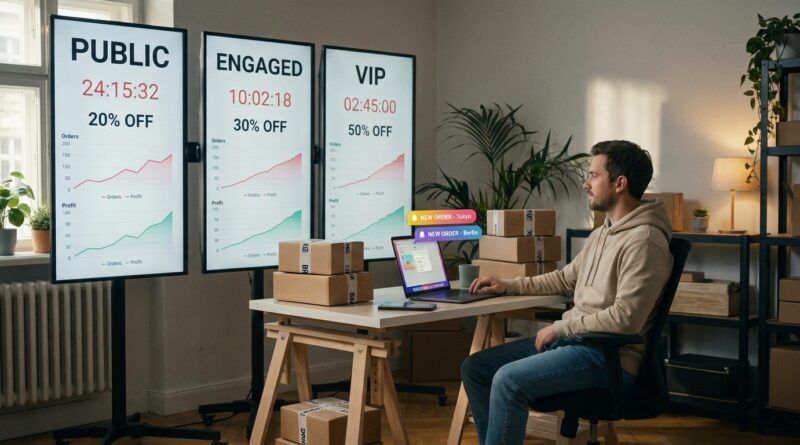
The ‘Three-Tier Flash’ Strategy: Turn One Discount Into Three Profit Levels Instead Of One Race To The Bottom
You can feel the trap, can’t you? Every week seems to bring another “biggest sale yet,” and if you run an ecommerce brand, the pressure to match it gets old fast. You cut 20 percent. A competitor cuts 25. Someone else throws in free shipping. Before long, you are working harder for less money, and your smartest customers start waiting for the next markdown instead of buying at full price. That is the part that really stings. The sale is supposed to help momentum, not train people to ignore you until prices drop again. A tiered flash sale strategy for ecommerce gives you a cleaner way to handle this. Instead of one blanket discount for everyone, you create three profit levels. Your best customers get the strongest offer first. Interested shoppers get a solid public deal next. And price-sensitive browsers still see a reason to act, without you setting your margins on fire.
⚡ In a Hurry? Key Takeaways
- A tiered flash sale strategy for ecommerce replaces one blanket discount with three offers, so you can sell more without racing to the lowest price.
- Start with your VIP or repeat buyers, then open a lighter public offer, then add a value-based final tier like a bundle or gift instead of a deeper cut.
- This protects margins and reduces discount fatigue, because not every shopper needs the same incentive to buy.
Why one big discount stops working
Shoppers are not just bargain-hunting right now. They are exhausted. Their inbox is full. Their social feeds are full. Their brains have seen “24-hour flash” so many times that another sitewide code barely registers.
That creates a bad habit for brands. You think the answer is a stronger discount. Often it is not. Often the answer is a better structure.
When everyone gets the same deal, three things happen.
You overpay to convert loyal buyers
Your repeat customers probably would have bought with a smaller nudge, early access, or a bonus perk. Giving them your deepest public discount is expensive and unnecessary.
You train shoppers to wait
If your audience knows the pattern, they delay purchases. Why buy today if next weekend might be 10 percent better?
You flatten your profit
A sale should create a burst of revenue and still leave enough margin to make the work worth it. A blanket markdown often does the first part and fails the second.
What a three-tier flash actually is
Think of it like giving different doors to different shoppers, instead of forcing everyone through the same one.
A three-tier flash sale strategy for ecommerce usually looks like this:
Tier 1: VIP or warm-audience offer
This is your strongest deal, but only for the people most likely to buy and most worth rewarding. That could be repeat customers, SMS subscribers, loyalty members, or your most engaged email segment.
Example: 25 percent off for six hours, or 20 percent off plus a free gift for customers who bought before.
Tier 2: Public flash offer
This is the visible sale on your site and social channels. Good enough to feel real, not so deep that it destroys margin.
Example: 15 percent off sitewide for 24 hours.
Tier 3: Value-based close
This final tier is where many brands make a mistake and go even lower on price. Don’t do that by default. Instead, shift the offer style.
Example: buy two, get a bonus item. Or free shipping over a threshold. Or a limited bundle that raises average order value.
The point is simple. Not every sale needs to get cheaper as it goes. Sometimes it should get smarter.
Why this works better than another sitewide code
It respects the reality that your audience is not one big blob.
Your best buyers want to feel recognized. New visitors need a clear reason to trust and try. Fence-sitters may need a deadline, a bundle, or a threshold perk more than another 5 percent off.
That is why tiers work. You match the offer to the buyer instead of handing out the same coupon like Halloween candy.
This also pairs nicely with list segmentation. If you want to tighten up your audience before sending the first tier, it is worth reading The ‘Inbox Warm Flash’ Strategy: Turn One Clean List Segment Into Your Safest High‑ROI Sale. The idea is similar. Start with the people most likely to convert well, then expand carefully.
How to set up a three-tier flash in one afternoon
Step 1: Pick one goal
Do not make this sale about everything at once. Choose the main job.
Maybe you want to move a seasonal category. Maybe you want to increase cash flow this weekend. Maybe you want to raise average order value.
Your tiers should support that one goal.
Step 2: Choose your audience groups
You do not need fancy software. A basic setup is enough.
Try this:
- Tier 1: past customers, loyalty members, or recent clickers
- Tier 2: all site visitors and your main email list
- Tier 3: cart abandoners, non-buyers, or late traffic during the final hours
Step 3: Set margin-safe offers
Run the math before you publish anything. This is the boring part, but it saves you from fake wins.
Look at:
- Product margin
- Shipping cost
- Payment fees
- Expected return rate
- Average order value by segment
A healthy rule of thumb is to reserve the strongest discount for the smallest, warmest audience. Keep the public tier lighter. Use bundles, gifts, or thresholds for the final push.
Step 4: Build the timing
The timing matters as much as the price.
A simple schedule:
- Morning: Tier 1 early-access email and SMS
- Afternoon: Tier 2 public launch on site and social
- Evening or next day: Tier 3 last-chance value offer
This creates momentum without showing your full hand to everyone at once.
Step 5: Change the message, not just the number
Too many brands reuse the same sale graphic and swap in a different code. Shoppers notice. It feels lazy.
Try messaging each tier differently:
- Tier 1: “Early access for our best customers”
- Tier 2: “24-hour flash on customer favorites”
- Tier 3: “Last chance. Bonus gift ends tonight”
Now the sale feels staged and intentional, not desperate.
A simple example for an indie brand
Let’s say you sell skincare.
Here is a realistic three-tier flash sale strategy for ecommerce:
- Tier 1: VIP email list gets 20 percent off bundles from 9 a.m. to 3 p.m.
- Tier 2: Public site banner offers 15 percent off bestsellers through midnight.
- Tier 3: Final six hours adds a free mini with orders over $60, instead of dropping to 25 percent off.
What happens here? Your best buyers feel appreciated. The public still sees a meaningful sale. And the late buyers get a reason to increase cart size without you giving away too much.
Common mistakes to avoid
Making every tier a deeper discount
This is the fastest way to teach customers that patience pays. If every stage gets cheaper, many shoppers will simply wait.
Using too many products
Keep the offer focused. Too much choice slows people down. Feature a collection, category, or top sellers.
Hiding the deadline
A flash needs a clear stop time. If shoppers have to guess, urgency disappears.
Ignoring your best customers
If your VIPs see the same public sale at the same time, the “exclusive” part feels fake. Give them a true head start or a better package.
What to measure after the sale
Do not judge the sale on revenue alone. That can fool you.
Look at:
- Conversion rate by tier
- Average order value
- Gross margin dollars, not just top-line sales
- Repeat purchase rate from each group
- Email and SMS engagement
You may find that the public tier brings the most traffic, while the VIP tier brings the healthiest profit. That is useful. It helps you refine the next one.
When to use this strategy
This works especially well during noisy retail moments when shoppers are seeing too many offers at once.
- Prime-style shopping weeks
- Payday weekends
- Holiday lead-up periods
- End-of-season clears
- Product restock moments
It is also a good option if you are a solo founder or tiny team. You do not need a massive campaign calendar. You need one smart sale flow that you can repeat.
At a Glance: Comparison
| Feature/Aspect | Details | Verdict |
|---|---|---|
| Blanket sitewide sale | One discount for everyone, easy to launch, but often cuts too deep for loyal buyers and trains shoppers to wait. | Fast, but usually weaker for margin and long-term pricing habits. |
| Three-tier flash sale | Different offer levels for VIPs, public shoppers, and late-stage buyers, with timing and message matched to each group. | Best balance of urgency, customer reward, and profit protection. |
| Final-tier value add | Uses gifts, bundles, or shipping thresholds instead of a deeper markdown to close fence-sitters. | Smart way to boost conversions without dropping into a price war. |
Conclusion
If your sale calendar is starting to feel like a panic button, this is a good week to change the pattern. Shoppers are drowning in overlapping sale events and feeling real discount fatigue. That means another generic “sitewide 30 percent off” is more likely to be ignored than celebrated. A three-tier flash gives indie ecommerce brands a simple, practical way to stand out. You reward your real fans first, protect your margins, and still put a strong public offer in front of everyone else without joining the race to the deepest cut. Better yet, it is not some giant enterprise playbook. A solo founder or small team can set it up in an afternoon, test it during a busy sales weekend, and reuse it for seasonal spikes all year long.