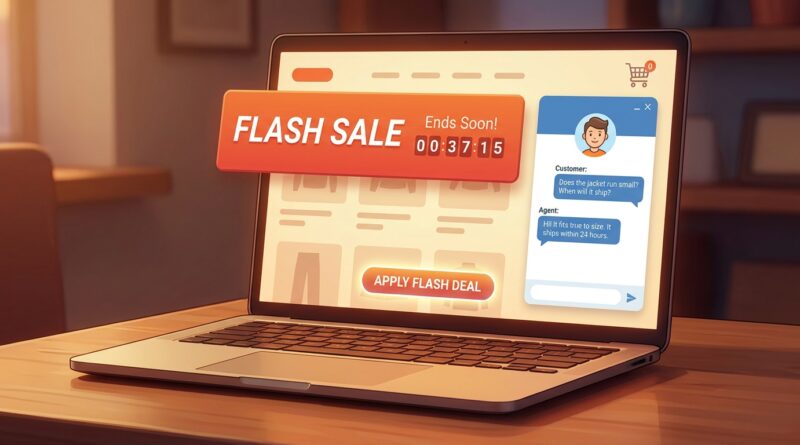
The ‘Chat Assist Flash’ Strategy: Turn One Live Q&A Window Into Your Highest-Converting Sale Hour
You can do everything right on a flash sale day and still watch carts die for silly reasons. A shopper likes the product, likes the discount, even clicks checkout. Then one tiny doubt pops up. Will it arrive by Friday? Is sizing true? Can I return it if it does not fit? Is this the lowest price you offer all year? That little wobble is often enough to kill the order, especially when the countdown clock starts to feel more stressful than exciting. The fix is not always more discounts. Often it is faster answers. That is where the conversational commerce flash sale strategy comes in. Instead of treating live chat like a passive support tool, you turn one sale hour into a staffed, visible Q&A window. Think of it like an office hour for buyers. People get quick, human-style help right when they hesitate, and you turn nervous browsers into confident customers.
⚡ In a Hurry? Key Takeaways
- Run one clearly announced live Q&A hour during your flash sale to answer buying doubts before they turn into abandoned carts.
- Prepare short canned replies for shipping, sizing, returns, stock, and price-match questions so your team can respond in seconds.
- Use the chat log as research. The questions people ask tell you exactly what to fix on product pages and in your next promo.
Why flash sales fail at the worst moment
Most flash sales do not lose people because the offer is bad. They lose people because the path to buying feels shaky.
During a regular shopping day, a customer might take time to poke around your FAQ, check your shipping page, or send an email. During a sale, they will not. The timer changes behavior. People want answers now. If they cannot get them, they do not calmly wait. They leave.
That is why conversational commerce is growing so fast in 2026. Shoppers now expect the same instant back-and-forth they get everywhere else online. They want help in the moment, not three hours later when the promo is over.
What the “Chat Assist Flash” strategy actually is
The idea is simple. You pick one high-intent hour during your flash sale and turn it into a visible live help session.
Not generic support. Not a tiny chat bubble hidden in the corner. A real event.
How it works
You announce something like this across your site, email, and social posts: “Live Sale Help, 7 to 8 PM. Ask us about fit, shipping, bundles, returns, or stock before the deal ends.”
Now your visitors know two things. First, there are real answers available right now. Second, they do not have to leave the page to get them.
That small shift matters more than many store owners think. You are reducing buying friction at the exact point where revenue usually slips away.
Why this works better for smaller brands than for big-box stores
Big retailers are good at scale. They are often bad at warmth.
A smaller brand can win by being faster, clearer, and more personal. If a customer asks, “I am between medium and large, what would you pick?” a good live reply can close the sale in under a minute. A giant chain usually gives them a size chart and wishes them luck.
This is also why the strategy pairs well with search-driven promotions. If you are already thinking about how real-time buyer intent shapes offers, it is worth reading The ‘AI Intent Flash’ Strategy: Turn One Real‑Time Search Into Your Highest‑Margin 60‑Minute Sale. It looks at the traffic side of the problem. Chat Assist Flash handles the hesitation side.
Set it up without making your team miserable
You do not need a huge support desk to pull this off. You need structure.
1. Pick one narrow time window
Sixty minutes is enough. It creates urgency, focuses staff, and makes promotion easier. You are not promising all-day live coverage you cannot maintain.
2. Put the invite everywhere
Use a site banner, cart message, email reminder, and product-page note. Tell people exactly what they can ask.
Good examples:
“Live now. Ask about fit, delivery dates, returns, or bundle deals.”
“Not sure before checkout? We are answering sale questions live until 8 PM.”
3. Build a mini answer bank
Before the sale starts, write short replies for the questions you know are coming:
- Shipping cutoffs
- Return policy
- Sizing or compatibility
- What is in stock
- Whether discounts stack
- Whether this is the best price
Keep the answers human. Short is good. Robotic is not.
4. Give agents permission to finish the sale
If someone asks, “Which one should I buy?” your team should be able to recommend, not just recite policy.
That means giving them quick product notes, common use cases, and simple upsell guidance.
What to say when customers ask the hard questions
This is where many brands get timid. They answer the literal question but ignore the fear behind it.
Question: “Is this really your best price?”
Bad reply: “This is our current promotion.”
Better reply: “Yes, this is our strongest public discount on this item right now, and it ends tonight at 8 PM.”
Question: “What if it does not fit?”
Bad reply: “You can review our returns page here.”
Better reply: “If the fit is off, you can return it within 30 days. If you want, tell me your usual size and I can point you toward the safer option first.”
Question: “Will it arrive by the weekend?”
Bad reply: “Shipping times vary.”
Better reply: “If you order in the next two hours, most customers in your area see delivery by Friday. If you want, I can check the fastest option for your ZIP code.”
The difference is confidence. You are not just answering. You are helping the customer move.
How to turn chat into conversion, not chaos
Live chat can become a mess if every question gets a custom essay. That is not the goal.
Use a triage system
Sort incoming chats into three buckets:
- Fast factual questions, like shipping and returns
- Purchase guidance, like sizing or product choice
- Checkout rescue, like coupon confusion or payment trouble
Handle the fast ones first. They are quick wins. Then move to the higher-touch chats that need actual advice.
Show social proof carefully
If someone is unsure, a useful line is: “This has been one of our top sellers today, especially with customers looking for X.”
Just keep it honest. People can smell fake urgency from a mile away.
Do not hide policy details
A flash sale is already stressful. If your answers sound slippery, trust disappears fast. Be direct about costs, limits, exclusions, and delivery timing.
The hidden bonus: your chat log becomes a goldmine
This is the part smart operators love. Every question asked during that hour is market research you did not have to pay for.
If twenty people ask whether a jacket runs small, your product page is missing something. If fifteen ask whether the sale price is the lowest of the season, your promo message is too vague. If people keep asking when an item will restock, that tells you what demand looks like beyond the sale itself.
After the event, review these patterns
- Top pre-purchase objections
- Products with the most fit or compatibility confusion
- Questions that delayed checkout
- Policies people did not understand
- Items that got repeated recommendation requests
Then fix the pages, FAQs, banners, and product copy before your next promotion. That is how one good sale hour makes the next one stronger.
Simple metrics to track
You do not need a giant dashboard. Start with a few numbers that tell a clear story.
Watch these first
- Chat-to-order conversion rate
- Average response time
- Revenue during the live Q&A hour
- Cart abandonment rate during that window
- Top repeated questions
If response time is slow, add one more person next time or tighten your saved replies. If conversion is high for people who chat, promote the chat window more aggressively in the next sale.
Common mistakes that weaken the strategy
Making the chat hard to find
If shoppers have to hunt for help, many will not bother.
Using canned replies that sound cold
Templates are fine. Lifeless templates are not.
Promising 24/7 support when you only have one staffer
Be honest. A focused hour is better than fake always-on availability.
Failing to brief the team on products
If agents only know policy and not product reality, they cannot help people choose.
Ignoring what people asked afterward
The live hour is not just a conversion tool. It is feedback. Use it.
At a Glance: Comparison
| Feature/Aspect | Details | Verdict |
|---|---|---|
| Live Q&A sale hour | One scheduled 60-minute window with visible chat support for buyers who are close to checkout. | Best option for turning hesitation into immediate sales. |
| Standard passive chat bubble | Always available in theory, but often unnoticed, slow, or too generic during a promo rush. | Useful baseline, but weaker during high-pressure sales. |
| FAQ-only flash sale support | Low effort, but shoppers must self-serve and may still leave with unanswered personal questions. | Fine for simple stores, not enough for high-intent conversion moments. |
Conclusion
The conversational commerce flash sale strategy works because it respects how people really buy. They do not always need a bigger discount. They often need a faster answer. In 2026, shoppers expect instant, human-style help right when doubt creeps in, especially during high-pressure promos. Turning one flash sale hour into a live-chat powered office hour gives smaller brands a real edge. You can beat bigger stores on responsiveness, pull more revenue from traffic you already paid for, and gather the kind of buyer insight that makes your next sale smarter. Start small. Pick one hour. Answer quickly. Listen closely. You may find that your best sale tool is not the countdown timer after all.