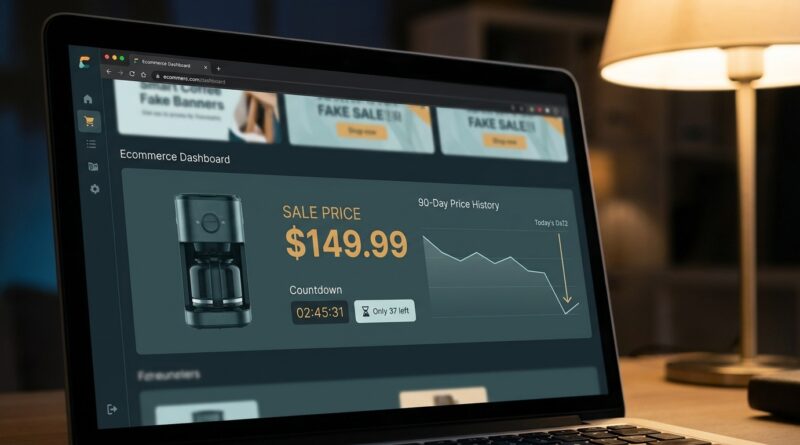
The ‘Price-Proof Flash’ Strategy: Turn Deal Skeptics Into Your Highest-Converting Shoppers
Your shoppers are not being difficult. They are being careful. After years of fake countdown timers, sketchy “was” prices, and endless “last chance” banners that somehow return every weekend, people have learned to doubt flash sales on sight. So they pause. They compare. They open another tab. Then your cart gets abandoned while they try to figure out whether your deal is real or just dressed up to look urgent. That is the problem a Price-Proof Flash fixes. Instead of asking people to trust your sale page, you show proof. Real recent price history. A clear current discount. A short deadline. A limited quantity. Put together, that turns urgency from something that feels manipulative into something that feels safe. For any store working on an ecommerce flash sale price history strategy, this is one of the simplest ways to earn trust fast and convert skeptical shoppers who would normally wait, bounce, or buy somewhere else.
⚡ In a Hurry? Key Takeaways
- A Price-Proof Flash works by showing the product’s real recent price history next to the current flash price.
- Start with one to three products, add a short deadline and limited stock count, and make the proof easy to read in one glance.
- This approach builds trust without fake urgency, which can protect your brand while improving clicks and conversions.
Why regular flash sales are losing people
A basic flash sale used to be enough. Put up a timer, add a bright discount badge, and watch orders come in.
That world is gone. Big sale events, browser extensions, price trackers, and marketplace habits have trained shoppers to verify everything. They know some “sale” prices are just the normal price with a red label on top. They know some timers reset. They know “only 3 left” is not always true.
So when a customer sees your flash deal, they do not just ask, “Do I want this?” They also ask, “Can I trust this?”
If the answer is unclear, they wait. And waiting is what kills a flash sale.
What a Price-Proof Flash actually is
A Price-Proof Flash is a short sale built around evidence, not hype.
You choose one product or a very small set of products. Then you show:
- The current flash sale price
- The recent average price or typical selling price
- A simple date range, such as the last 30 or 60 days
- A real deadline
- A real quantity limit
That is the heart of an ecommerce flash sale price history strategy. You are not just saying the price is good. You are proving it is lower than what shoppers would likely have paid recently.
What the customer sees
Think of a product card that says:
“Flash price: $79. Recent 30-day average: $99. Ends tonight at 10 PM. 42 units left.”
That lands differently than “20% OFF. Hurry.” One sounds like a pitch. The other sounds like information.
Why this works so well right now
People still love a deal. They just do not love feeling fooled.
Prime-style events and holiday sales have taught shoppers to cross-check prices before buying. Oddly enough, that creates an opening for smaller stores. If you can show honest price history right on the page, you remove the need for extra research. You save them a tab, a search, and a little anxiety.
That matters more than many store owners realize. Convenience is not just fast shipping. It is also fast certainty.
How to build a Price-Proof Flash without making it complicated
1. Pick only a few products
Do not start with your whole catalog. That becomes messy fast.
Choose one hero item or a tight set of products that meet three rules:
- They have stable enough pricing history to compare clearly
- They already get decent traffic or interest
- You can afford to discount them honestly
This is also where audience targeting helps. If you want to get more precise, pair this approach with The ‘Micro-Segment Flash’ Strategy: Turn 3 Tiny Buyer Groups Into One Profitable 2‑Hour Sale. Price proof gets trust. Micro-segmentation gets relevance. Together, they can make a short sale feel much more convincing.
2. Pull real historical pricing
Use your ecommerce platform, analytics, ERP, pricing app, or a tracking tool. You are looking for a number that is honest and easy to explain.
Good options include:
- Average selling price over the last 30 days
- Average selling price over the last 60 days
- Most common pre-sale price over the last month
- Lowest recent price versus current flash price, if that comparison is still strong and fair
Keep it clean. Too much detail can confuse people. The goal is confidence, not a spreadsheet.
3. Show the proof beside the sale price
Do not bury the pricing proof in a tooltip or FAQ.
Put it right next to the flash price so customers can understand it at a glance. For example:
- Now: $49
- 30-day average: $64
- You save: $15
If your design allows it, add a tiny note like “based on actual store pricing from the last 30 days.” That one line can do a lot of work.
4. Use urgency, but make it real
Urgency is still useful. The difference is that it needs to be believable.
A good Price-Proof Flash includes:
- A short end time, such as 2 hours, 6 hours, or same-day
- A limited quantity that reflects real inventory
- No fake timer resets after expiry
The moment customers suspect the deadline is pretend, your proof loses value. Honesty has to carry through the whole experience.
5. Explain the deal in plain English
Do not make people decode marketing language.
Try copy like:
“This item usually sold for $89 over the last 30 days. Today it is $69 until 8 PM or until 60 units are gone.”
That is simple, direct, and hard to misread.
Common mistakes that ruin the strategy
Using a fake “regular price” nobody believes
If your reference price was barely used, shoppers can smell it. Use real pricing history, not a fantasy anchor.
Adding too much visual noise
If every badge is flashing, nothing feels trustworthy. Keep the key facts easy to scan.
Proving the price, but not the timeline
A real deal still needs a real end. If the product stays “on flash” for days, people learn to wait.
Choosing products with messy pricing patterns
If an item has bounced all over the place, your proof may raise more questions than it answers. Start with products that tell a clean story.
How shoppers can judge whether a flash sale is worth it
This strategy is useful for buyers too, not just stores.
If you are looking at a flash sale and want to know if it is real, check for these signs:
- There is a specific recent price comparison, not just a crossed-out number
- The date range is clear
- The quantity limit feels realistic
- The timer does not feel recycled
- The wording is straightforward, not overly dramatic
If a store can show you the item is meaningfully below its recent average, that is a stronger signal than a giant percent-off badge by itself.
Who should use this first
This works especially well for stores that sell products people compare carefully before buying. Think electronics, home gear, beauty tools, hobby equipment, and premium everyday items.
It is also helpful for brands that already sense a trust problem. If traffic is solid but flash sale conversion is weak, hesitation may be the issue. Price proof gives shoppers a reason to stop researching and start buying.
At a Glance: Comparison
| Feature/Aspect | Details | Verdict |
|---|---|---|
| Standard flash sale | Uses discount labels and timers, but often gives no evidence that the price is truly low. | Fast to launch, but trust is weak. |
| Price-Proof Flash | Shows actual recent price history beside the current deal, with a real deadline and limited quantity. | Best for winning skeptical shoppers quickly. |
| Overbuilt sale page | Adds too many badges, popups, and claims, which can make the offer feel less believable. | Looks busy, converts worse if trust drops. |
Conclusion
Shoppers have changed. They are not slower because they do not want deals. They are slower because they have been trained to double check everything. That is why this approach matters. When you can prove a flash price is actually below the product’s recent average, you remove doubt at the exact moment people are deciding whether to click Buy Now or keep browsing. A Price-Proof Flash is built for this new reality. Pick one or a few products, pull real historical pricing from your platform or tracking tool, and show that proof next to a short deadline and limited quantity. Done right, it helps people feel safe moving fast instead of waiting for the next giant sale event. For The Deal’s community, that makes this more than a prettier promotion. It is a practical way to run, or judge, flash sales that are truly worth it today.