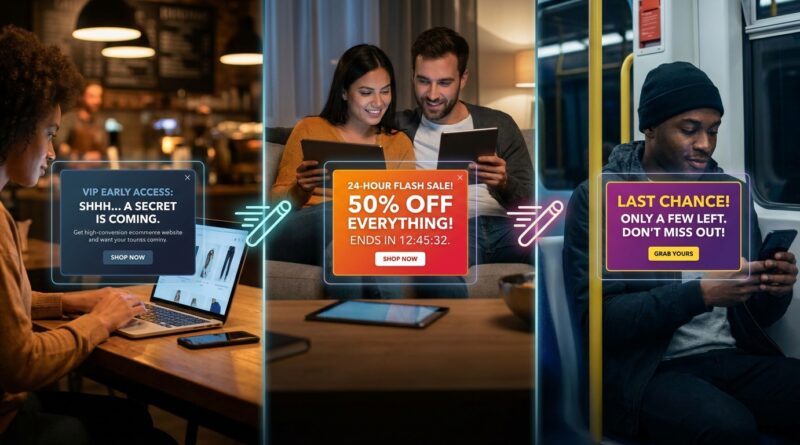
The ‘Popup Relay Flash’ Strategy: Turn One Offer Handoff Into A 24‑Hour Conversion Sprint
Flash sale popups often fail for a simple reason. They treat every visitor the same, even when those visitors are clearly not the same. That is frustrating when you have only 24 hours to make a sale work. A first-time shopper gets the same discount as a loyal buyer. An email subscriber sees a signup offer they already claimed. A weak deal stays on screen for hours because nobody has time to swap it out mid-sale. The result is wasted traffic, messy margins, and customers who leave without feeling any urgency at all. A better ecommerce flash sale popup strategy works like a relay race. One popup hands the visitor to the next best offer based on what they did, what page they are on, and whether they already know your brand. You do not need a giant team to do this either. You just need a simple handoff plan you can run in one day.
⚡ In a Hurry? Key Takeaways
- Stop using one popup for everyone. Build a short sequence of offers based on visitor type and behavior.
- Set up a 24-hour relay with three stages: capture, qualify, and convert, then swap weak offers while the sale is live.
- Suppress people who already subscribed or purchased, so you protect margins and avoid annoying your best customers.
Why the one-popup approach breaks during flash sales
Think about what usually happens. The sale goes live. Traffic spikes. Your popup appears with one discount, one headline, one timer. Then real shoppers start behaving in very different ways.
Some are brand new and need a reason to trust you. Some came from email and do not need another opt-in bribe. Some are hovering on product pages, waiting for a nudge. Others are about to leave.
If all of them see the same message, your popup becomes background noise.
That is why the relay model works better. Instead of asking one popup to do everything, you give each popup one job. Then you pass the visitor to the next message only if it makes sense.
What the Popup Relay Flash strategy actually is
The Popup Relay Flash strategy is a simple sequence for a 24-hour sale:
Stage 1: Capture attention
Show the first popup fast, but only to the right people. This is the opening handoff. The goal is not to close every sale right there. The goal is to sort visitors into useful groups.
Stage 2: Qualify the visitor
Based on what they do next, show a different message. If they subscribe, stop pushing signup offers. If they ignore the first message but browse deeper, show a product or category-specific offer later.
Stage 3: Convert with urgency
As the sale window tightens, move from broad messaging to stronger urgency. That could be a countdown, low-stock message, free shipping threshold, or a cart saver.
It is called a relay because each offer hands off to the next one. You are not starting from scratch every time.
The three visitor groups you should plan for first
You can get fancy later. Tonight, keep it simple. Build your ecommerce flash sale popup strategy around these three groups.
1. New visitors
These people need context. Lead with your safest, easiest yes. That might be 10 percent off, early access, or free shipping.
2. Existing subscribers
Do not show them an email capture popup again. This is where suppression matters. Show sale reminders, best-seller bundles, or a VIP-style message instead.
3. Cart or product-page visitors
These shoppers are closer to buying. They should get a more specific offer tied to what they are viewing, not a generic homepage discount.
If you only make this one change, your popup performance usually gets cleaner fast.
The 24-hour relay framework you can set up in a day
Step 1: Pick one main goal for the sale
Do not try to maximize everything at once. Choose the top priority.
- More email or SMS opt-ins
- Higher average order value
- Moving specific inventory
- Protecting margins while still driving conversion
Your popup sequence should support that goal. If margin matters most, do not lead with your deepest discount.
Step 2: Create your first handoff popup
This is the first message people see. Keep it clear.
For example:
- New visitor on landing page: “24-hour sale. Get 10% off your first order when you join.”
- Returning visitor: “Flash sale ends tonight. Shop customer favorites before they sell out.”
The point is to sort people. New people can opt in. Returning people can go straight to product discovery.
Step 3: Set suppression rules
This is where many small shops lose easy wins. If someone already subscribed, exclude them from signup popups. If someone already bought during the sale, stop showing aggressive discounts and switch to cross-sell or thank-you messaging.
Most modern popup tools on Shopify and WooCommerce can do this with tags, cookies, URL rules, or list membership.
Step 4: Build the second popup based on behavior
This is your actual handoff.
- If visitor subscribed but did not buy, show the code reminder after 2 to 3 pageviews.
- If visitor viewed a product twice, show a category-specific incentive.
- If visitor moved toward exit, show a last-chance message.
Now your popup is reacting to intent, not just shouting the same thing again.
Step 5: Schedule offer rotation across the 24 hours
Not every offer should run all day. Plan your sale in blocks.
Hours 1 to 6: Broad capture offer.
Hours 7 to 16: Best-seller or category-specific offer.
Hours 17 to 24: Urgency-heavy closeout message.
This is especially useful when your best traffic comes in waves. Morning shoppers behave differently from evening shoppers.
Step 6: Watch one live metric every few hours
Do not drown in dashboards. During a one-day sale, track:
- Popup view-to-submit rate
- Submit-to-purchase rate
- Revenue per popup impression
If one message is underperforming badly, replace it while the sale is still running. A flash sale is not the time to be precious about creative.
What to put in each popup so it actually converts
Keep the copy specific
“Save now” is weak. “Ends at midnight. Free shipping over $60” is stronger. Specific beats clever during a flash sale.
Make the button finish the sentence
Instead of “Submit,” use “Unlock My Code” or “Shop the Sale.” It sounds small, but it helps people understand the next step.
Use one idea per popup
Do not stack discount, giveaway, countdown, and newsletter pitch into one crowded box. If a popup tries to do five jobs, it usually does none of them well.
A practical example for Shopify or Woo
Let us say you run a skincare store.
Popup 1 for new visitors: “Flash sale today only. Join for 10% off your first order.”
Popup 2 after signup: “Your code is ready. Best sellers under $40 are moving fastest.”
Popup 3 on exit from product page: “Still thinking it over? Free shipping kicks in at $50. Add one more item before midnight.”
For existing subscribers, you skip Popup 1 and start with a sale reminder or product collection message.
That one change alone keeps your regular customers from seeing irrelevant opt-in prompts.
How this differs from a basic popup blast
If you have used a simpler model before, you may want to compare it with The ‘One-Touch Pop‑Up Flash’ Strategy: Turn A Single On‑Site Prompt Into Your Highest‑Converting Sale Of The Week. That approach is useful when you need one fast prompt and very little setup. The relay version builds on the same idea, but adds handoffs, suppression, and live offer rotation for a tighter 24-hour sprint.
Common mistakes that hurt margins
Showing your biggest discount first
Start with the smallest offer that can still get action. Save stronger incentives for high-intent visitors or late-stage urgency.
Forgetting to exclude current subscribers
This is one of the easiest ways to make your brand feel clumsy. If customers already raised their hand, respect that.
Leaving bad popups live too long
If a message is not getting clicks or signups, swap it. A flash sale is short. Stale creative is expensive.
Using the same popup on every page
Your homepage visitor and cart visitor are not in the same headspace. Treat them differently.
Tools and setup notes for small teams
You do not need enterprise software to do this. Many popup apps already support:
- Audience targeting by page, source, or device
- Suppression for subscribers and buyers
- Countdown timers
- A/B testing
- Behavior triggers like exit intent or scroll depth
If you use Shopify, look for apps that sync with your email or SMS list so suppression is automatic. If you use WooCommerce, make sure the popup tool can read customer state and page behavior cleanly.
The smartest move is not to build something huge. It is to build something repeatable.
At a Glance: Comparison
| Feature/Aspect | Details | Verdict |
|---|---|---|
| One popup for everyone | Same offer, same timing, no suppression or behavior-based handoff | Easy to launch, but wasteful during a flash sale |
| Relay popup sequence | Different messages for new visitors, subscribers, and high-intent shoppers across the 24-hour window | Best balance of speed, relevance, and margin control |
| Live offer rotation | Swap weak messages and tighten urgency as the day goes on | Strong value if you can check results a few times during the sale |
Conclusion
A good ecommerce flash sale popup strategy does not have to be complicated. It just has to stop treating every shopper like the same person. Right now, flash sale windows are shrinking while customer acquisition costs climb, which means you cannot afford to waste a single visit on a stale or mistimed message. New popup tools make it possible to rotate offers in real time, suppress subscribers who already opted in, and keep testing variants while the sale is live, but most small teams have no idea how to turn that into a simple, repeatable system they can run in a day. The relay approach fixes that. Set one opening handoff, build one or two smart follow-ups, and rotate offers as the clock runs down. Do that tonight on Shopify, Woo, or almost any storefront, and tomorrow’s 24-hour sale has a much better shot at bringing in more opt-ins, cleaner margins, and more full-price repeat buyers instead of one chaotic discount blast.