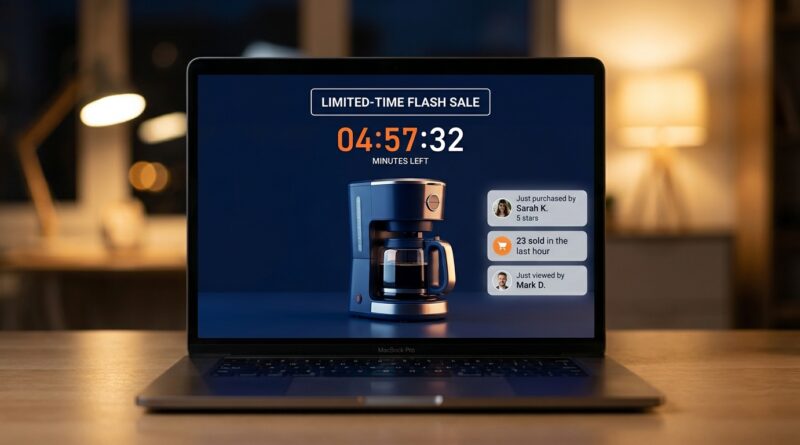
The ‘Real-Time Social Proof Flash Sale’ Strategy: Make Your Deal Feel Like It’s Selling Out In Front Of Your Eyes
You know the feeling. You set up a flash sale, add a countdown timer, maybe toss in a coupon code, and then wait for the rush. But the page feels flat. Quiet. A shopper lands, looks around, and leaves because nothing on the screen says, “Other people are buying this right now.” That missing signal matters more than most store owners think. A good flash sale social proof strategy does not just show a discount. It shows motion. It gives shoppers proof that the offer is real, active, and worth acting on before they miss it. The good news is you do not need a giant brand budget to do this. Small stores can use simple buyer notifications, stock counts, recent order popups, and tight customer quotes to make a sale page feel busy in a believable way. That is often the nudge that turns “maybe later” into “buy now.”
⚡ In a Hurry? Key Takeaways
- A strong flash sale social proof strategy combines a real deadline with visible buyer activity, not just a timer and a discount.
- Start with three simple elements: recent purchase alerts, honest low-stock messaging, and short specific testimonials near the buy button.
- Keep it real. Fake popups, fake stock counts, and made-up urgency may lift clicks for a moment, but they hurt trust and repeat sales.
Why your flash sale feels quiet
Most weak flash sales have the same problem. They ask people to feel urgency without giving them any evidence.
A timer alone is not evidence. Neither is a bright red banner screaming “Ends tonight.” Shoppers have seen that trick a thousand times. They are numb to it.
What cuts through is human activity. Someone bought this five minutes ago. Twelve units are left. A customer says the blue version fits true to size. Those tiny details answer the silent question in the shopper’s head.
“Is this actually worth jumping on?”
That is why the best flash sale social proof strategy makes the page feel alive, not noisy.
What “real-time social proof” actually means
Real-time social proof is visible proof that people are engaging with your offer right now, or very recently.
It can look like this
“23 people bought in the last 24 hours.”
“Only 8 left in Medium.”
“Jessica in Austin just ordered the starter bundle.”
“Over 140 shoppers grabbed this deal since 9 a.m.”
“Best for me was the battery life. Got two for travel.”
The key word is real. If the activity is fake, people can smell it. And if they cannot, they often still feel something is off.
Why this works so well in 2026
People do not just buy on price. They buy when doubt drops low enough.
Fresh 2026 research on scarcity and social proof keeps pointing to the same pattern. A genuine deadline plus visible proof of buyer activity can lift conversions because it lowers hesitation at the exact moment somebody is deciding.
It works for a simple reason. Humans look sideways before they move forward. If others are buying, reviewing, or snapping up the remaining stock, the offer feels safer and more urgent.
That matters even more now because paid traffic is expensive and discount fatigue is real. You do not always need to cut another 10 percent. Sometimes you need to make the existing offer feel credible, current, and wanted.
The three pieces every flash sale social proof strategy needs
1. A real deadline
The sale needs an honest start and stop time. Not a timer that magically resets tomorrow.
Try language like “Flash sale ends tonight at 11:59 p.m.” or “Weekend drop closes Sunday at 8 p.m.” Specific beats vague.
When the deadline is genuine, the rest of your social proof has something to attach to. Activity matters more when shoppers know the window is short.
2. Visible buyer movement
This is the heartbeat of the page.
Use one or two of these:
- Recent purchase popups
- Orders in the last hour or day
- Views or carts right now, if the data is accurate
- Low-stock messages by size, color, or bundle
Do not pile on all of them. One clean signal is better than five blinking ones.
3. Short, specific testimonials
Generic praise is forgettable. Specific praise sells.
“Love it” does very little.
“Set this up in ten minutes and used it the same day” does a lot.
Place these near the product options or buy button. Keep them short. Tie them to the offer if possible.
How to build this without turning your page into a circus
This is where many stores overdo it. They add spinning countdowns, flashing stock bars, giant trust badges, and nonstop popups.
That does not feel alive. It feels desperate.
A better setup is simple:
- One timer with a real end time
- One stock message if inventory is genuinely limited
- One recent activity module
- Two to three short customer quotes
That is enough for most stores.
Good example
“Flash sale ends in 6 hours.”
“14 bundles sold since this morning.”
“Only 6 left in charcoal.”
“‘Bought one for my desk and one for travel. The smaller size is perfect.’”
Clean. Believable. Useful.
Bad example
“Hurry!!! 97 people are viewing!!!”
“Only 1 left!!!”
“Mary from New York bought 12 seconds ago.”
“Timer ends in 10:00” and resets on refresh.
That sort of thing may get a few panic clicks, but it also trains buyers not to trust you.
Where to place each element on the page
Placement matters because shoppers do not read top to bottom like a novel. They scan.
Above the fold
Put the sale deadline and one short line of proof near the product title or price.
Example: “Sale ends tonight. 31 orders placed today.”
Near the variant selector
This is the best spot for stock messages.
Example: “Only 4 left in Large.”
Near the add-to-cart button
Add a testimonial or satisfaction detail that removes hesitation.
Example: “Fast shipping and true-to-size fit, based on 84 reviews.”
Lower on the page
Put the fuller review section, FAQ, and product details here.
The top of the page creates urgency. The lower section handles objections.
How to keep it honest
This part is important. Social proof works best when it is true.
If 3 people bought today, say 3. If there are 11 units left, say 11. If your tool rounds up or creates fake names and cities, turn that feature off.
Shoppers are getting better at spotting fake urgency. Regulators are paying more attention too. So honesty is not just morally better. It is safer for the business.
Think of this as trust-enhancing design, not pressure for pressure’s sake.
A practical setup for small stores
If you run on Shopify, WooCommerce, BigCommerce, or a similar platform, you can usually set this up with lightweight apps or built-in widgets.
Start with this stack
- A sale timer tied to a real campaign end time
- A recent-sales notification tool using actual order data
- A low-stock alert tied to inventory
- A review widget that lets you pin short, useful quotes
You do not need a custom build to test this. Start small. Measure conversion rate, add-to-cart rate, and average order value.
If conversions rise without crushing your margins, you are on the right track.
What to say, specifically
Many stores fail not because the tool is wrong, but because the copy is weak.
Use wording like this
- “Flash sale ends at midnight.”
- “19 customers grabbed this deal today.”
- “Only 7 left in this color.”
- “Most buyers mention the easy setup and sturdy feel.”
- “Our weekend bundle is moving fastest in black.”
Avoid wording like this
- “Everyone is buying this now!!!”
- “Going fast” with no proof
- “Act now before it’s too late”
- “Limited time only” when the deal runs every week
Specific language feels calmer and more believable.
Do this after a sellout too
One nice side benefit of this approach is that it sets you up well if the product does sell out. Instead of losing that momentum, you can turn it into a waitlist or next-drop campaign.
If that is your next problem, read The ‘Waitlist Rescue’ Flash Sale Strategy: Turn Sold-Out Hype Into Your Highest-Converting Drop. It fits naturally with this method because both strategies use visible demand in a way that feels real, not forced.
Common mistakes that quietly kill conversions
- Using fake live activity
- Running “flash” sales too often
- Showing urgency without social proof
- Showing social proof without a clear deadline
- Cluttering the page with too many widgets
- Burying testimonials far below the add-to-cart button
If your page feels chaotic, simplify. If it feels empty, add one believable sign of motion.
At a Glance: Comparison
| Feature/Aspect | Details | Verdict |
|---|---|---|
| Countdown timer alone | Creates a deadline, but gives no proof that other shoppers care or are buying. | Useful, but weak on its own |
| Real-time buyer activity | Shows recent orders, low stock, or deal uptake using real store data. | Strong trust and urgency booster |
| Short specific testimonials | Removes doubt by answering practical questions in a human way. | Best placed near the buy button |
Conclusion
The brands winning flash sales right now are not always the ones shouting the biggest discount. They are the ones making the page feel alive with real buyers, real movement, and real urgency. Fresh research in 2026 shows that genuine limited-time offers work much better when shoppers can also see honest signs that other people are acting now. That mix helps people cross the final line of doubt without training them to wait around for a 40 percent-off blowout every week. For The Deal community, that is a smart way to protect margins while still making a modest offer feel exciting. And the best part is that you can plug this into almost any store with simple tools and clear copy. In a world where ad costs keep rising and generic “Sale ends tonight” banners barely register, a thoughtful flash sale social proof strategy can help a smaller store punch far above its weight.